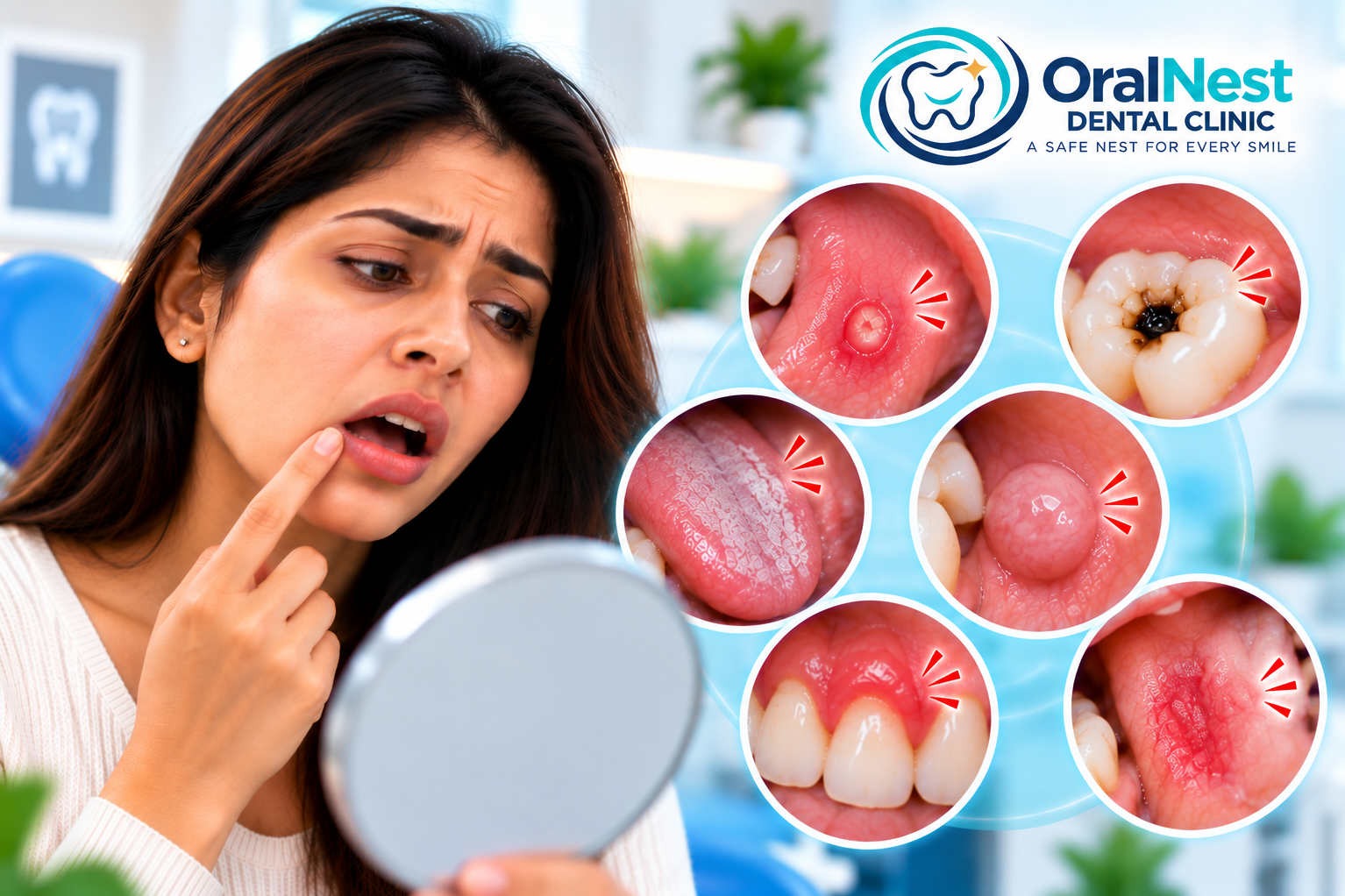
Most changes inside the mouth are not emergencies.
A small ulcer may heal. Minor irritation may settle. A sore area caused by accidental biting may disappear after the tissue recovers.
But sometimes an oral symptom persists, returns repeatedly, changes over time or appears without an obvious explanation.
That is when it becomes important to stop guessing and have it evaluated.
The purpose of an oral examination is not to assume that something serious is present.
It is to answer a more useful question:
“Is there a clear explanation for this symptom, or does it need further investigation?”
Which oral symptoms deserve attention?
Several findings are worth getting checked when they persist or behave unusually, including:
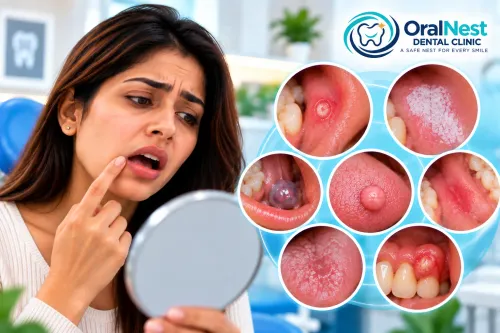
a mouth ulcer that does not heal
a persistent red or white patch
an unexplained lump or swelling
thickening of an area inside the mouth
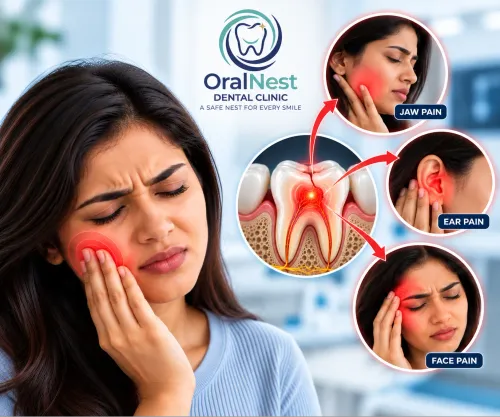
persistent mouth pain or soreness
unexplained bleeding
numbness or altered sensation
difficulty chewing or swallowing
difficulty moving the tongue or jaw
a persistent change in voice
a recurring lesion in exactly the same location
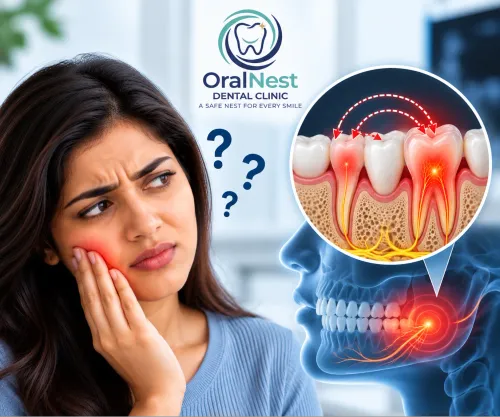
unexplained changes around a tooth
NIDCR advises seeing a dentist or doctor when a sore, irritation, lump, thick patch, or red/white patch persists for more than two weeks.
The NHS similarly advises assessment of persistent mouth ulcers, lumps, red or white patches, and ongoing mouth pain.
Does every mouth ulcer need to be investigated?
No.
Mouth ulcers are common and many heal naturally within one to two weeks.
The concern changes when an ulcer:
does not heal as expected
repeatedly appears in the same location
becomes larger
starts bleeding
becomes increasingly painful
looks different from previous ulcers
occurs without an obvious cause
A persistent ulcer should not automatically be assumed to be something serious.
But it should also not be repeatedly treated without understanding why it is not healing.
What about a red or white patch?
A red or white patch can have many explanations.
It may be related to:
irritation
trauma
infection
tobacco exposure
inflammatory oral conditions
other mucosal changes
Some persistent red or white lesions require closer evaluation because their significance cannot always be determined simply by looking at them.
NIDCR specifically lists persistent red or white patches among oral findings that should be evaluated.
The key principle is:
Colour is a clue—not a diagnosis.
What if there is a lump inside the mouth?
A lump can arise from many different causes.
It may be associated with:
trauma
a dental infection
salivary tissue
a cyst
inflammation
a benign soft-tissue growth
other oral conditions
Many oral lumps are not dangerous.
But a lump that persists, enlarges, becomes firm, bleeds or has an unexplained cause deserves assessment.
A lump does not need to be painful to be worth checking.
What if the symptom is painless?
This is one of the most important points.
The absence of pain does not automatically mean the absence of a problem.
Some oral changes are discovered accidentally because they cause no discomfort.
A person may notice a patch while brushing or a lump while running the tongue over the cheek.
Pain is only one part of the clinical picture.
Duration, location, appearance, texture and change over time may be equally important.
What if the symptom keeps coming back?
Recurrence is valuable diagnostic information.
If the same area repeatedly becomes sore, develops an ulcer or swells, ask:
What keeps triggering it?
Possibilities may include:
cheek biting
a sharp tooth
a rough restoration
an erupting wisdom tooth
repeated trauma
infection
inflammatory conditions
other oral mucosal problems
A recurring symptom should not automatically be treated as a series of unrelated episodes.
Sometimes the repeated pattern itself provides the clue.
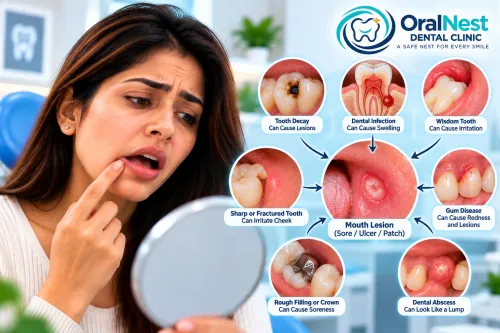
Can a dental problem cause an oral symptom?
Yes.
Not every oral lesion originates from the oral mucosa itself.
A tooth infection can produce swelling in the surrounding tissues.
A sharp tooth can repeatedly traumatise the cheek.
A rough restoration can irritate the tongue or cheek.
A wisdom tooth can contribute to inflammation around the surrounding tissues.
This is why an oral examination should consider both the visible lesion and the structures around it.
What if my teeth are fine?
An oral symptom can occur even when the teeth appear normal.
Burning, soreness, dryness, altered taste and other symptoms may have causes involving the tongue, oral mucosa, salivary environment, medications, jaw muscles or other factors.
For example, NIDCR notes that burning-mouth symptoms can occur even when there are no obvious visible changes in the mouth, making the history and exclusion of other causes important.
So:
“My teeth are fine” does not necessarily explain why my mouth feels different.
When does an oral symptom become more important?
A useful way to think about it is through four questions:
1. Is it persistent?
Has it remained longer than expected?
2. Is it unexplained?
Is there no obvious injury, irritation or dental cause?
3. Is it changing?
Is it becoming larger, thicker, more painful or visually different?
4. Is it recurring?
Does the same problem keep returning?
The more these questions apply, the more useful a clinical evaluation becomes.
What symptoms should not be casually ignored?
Pay particular attention to:
Persistent ulceration
Especially an ulcer that does not heal normally.
Persistent red or white areas
Especially when there is no clear explanation.
Unexplained lump or thickening
Particularly if it persists or grows.
Persistent bleeding
Especially when there is no obvious source of trauma.
Numbness
Unexplained altered sensation in the tongue, lip or other oral area deserves assessment.
Difficulty swallowing or chewing
This can have many causes and should not be ignored when persistent.
Difficulty moving the tongue or jaw
Particularly when the symptom is new or unexplained.
Persistent mouth pain
Pain that does not settle should be evaluated rather than continually masked.
NIDCR includes several of these findings among symptoms that warrant professional evaluation when persistent.
Does “two weeks” mean something is definitely serious?
No.
This distinction is extremely important.
The two-week threshold used in oral-health guidance is a reason to seek evaluation, not a diagnosis.
A lesion that has lasted two weeks is not automatically cancer.
A lesion that lasts less than two weeks is not automatically harmless either.
The clinical context matters.
The purpose of the time threshold is to prevent people from indefinitely ignoring a change that should have healed but has not.
Why early evaluation is different from early diagnosis of disease
When a patient gets an oral symptom checked early, several outcomes are possible.
The examination may show:
A simple traumatic cause
→ remove the source and allow healing.
An infection
→ treat the identified cause.
A dental problem
→ address the responsible tooth or surrounding tissues.
An inflammatory or mucosal condition
→ manage or investigate appropriately.
An unexplained persistent lesion
→ consider further evaluation.
The value of early assessment is therefore not simply about detecting serious disease.
It is also about identifying what does not require serious treatment and avoiding unnecessary uncertainty.
What does an oral examination actually involve?
A diagnosis-focused examination may begin with questions about:
when the symptom started
how it has changed
whether it has occurred before
associated pain or burning
bleeding
tobacco or other habits
medications
recent dental treatment
trauma
dietary triggers
dryness
medical history
The clinician may then examine:
lips
cheeks
gums
tongue
floor of the mouth
palate
teeth
jaw-related structures
salivary areas
neck when clinically relevant
If something remains unexplained, additional investigation may be considered.
Why the entire mouth should sometimes be examined
A patient may notice one small lesion.
But the clinical picture may become clearer when the entire mouth is assessed.
For example:
A cheek lesion may be related to a sharp tooth.
A tongue symptom may occur alongside dry mouth.
A gum swelling may originate from an infected tooth.
A persistent white patch may require assessment of the surrounding mucosa.
This broader view is particularly important in oral medicine because the mouth contains multiple interacting tissues and structures.
When should you stop self-treating?
Self-care can be reasonable for short-lived minor irritation when there is an obvious explanation and the area is improving.
But repeatedly changing gels, mouthwashes or medications without knowing the cause is not a substitute for diagnosis.
Consider professional evaluation when:
the symptom persists, keeps returning, changes, or has no clear explanation.
The goal is not to make every minor symptom complicated.
It is to recognise when the normal healing pattern is no longer being followed.
Why diagnosis matters more than reassurance
A patient may want to hear:
“Don't worry, it's nothing.”
But reassurance without an adequate examination may not answer the real question.
A more useful approach is:
“Let's understand what it is.”
If the finding is harmless, that understanding can provide appropriate reassurance.
If it requires treatment, the cause can be addressed.
If further investigation is necessary, it can be planned based on the actual clinical findings.
That is more meaningful than reassurance based only on appearance.
The role of Dr. Ashutosh Dighe at OralNest
At OralNest Dental Clinic | Wakad, Dr. Ashutosh Dighe, BDS, MDS in Oral Medicine & Maxillofacial Radiology, PhD Scholar, with Fellowship in Contemporary Endodontics and Certified Endodontist credentials, brings a diagnosis-focused perspective to patients presenting with unexplained oral symptoms.
His Oral Medicine and Maxillofacial Radiology background is particularly relevant when a patient's concern extends beyond a straightforward cavity or routine dental complaint.
The clinical objective is not to assume that every unusual symptom represents a disease.
It is to examine the finding systematically, identify the most appropriate explanation, and determine whether treatment, monitoring or further investigation is required.
When should you actually make an appointment?
A practical approach is:
Make an appointment when:
an ulcer is not healing as expected
a red or white patch persists
a lump remains or grows
mouth pain continues
unexplained bleeding occurs
numbness develops
swallowing or chewing becomes difficult
the jaw or tongue becomes difficult to move
the same lesion repeatedly returns
you cannot identify a reasonable cause for the change
And importantly:
You do not need to wait until the symptom becomes severe.
An oral examination is about understanding a change—not waiting for it to become painful enough to demand attention.
The principle to remember
Most oral symptoms are not cancer.
Many have simple explanations.
But persistent, unexplained or changing oral findings deserve evaluation because you cannot reliably determine their cause from appearance alone.
The right approach is neither panic nor neglect.
It is:
Notice → Evaluate → Understand → Decide.
Oral Medicine & Oral Diagnosis at OralNest Dental Clinic | Wakad
At OralNest Dental Clinic | Wakad, the approach to unexplained oral symptoms begins with careful clinical evaluation rather than assumptions.
Dr. Ashutosh Dighe’s training in Oral Medicine & Maxillofacial Radiology, along with his clinical focus on oral diagnosis, supports a structured assessment of symptoms involving the oral mucosa, tongue, gums, jaw-related structures and other areas beyond routine tooth problems.
The objective is simple:
Understand the symptom. Identify the cause. Decide what it actually needs.
For patients from Wakad and nearby areas including Hinjawadi, Tathawade, Punawale, Pimple Saudagar, Pimple Gurav and Rahatani, persistent or unexplained oral symptoms can be evaluated through a structured oral diagnosis.
Clinic Timings
Monday–Saturday: 5:30 PM–9:00 PM
Sunday: 10:00 AM–1:00 PM
Prior appointment is convenient.
At OralNest Dental Clinic | Wakad
Understand First. Diagnose Carefully. Decide With Clarity.
Keywords