Full Mouth Dental Implants (All-on-4 / All-on-6)
Full Mouth Dental Implants (All-on-4 / All-on-6) in Wakad & Pimple Gurav, Pune | OralNest Dental Clinic
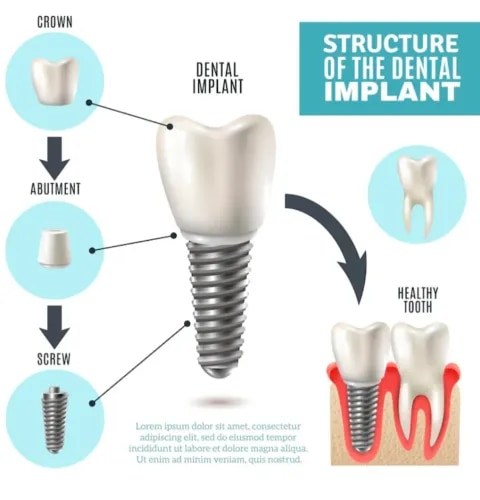
Have you lost most or all of your teeth? Are you struggling with loose dentures, difficulty chewing, changes in facial support or the uncertainty of whether your remaining teeth can be saved? Full mouth dental implant treatment may offer a way to restore an entire dental arch using implant-supported replacement teeth. All-on-4 and All-on-6 are treatment concepts that use four or six strategically positioned dental implants, respectively, to support a fixed full-arch prosthesis in appropriately selected patients. However, the right approach depends on your bone condition, remaining teeth, gum health, medical history and long-term restorative needs.
At OralNest Dental Clinic, patients exploring full mouth dental implants in Wakad and Pimple Gurav, Pune, can receive an assessment of their oral condition and the factors influencing full-mouth rehabilitation. Dr. Ashutosh Dighe (BDS, MDS – Oral Medicine & Maxillofacial Radiology, PhD Scholar, Fellowship in Contemporary Endodontics, Certified Endodontist) evaluates relevant clinical findings and helps patients understand diagnostic requirements, tooth-preservation considerations and the need for appropriate surgical and restorative treatment planning.
1) When Should You Consider Full Mouth Dental Implants?
Full mouth dental implant rehabilitation may be considered when you have lost all teeth in the upper or lower jaw, have several missing teeth with remaining teeth that cannot be predictably restored, or experience significant difficulty using conventional dentures. It may also be an option for selected patients who want to explore fixed implant-supported replacement teeth rather than removable dentures.
However, losing multiple teeth does not automatically mean that all remaining teeth should be extracted. Teeth that are healthy or predictably restorable should be assessed individually before irreversible treatment is considered. The decision to remove a tooth should be based on its condition, supporting bone, gum health and overall prognosis.
All-on-4 and All-on-6 differ primarily in the number and distribution of implants supporting the full-arch restoration. Four implants may provide adequate support in selected cases, while six implants may be appropriate when additional support or a different distribution of forces is indicated. Neither option is universally better; the choice depends on individual anatomy, the restorative design and the overall treatment plan.
2) What Happens During a Full Mouth Dental Implant Consultation?
The assessment may include a detailed review of your dental and medical history, examination of remaining teeth, gum health, bite relationships, jawbone condition and any existing dentures or restorations. Your chewing difficulties, aesthetic expectations, medical considerations and ability to maintain the final restoration are also important.
Dental X-rays and three-dimensional imaging, such as CBCT, may be recommended when clinically indicated to evaluate bone dimensions and the relationship of planned implant sites to important anatomical structures. Digital scans, photographs and other records may also support restorative planning.
Based on the findings, the treatment plan may involve preserving suitable teeth, removing teeth that cannot be predictably restored, managing gum disease, bone augmentation where necessary, implant placement and fabrication of a fixed full-arch prosthesis. Some patients may qualify for a temporary fixed restoration soon after implant placement, while others require a different sequence depending on bone quality, initial implant stability and healing requirements.
Before treatment begins, it is important to understand the number of implants planned, the type of prosthesis, whether additional procedures are required, the expected timeline, the maintenance requirements and the complete treatment cost.
3) How Do You Choose Between All-on-4 and All-on-6?
The decision between All-on-4 and All-on-6 should not be based on implant numbers alone. The available bone, jaw anatomy, distribution of implant positions, bite forces, prosthesis design and long-term maintenance requirements all influence the choice.
All-on-4 uses four implants to support a full-arch restoration in suitable cases. All-on-6 uses six implants and may provide additional support where the clinical and restorative circumstances favour that approach. However, placing more implants does not automatically guarantee a better outcome, and fewer implants do not necessarily mean that treatment is inadequate.
Not every patient is suitable for immediate loading, in which a temporary fixed restoration is attached shortly after implant placement. The decision depends on factors such as implant stability, bone condition and the planned restoration. Healing and integration with the bone must be considered when determining when the final prosthesis can be delivered.
Full-mouth implant rehabilitation is a substantial treatment commitment involving surgery, restorative work and ongoing maintenance. A carefully planned approach considers function, appearance, cleanability, repair requirements and long-term prognosis rather than focusing only on obtaining fixed teeth quickly.
Full Mouth Dental Implants (All-on-4 / All-on-6) in Wakad & Pimple Gurav
OralNest Dental Clinic welcomes patients from Wakad, Pimple Gurav, Rahatani, Pimple Saudagar, Hinjawadi, Baner, Balewadi, Tathawade and nearby Pimpri-Chinchwad areas who want to understand their options for replacing multiple missing teeth or rehabilitating an entire dental arch.
Whether you currently wear removable dentures, have several failing teeth, have been advised to consider full-mouth extraction or want a second opinion before undergoing extensive implant treatment, a personalised consultation can help clarify your suitability, the investigations required and the alternatives available for your condition.
Frequently Asked Questions
1) What is the difference between All-on-4 and All-on-6 dental implants?
All-on-4 uses four strategically positioned implants to support a full-arch prosthesis, while All-on-6 uses six implants. The appropriate option depends on bone availability, implant distribution, bite forces, restorative design and individual clinical findings.
2) Can full mouth dental implants be placed if I have bone loss?
Possibly. The extent and location of bone loss influence whether implant placement is feasible and whether additional procedures, such as bone augmentation, may be required. Appropriate examination and imaging help determine the available options.
3) Can I get fixed teeth on the same day as implant surgery?
Some carefully selected patients may receive a temporary fixed restoration soon after implant placement. This is not suitable for everyone and depends on implant stability, bone condition, the planned restoration and other clinical factors. Immediate fixed teeth should not be assumed to be possible in every case.
4) Are full mouth dental implants better than conventional dentures?
They serve different needs. Implant-supported teeth may provide greater stability for suitable patients, while conventional removable dentures can be a reasonable option for others. Cost, surgical suitability, maintenance, comfort and individual preferences should all be considered before choosing.
5) How much do All-on-4 and All-on-6 dental implants cost in Wakad and Pimple Gurav, Pune?
The cost depends on the number of implants, the type and material of the prosthesis, bone condition, extractions, additional surgical procedures and the complexity of rehabilitation. A personalised treatment plan is needed to understand the complete cost, including temporary and final restorations and ongoing maintenance.
At OralNest Dental Clinic, full mouth dental implant consultation focuses on understanding the condition of your remaining teeth, evaluating your suitability for implant-supported rehabilitation and explaining the available alternatives. Whether All-on-4, All-on-6, another implant-supported approach or conventional dentures may be appropriate, the objective is to support an informed decision based on your individual clinical condition, functional needs and long-term oral health.