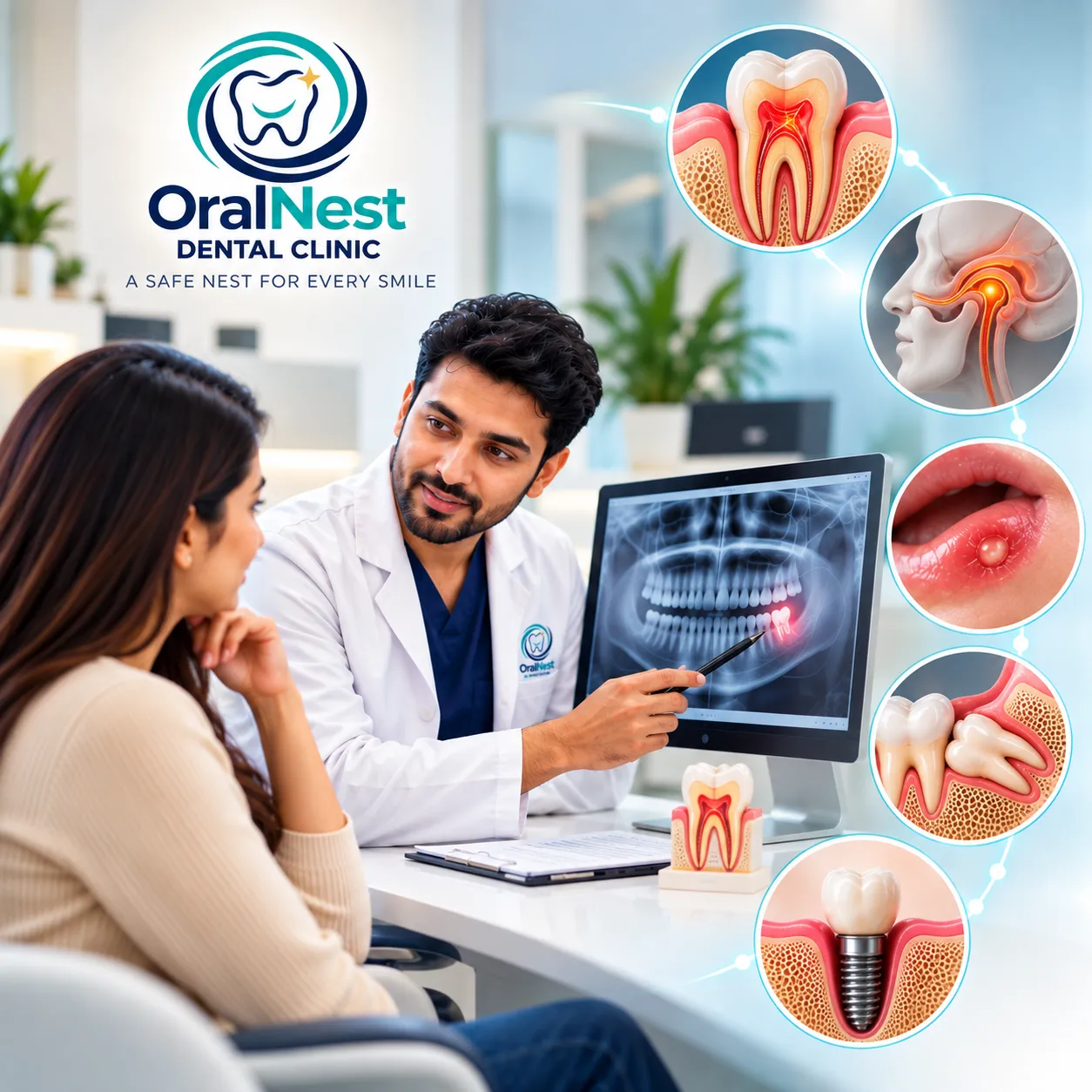
A dental problem can sometimes look simple from the outside but have a very different cause underneath.
A tooth may hurt because of decay, inflammation, a crack, gum-related problems, an old restoration, or another source of pain. Jaw discomfort may come from the temporomandibular joint, muscles, teeth, or other orofacial structures. A mouth ulcer may be temporary, while a persistent or recurrent oral lesion may deserve further evaluation.
This is why the first question in dentistry should not always be:
“What treatment do I need?”
A more important question is:
“What is actually causing the problem?”
The answer can influence whether treatment is required, what treatment is appropriate, how urgently it should be considered, and whether there are alternatives.
At OralNest Dental Clinic | Wakad, this principle forms an important part of a diagnosis-focused approach to dental care.
A Symptom Is Not the Same as a Diagnosis
Patients usually arrive with a symptom.
“I have tooth pain.”
“My jaw hurts.”
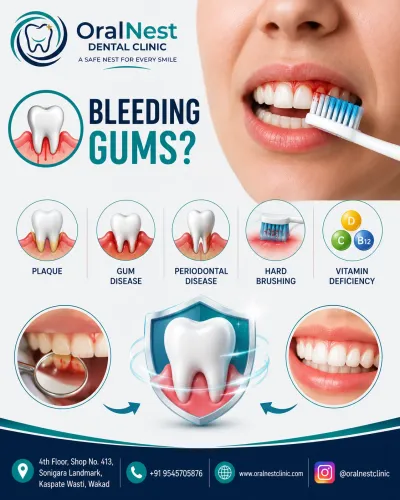
“My gums bleed.”
“I have a mouth ulcer.”
“My wisdom tooth is painful.”
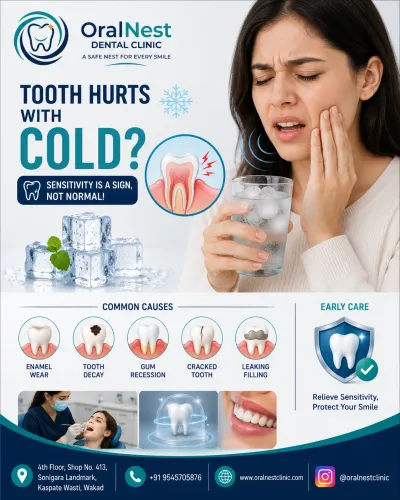
“My tooth is sensitive.”
But a symptom describes what you are experiencing. It does not necessarily explain why it is happening.
For example, tooth sensitivity can occur for several reasons. Tooth pain can have several possible causes. Jaw pain can originate from different structures.
Therefore, two patients with the same complaint may not require the same treatment.
This is one of the reasons diagnosis is so important.
The symptom starts the investigation. The diagnosis guides the decision.
Why Treatment Should Follow Diagnosis
Every dental treatment has a purpose.
A filling is intended to restore damaged tooth structure.
Root canal treatment addresses problems involving the dental pulp and root canal system.
A crown may be used to restore and protect a structurally compromised tooth when clinically appropriate.
A dental implant replaces the root component of a missing tooth as part of a planned tooth-replacement treatment.
Wisdom tooth removal is considered when the clinical situation indicates that removal is appropriate.
TMJ treatment depends on the underlying condition affecting the joint, muscles or related structures.
The procedure therefore makes sense only when it is connected to the actual clinical problem.
Without an adequate understanding of the condition, it becomes difficult to know whether a particular treatment is necessary, appropriate or premature.
Consider Tooth Pain
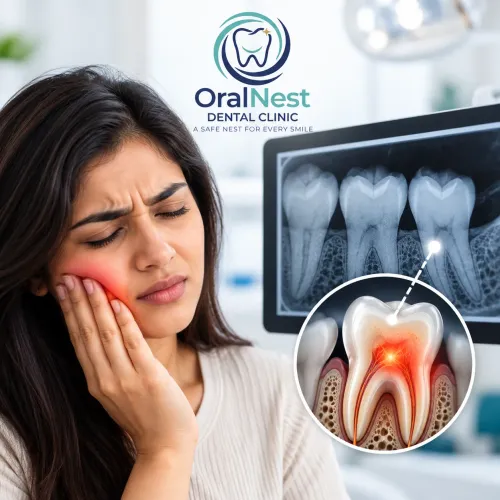
Tooth pain is one of the most common reasons people seek dental care.
But “tooth pain” is not a diagnosis.
Pain may be associated with:
dental decay;
inflammation of the pulp;
infection;
tooth sensitivity;
a cracked or fractured tooth;
trauma;
an existing filling or crown;
gum-related conditions;
problems involving surrounding structures;
or, in some situations, pain that is not originating from the tooth itself.
The pattern of pain can provide useful clues.
Does it occur spontaneously?
Does cold trigger it?
Does heat trigger it?
Does it hurt while biting?
Does it continue after the stimulus is removed?
Has it been getting worse?
Is there swelling?
Has the tooth been treated previously?
These details can help form the clinical picture.
But they do not replace an examination.
Does Every Toothache Need a Root Canal?
No.
This is an important distinction.
Root canal treatment should not be decided simply because a tooth hurts.
The need for root canal treatment depends on the condition of the pulp and surrounding tissues, clinical findings, diagnostic evaluation and the overall condition of the tooth.
In some situations, the appropriate treatment may be a restoration.
In another situation, root canal treatment may be indicated.
In another, further diagnostic evaluation may be required before making a decision.
And in some circumstances, the tooth may not be the source of the pain at all.
This is why a diagnosis should come before committing to an irreversible treatment.
What About a Tooth That Has Been Recommended for Extraction?
Extraction is sometimes necessary.
However, removing a tooth is an irreversible decision.
When appropriate, it is reasonable to understand:
Why does the tooth need to be removed?
What is the condition of the tooth?
Can the tooth be predictably restored or preserved?
What are the alternatives?
What happens if treatment is delayed?
If the tooth is removed, how will the missing tooth be replaced?
These questions do not mean extraction is wrong.
They mean that the decision should be based on an adequate understanding of the clinical situation.
This is particularly relevant when a tooth is important for chewing, aesthetics or overall dental function.
Diagnosis Matters in Wisdom Tooth Problems Too
A painful wisdom tooth does not automatically mean that every wisdom tooth needs immediate removal.
The decision can depend on:
its position;
whether it is impacted;
surrounding tissue condition;
recurrent infection;
effect on the neighbouring tooth;
ability to maintain hygiene;
symptoms;
relationship with surrounding anatomical structures;
and the findings of clinical and radiographic evaluation.
Sometimes removal is appropriate.
Sometimes monitoring may be reasonable.
The important question is not simply:
“Is this a wisdom tooth?”
It is:
“What is this particular wisdom tooth doing, and what is the appropriate course of action?”
Diagnosis Matters in Jaw Pain
Jaw pain can be particularly confusing because the source is not always obvious.
A person may experience:
pain near the ear;
clicking or popping;
difficulty opening the mouth;
discomfort while chewing;
facial pain;
muscle tenderness;
jaw stiffness;
headaches associated with jaw symptoms.
These symptoms can have different possible causes.
Not every clicking jaw needs treatment.
Not every headache is caused by TMJ problems.
Not every facial pain is caused by a tooth.
A careful assessment helps determine what structures may be involved and whether treatment is actually required.
Oral Problems Need the Same Careful Thinking
The same principle applies to the soft tissues of the mouth.
A mouth ulcer, white patch, red area, burning sensation, tongue discomfort or unexplained lump can have different possible causes.
Some conditions may resolve naturally.
Others may recur.
Some may require symptomatic management.
Others may need a more detailed oral examination or further investigation.
This is why persistent or unusual oral changes should not simply be diagnosed through online images or assumptions.
The mouth can provide important clinical information, but that information needs to be interpreted in context.
What Does a Good Diagnosis Involve?
Diagnosis is not simply giving a name to a condition.
It involves putting several pieces of information together.
1. Your history
When did the problem begin?
Has it happened before?
Is it getting better or worse?
What triggers it?
What relieves it?
Have you had previous treatment?
2. Clinical examination
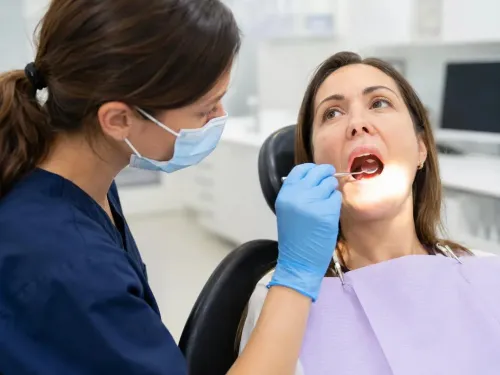
The affected tooth, gums, oral tissues, jaw, muscles or other relevant structures may need to be examined.
3. Diagnostic imaging when indicated
Radiographs or other appropriate imaging may provide information that cannot be obtained from visual examination alone.
4. Correlation of findings
The clinical symptoms, examination and diagnostic information need to make sense together.
5. Consideration of alternatives
Sometimes more than one diagnosis may initially be possible.
The objective is to narrow those possibilities and identify the most appropriate explanation based on the available evidence.
Why Imaging Alone Is Not a Diagnosis
A dental X-ray can provide valuable information.
But an image should not be interpreted in isolation.
A radiographic finding needs to be considered alongside the patient's symptoms and clinical examination.
For example, an abnormal-looking area on an image may not necessarily explain the patient's current symptoms.
Similarly, a tooth that appears relatively normal on a basic image may still require clinical evaluation when symptoms suggest an underlying problem.
Good diagnosis connects the image with the patient—not the patient with the image.
What Happens When the Diagnosis Is Unclear?
Not every dental problem can be identified immediately.
Sometimes the findings are straightforward.
Sometimes additional information is required.
This may involve:
further clinical examination;
additional diagnostic imaging;
reviewing previous dental records;
observing how symptoms develop;
evaluating another possible source of pain;
or obtaining a second opinion when appropriate.
Uncertainty does not necessarily mean something serious is happening.
It simply means that the available information may not yet be sufficient to make a confident treatment decision.
In such situations, rushing into treatment may not be the most appropriate approach.
Diagnosis Can Prevent Unnecessary Treatment
One of the benefits of careful diagnosis is that it can help distinguish between:
treatment that is needed
and
treatment that is not needed.
This is particularly important in dentistry because some treatments are irreversible.
Removing a tooth cannot be undone.
Preparing a tooth extensively for a restoration cannot simply be reversed.
Starting a major treatment without understanding the underlying problem can complicate future decisions.
Therefore:
The purpose of diagnosis is not only to identify what should be treated. It can also help identify what does not need treatment.
Diagnosis Also Helps Plan Better Treatment
When treatment is required, diagnosis provides the foundation for planning.
Consider root canal treatment.
The treatment approach can depend on:
the tooth involved;
root and canal anatomy;
infection;
previous treatment;
complexity;
remaining tooth structure;
and the final restoration required.
Similarly, implant treatment depends on factors such as the missing tooth, surrounding tissues, available bone, restoration and long-term functional requirements.
The more accurately the problem is understood, the more logically the treatment can be planned.
The Importance of Understanding Before Consent
Patients should not feel that they have to agree to treatment simply because a procedure has been recommended.
Before proceeding with significant dental treatment, it is reasonable to understand:
What is the diagnosis?
Why is this treatment being recommended?
What is the purpose of the treatment?
Are there alternatives?
What happens if treatment is delayed?
What are the limitations or risks?
What will happen after treatment?
These questions encourage informed decision-making.
A good consultation should leave you with greater clarity—not simply a treatment name.
A Diagnosis-First Approach at OralNest
At OralNest Dental Clinic | Wakad, our clinical approach is centred around understanding the patient's problem before deciding how it should be managed.
This is particularly relevant to concerns involving:
Oral Medicine and oral mucosal conditions;
TMJ disorders and orofacial pain;
unexplained dental pain;
root canal and endodontic problems;
wisdom tooth conditions;
dental implants;
complex treatment planning;
and dental second opinions.
Dr. Ashutosh Dighe's background includes BDS, MDS in Oral Medicine & Maxillofacial Radiology, PhD Scholar, Fellowship in Contemporary Endodontics and Certified Endodontist.
The objective is not to make every consultation complicated.
It is to give appropriate attention to the problems that genuinely require careful diagnosis and treatment planning.
Convenient Evening Appointments at OralNest
For working professionals and patients with busy daytime schedules, planned evening consultations can make dental care easier to fit into the day.
Monday–Saturday
5:30 PM – 9:00 PM
Sunday
10:00 AM – 1:00 PM
Prior appointment is convenient
A prior appointment is particularly useful when you are coming for:
a detailed dental consultation;
a second opinion;
tooth pain evaluation;
TMJ or jaw pain assessment;
oral lesion evaluation;
root canal consultation;
wisdom tooth assessment;
implant planning;
or a complex treatment discussion.
If you have previous X-rays, scans, prescriptions, treatment reports or dental records, bringing them can also help provide a more complete clinical picture.
The Right Question to Ask
Instead of asking only:
“How much will this treatment cost?”
or
“Can this be done in one sitting?”
or
“Do I need a root canal?”
begin with:
“What is the diagnosis, and why is this treatment appropriate for me?”
That question changes the conversation.
It moves the focus from the procedure to the reason behind the procedure.
And that is where meaningful dental decision-making begins.
Final Thought
Dental treatment should not be driven solely by symptoms, assumptions or the name of a procedure.
A painful tooth deserves an explanation.
A problematic wisdom tooth deserves an appropriate assessment.
Jaw pain deserves an understanding of its possible source.
A persistent oral change deserves attention when its behaviour warrants evaluation.
And before an irreversible treatment is chosen, the diagnosis should be sufficiently understood.
The right diagnosis does more than name the problem.
It helps determine what should happen next.
At OralNest Dental Clinic | Wakad, this is the principle behind a diagnosis-focused approach:
Understand First. Decide Carefully. Treat Precisely.
A tooth may hurt because of decay, inflammation, a crack, gum-related problems, an old restoration, or another source of pain. Jaw discomfort may come from the temporomandibular joint, muscles, teeth, or other orofacial structures. A mouth ulcer may be temporary, while a persistent or recurrent oral lesion may deserve further evaluation.
This is why the first question in dentistry should not always be:
“What treatment do I need?”
A more important question is:
“What is actually causing the problem?”
The answer can influence whether treatment is required, what treatment is appropriate, how urgently it should be considered, and whether there are alternatives.
At OralNest Dental Clinic | Wakad, this principle forms an important part of a diagnosis-focused approach to dental care.
A Symptom Is Not the Same as a Diagnosis
Patients usually arrive with a symptom.
“I have tooth pain.”
“My jaw hurts.”
“My gums bleed.”
“I have a mouth ulcer.”
“My wisdom tooth is painful.”
“My tooth is sensitive.”
But a symptom describes what you are experiencing. It does not necessarily explain why it is happening.
For example, tooth sensitivity can occur for several reasons. Tooth pain can have several possible causes. Jaw pain can originate from different structures.
Therefore, two patients with the same complaint may not require the same treatment.
This is one of the reasons diagnosis is so important.
The symptom starts the investigation. The diagnosis guides the decision.
Why Treatment Should Follow Diagnosis
Every dental treatment has a purpose.
A filling is intended to restore damaged tooth structure.
Root canal treatment addresses problems involving the dental pulp and root canal system.
A crown may be used to restore and protect a structurally compromised tooth when clinically appropriate.
A dental implant replaces the root component of a missing tooth as part of a planned tooth-replacement treatment.
Wisdom tooth removal is considered when the clinical situation indicates that removal is appropriate.
TMJ treatment depends on the underlying condition affecting the joint, muscles or related structures.
The procedure therefore makes sense only when it is connected to the actual clinical problem.
Without an adequate understanding of the condition, it becomes difficult to know whether a particular treatment is necessary, appropriate or premature.
Consider Tooth Pain
Tooth pain is one of the most common reasons people seek dental care.
But “tooth pain” is not a diagnosis.
Pain may be associated with:
dental decay;
inflammation of the pulp;
infection;
tooth sensitivity;
a cracked or fractured tooth;
trauma;
an existing filling or crown;
gum-related conditions;
problems involving surrounding structures;
or, in some situations, pain that is not originating from the tooth itself.
The pattern of pain can provide useful clues.
Does it occur spontaneously?
Does cold trigger it?
Does heat trigger it?
Does it hurt while biting?
Does it continue after the stimulus is removed?
Has it been getting worse?
Is there swelling?
Has the tooth been treated previously?
These details can help form the clinical picture.
But they do not replace an examination.
Does Every Toothache Need a Root Canal?
No.
This is an important distinction.
Root canal treatment should not be decided simply because a tooth hurts.
The need for root canal treatment depends on the condition of the pulp and surrounding tissues, clinical findings, diagnostic evaluation and the overall condition of the tooth.
In some situations, the appropriate treatment may be a restoration.
In another situation, root canal treatment may be indicated.
In another, further diagnostic evaluation may be required before making a decision.
And in some circumstances, the tooth may not be the source of the pain at all.
This is why a diagnosis should come before committing to an irreversible treatment.
What About a Tooth That Has Been Recommended for Extraction?
Extraction is sometimes necessary.
However, removing a tooth is an irreversible decision.
When appropriate, it is reasonable to understand:
Why does the tooth need to be removed?
What is the condition of the tooth?
Can the tooth be predictably restored or preserved?
What are the alternatives?
What happens if treatment is delayed?
If the tooth is removed, how will the missing tooth be replaced?
These questions do not mean extraction is wrong.
They mean that the decision should be based on an adequate understanding of the clinical situation.
This is particularly relevant when a tooth is important for chewing, aesthetics or overall dental function.
Diagnosis Matters in Wisdom Tooth Problems Too
A painful wisdom tooth does not automatically mean that every wisdom tooth needs immediate removal.
The decision can depend on:
its position;
whether it is impacted;
surrounding tissue condition;
recurrent infection;
effect on the neighbouring tooth;
ability to maintain hygiene;
symptoms;
relationship with surrounding anatomical structures;
and the findings of clinical and radiographic evaluation.
Sometimes removal is appropriate.
Sometimes monitoring may be reasonable.
The important question is not simply:
“Is this a wisdom tooth?”
It is:
“What is this particular wisdom tooth doing, and what is the appropriate course of action?”
Diagnosis Matters in Jaw Pain
Jaw pain can be particularly confusing because the source is not always obvious.
A person may experience:
pain near the ear;
clicking or popping;
difficulty opening the mouth;
discomfort while chewing;
facial pain;
muscle tenderness;
jaw stiffness;
headaches associated with jaw symptoms.
These symptoms can have different possible causes.
Not every clicking jaw needs treatment.
Not every headache is caused by TMJ problems.
Not every facial pain is caused by a tooth.
A careful assessment helps determine what structures may be involved and whether treatment is actually required.
Oral Problems Need the Same Careful Thinking
The same principle applies to the soft tissues of the mouth.
A mouth ulcer, white patch, red area, burning sensation, tongue discomfort or unexplained lump can have different possible causes.
Some conditions may resolve naturally.
Others may recur.
Some may require symptomatic management.
Others may need a more detailed oral examination or further investigation.
This is why persistent or unusual oral changes should not simply be diagnosed through online images or assumptions.
The mouth can provide important clinical information, but that information needs to be interpreted in context.
What Does a Good Diagnosis Involve?
Diagnosis is not simply giving a name to a condition.
It involves putting several pieces of information together.
1. Your history
When did the problem begin?
Has it happened before?
Is it getting better or worse?
What triggers it?
What relieves it?
Have you had previous treatment?
2. Clinical examination
The affected tooth, gums, oral tissues, jaw, muscles or other relevant structures may need to be examined.
3. Diagnostic imaging when indicated
Radiographs or other appropriate imaging may provide information that cannot be obtained from visual examination alone.
4. Correlation of findings
The clinical symptoms, examination and diagnostic information need to make sense together.
5. Consideration of alternatives
Sometimes more than one diagnosis may initially be possible.
The objective is to narrow those possibilities and identify the most appropriate explanation based on the available evidence.
Why Imaging Alone Is Not a Diagnosis
A dental X-ray can provide valuable information.
But an image should not be interpreted in isolation.
A radiographic finding needs to be considered alongside the patient's symptoms and clinical examination.
For example, an abnormal-looking area on an image may not necessarily explain the patient's current symptoms.
Similarly, a tooth that appears relatively normal on a basic image may still require clinical evaluation when symptoms suggest an underlying problem.
Good diagnosis connects the image with the patient—not the patient with the image.
What Happens When the Diagnosis Is Unclear?
Not every dental problem can be identified immediately.
Sometimes the findings are straightforward.
Sometimes additional information is required.
This may involve:
further clinical examination;
additional diagnostic imaging;
reviewing previous dental records;
observing how symptoms develop;
evaluating another possible source of pain;
or obtaining a second opinion when appropriate.
Uncertainty does not necessarily mean something serious is happening.
It simply means that the available information may not yet be sufficient to make a confident treatment decision.
In such situations, rushing into treatment may not be the most appropriate approach.
Diagnosis Can Prevent Unnecessary Treatment
One of the benefits of careful diagnosis is that it can help distinguish between:
treatment that is needed
and
treatment that is not needed.
This is particularly important in dentistry because some treatments are irreversible.
Removing a tooth cannot be undone.
Preparing a tooth extensively for a restoration cannot simply be reversed.
Starting a major treatment without understanding the underlying problem can complicate future decisions.
Therefore:
The purpose of diagnosis is not only to identify what should be treated. It can also help identify what does not need treatment.
Diagnosis Also Helps Plan Better Treatment
When treatment is required, diagnosis provides the foundation for planning.
Consider root canal treatment.
The treatment approach can depend on:
the tooth involved;
root and canal anatomy;
infection;
previous treatment;
complexity;
remaining tooth structure;
and the final restoration required.
Similarly, implant treatment depends on factors such as the missing tooth, surrounding tissues, available bone, restoration and long-term functional requirements.
The more accurately the problem is understood, the more logically the treatment can be planned.
The Importance of Understanding Before Consent
Patients should not feel that they have to agree to treatment simply because a procedure has been recommended.
Before proceeding with significant dental treatment, it is reasonable to understand:
What is the diagnosis?
Why is this treatment being recommended?
What is the purpose of the treatment?
Are there alternatives?
What happens if treatment is delayed?
What are the limitations or risks?
What will happen after treatment?
These questions encourage informed decision-making.
A good consultation should leave you with greater clarity—not simply a treatment name.
A Diagnosis-First Approach at OralNest
At OralNest Dental Clinic | Wakad, our clinical approach is centred around understanding the patient's problem before deciding how it should be managed.
This is particularly relevant to concerns involving:
Oral Medicine and oral mucosal conditions;
TMJ disorders and orofacial pain;
unexplained dental pain;
root canal and endodontic problems;
wisdom tooth conditions;
dental implants;
complex treatment planning;
and dental second opinions.
Dr. Ashutosh Dighe's background includes BDS, MDS in Oral Medicine & Maxillofacial Radiology, PhD Scholar, Fellowship in Contemporary Endodontics and Certified Endodontist.
The objective is not to make every consultation complicated.
It is to give appropriate attention to the problems that genuinely require careful diagnosis and treatment planning.
Convenient Evening Appointments at OralNest
For working professionals and patients with busy daytime schedules, planned evening consultations can make dental care easier to fit into the day.
Monday–Saturday
5:30 PM – 9:00 PM
Sunday
10:00 AM – 1:00 PM
Prior appointment is convenient
A prior appointment is particularly useful when you are coming for:
a detailed dental consultation;
a second opinion;
tooth pain evaluation;
TMJ or jaw pain assessment;
oral lesion evaluation;
root canal consultation;
wisdom tooth assessment;
implant planning;
or a complex treatment discussion.
If you have previous X-rays, scans, prescriptions, treatment reports or dental records, bringing them can also help provide a more complete clinical picture.
The Right Question to Ask
Instead of asking only:
“How much will this treatment cost?”
or
“Can this be done in one sitting?”
or
“Do I need a root canal?”
begin with:
“What is the diagnosis, and why is this treatment appropriate for me?”
That question changes the conversation.
It moves the focus from the procedure to the reason behind the procedure.
And that is where meaningful dental decision-making begins.
Final Thought
Dental treatment should not be driven solely by symptoms, assumptions or the name of a procedure.
A painful tooth deserves an explanation.
A problematic wisdom tooth deserves an appropriate assessment.
Jaw pain deserves an understanding of its possible source.
A persistent oral change deserves attention when its behaviour warrants evaluation.
And before an irreversible treatment is chosen, the diagnosis should be sufficiently understood.
The right diagnosis does more than name the problem.
It helps determine what should happen next.
At OralNest Dental Clinic | Wakad, this is the principle behind a diagnosis-focused approach:
Understand First. Decide Carefully. Treat Precisely.
Keywords