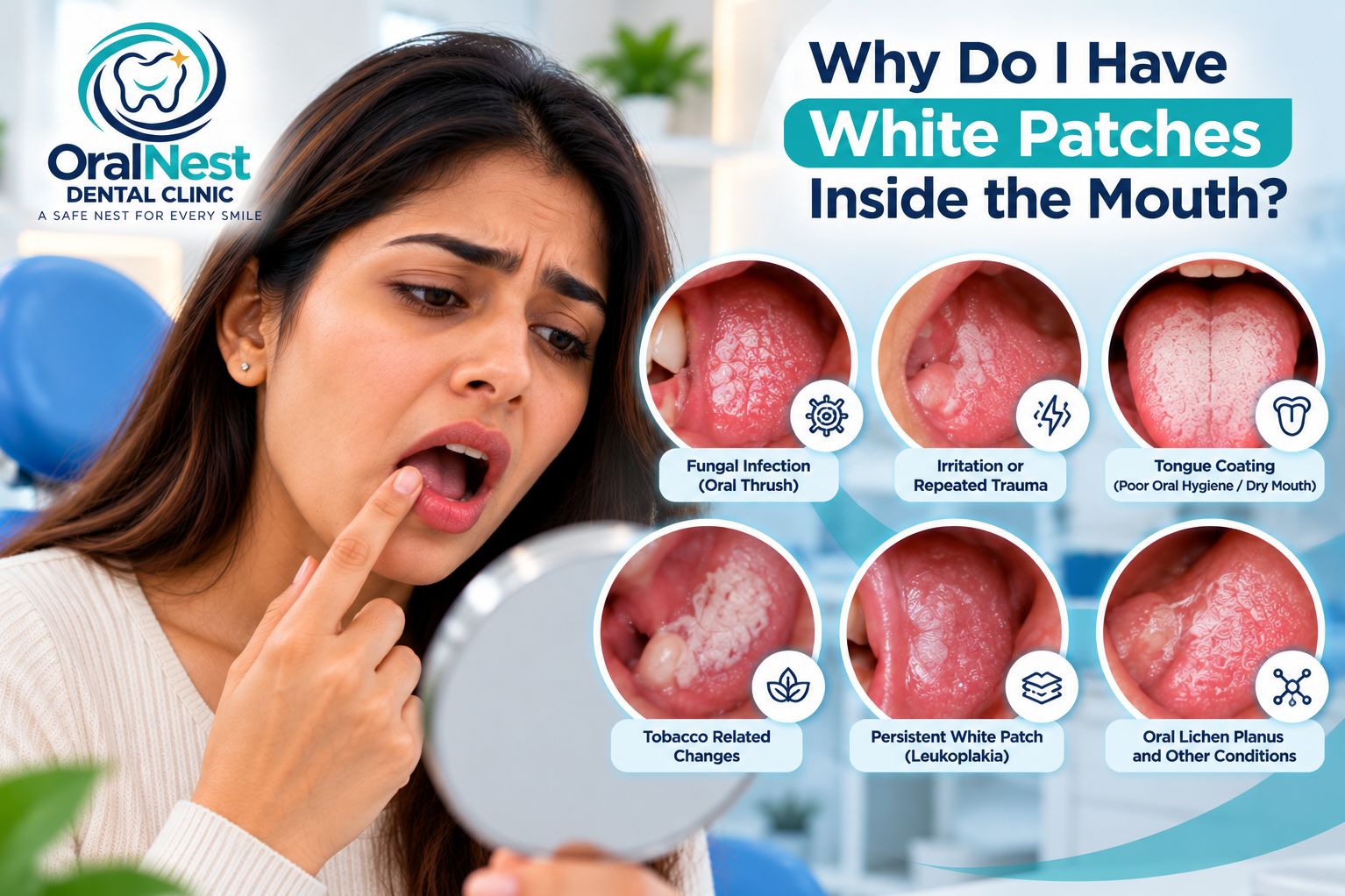
Noticing a white patch inside the cheek, on the gums, tongue, palate or another part of the mouth can be unsettling. The first reaction is often to assume it is due to food, poor oral hygiene or a fungal infection.
Sometimes that may be the explanation.
But a persistent white patch inside the mouth can have several different causes, and the appearance alone is not enough to determine which one applies.
The more useful question is:
“Why is this white patch present, and does it need to be investigated?”
Is every white patch inside the mouth the same?
No.
“White patch” is a description of appearance, not a diagnosis.
A white area can develop because of surface debris, friction, irritation, infection, changes in the oral lining, or other conditions affecting the mucosal tissues.
Two white patches may look similar to a patient but behave very differently when examined.
A clinician may therefore assess:
where the patch is located
how long it has been present
whether it can be wiped away
whether the underlying tissue is red or normal
whether it is painful or completely symptom-free
whether its size or appearance is changing
whether there is a history of repeated irritation
whether similar areas are present elsewhere
These details help narrow down the possible causes.
What can cause a white patch in the mouth?
There is no single explanation.
1. Surface coating or debris
Sometimes material accumulates on the oral surface and creates a temporary white appearance.
This may improve with normal oral hygiene and does not necessarily represent a disease of the oral tissues.
2. Local irritation
Repeated trauma can produce changes in the oral lining.
Possible sources include:
cheek or lip biting
sharp tooth edges
fractured teeth
rough dental restorations
poorly fitting appliances
repeated friction
If the source of irritation continues, the white area may persist.
3. Oral fungal infection
Oral candidiasis can produce white or creamy patches.
Depending on the presentation, these areas may be removable and may leave a red or irritated surface underneath.
Risk factors can include recent antibiotics, certain medications, inhaled corticosteroids and other local or systemic factors.
However, not every white patch is oral thrush.
That distinction matters because treatment depends on the underlying cause.
What is a white patch that does not wipe away?
A persistent white patch that cannot be gently removed deserves closer attention.
One condition that clinicians may consider is leukoplakia, a clinical term used for a persistent white plaque that cannot be explained by another identifiable condition.
Importantly, the presence of a white patch does not automatically mean cancer.
Leukoplakia itself is a clinical diagnosis of exclusion, and some lesions may have different levels of risk depending on their clinical and microscopic characteristics.
This is why persistent unexplained white patches should not simply be ignored.
The appropriate response is evaluation—not panic.
Can friction from a tooth cause a white patch?
Yes.
The inside of the cheek is particularly vulnerable to repeated mechanical irritation.
A sharp tooth, rough filling, biting habit or dental appliance can repeatedly traumatize the same area.
The tissue may respond with thickening or a whitish appearance.
If the suspected irritant is removed and the area subsequently improves, that information can be clinically useful.
But if the white patch persists despite removing the suspected source, further evaluation may be appropriate.
Can tobacco cause white patches?
Tobacco exposure can contribute to several changes in the oral tissues.
A persistent white patch in someone who uses tobacco should therefore receive appropriate attention, particularly if it does not resolve or has an unusual appearance.
The important point is not to assume that every tobacco-associated white patch is dangerous.
Instead, tobacco history becomes one part of the diagnostic picture.
The clinician may consider the location, appearance, duration, texture and other findings before deciding whether further investigation is required.
What if the white patch does not hurt?
This is an important misconception.
The absence of pain does not automatically mean that an oral lesion is harmless.
Many oral changes can remain completely symptom-free.
A person may notice a white patch incidentally while brushing, eating or taking a photograph.
That does not mean it should be ignored if it persists.
Pain is only one clinical feature.
Duration, appearance, location, texture and behaviour can be equally important.
What if the patch keeps coming back?
A recurrent white patch deserves attention because recurrence may provide clues about its cause.
For example, repeated irritation, dryness, habits or certain oral conditions may produce recurring changes.
Instead of repeatedly treating the appearance without identifying the reason, it is more useful to document:
when it appears
how long it lasts
whether it can be removed
what makes it better or worse
whether it occurs in the same location
whether other symptoms accompany it
This history can make an oral examination considerably more informative.
Can a white patch be related to oral lichen planus?
Yes.
Oral lichen planus is one of the conditions that can produce white lines or patches inside the mouth.
The pattern may be quite different from an ordinary coating.
It can sometimes appear as a network-like or lace-like pattern, although oral lichen planus can have different clinical presentations.
Some patients may also experience soreness or burning, particularly with spicy or acidic foods.
Because several oral conditions can produce overlapping appearances, examination is important when the pattern is persistent or symptomatic.
Can an oral white patch require a biopsy?
Sometimes.
A biopsy is not required for every white patch.
The decision depends on the clinical findings.
If an oral lesion has an unexplained, persistent or suspicious appearance, or if its diagnosis cannot be established confidently through clinical assessment, tissue sampling may be considered.
A biopsy allows the tissue to be examined microscopically.
This can provide information that cannot always be obtained simply by looking at the lesion.
The important principle is:
A biopsy is a diagnostic tool—not a conclusion that something is cancer.
When should you get a white patch checked?
An oral examination is particularly reasonable when a white patch:
persists for more than a short period
cannot be gently wiped away
repeatedly returns
is increasing in size
changes in appearance or texture
becomes painful or irritated
bleeds
occurs with a red area
is associated with difficulty eating or swallowing
appears without an obvious cause
occurs alongside other unexplained oral changes
A persistent oral lesion should be assessed in context rather than judged from a photograph or mirror image alone.
What happens during an oral examination?
A proper assessment usually begins with understanding the history.
You may be asked:
When did you first notice it?
Has it changed?
Does it come off with gentle cleaning?
Is it painful or sensitive?
Have you noticed similar changes elsewhere?
Do you have any habits or sources of repeated irritation?
Have you recently taken antibiotics or other medications?
Do you use tobacco or other oral products?
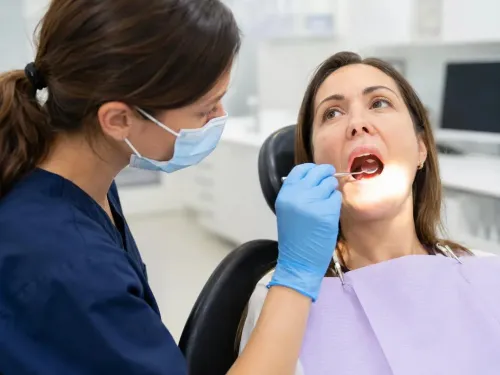
The lesion is then examined carefully.
Its exact location, size, colour, surface, borders, texture and relationship with surrounding tissues can all provide useful information.
In selected cases, additional investigations may be appropriate.
The objective is not to over-investigate every harmless variation.
It is to avoid overlooking a persistent unexplained lesion.
Why self-treatment can sometimes delay the right diagnosis
One of the common patterns with oral white patches is repeated self-treatment.
A person may assume:
“It is fungal.”
Another may think:
“It is because I don't clean my tongue properly.”
Someone else may assume:
“I must have bitten my cheek.”
Sometimes these explanations are correct.
But if the lesion persists despite the expected treatment or removal of the suspected cause, continuing the same approach may simply delay understanding what is actually happening.
A persistent oral change deserves a diagnosis based on its clinical features.
White patch vs white coating: why the distinction matters
A generalized coating over the tongue is different from a clearly defined white patch on the cheek or gum.
A coating may be related to surface accumulation.
A localized patch may involve the oral mucosa itself.
This distinction is one reason patients should avoid trying to diagnose oral lesions solely by comparing photographs online.
The mouth contains many different tissues, and similar colours can represent very different processes.
The most important question is not “Is it serious?”
When patients discover a white patch, they often immediately search:
“Is this cancer?”
That question is understandable—but it is not the first question that should be answered.
The first question is:
“What is this lesion?”
Once the lesion is identified or narrowed down, its significance and management can be discussed appropriately.
This approach avoids both unnecessary fear and false reassurance.
Oral Medicine & Oral Diagnosis at OralNest Dental Clinic | Wakad
White patches, persistent oral lesions and unexplained changes inside the mouth are part of oral diagnosis—not simply routine dental cleaning.
At OralNest Dental Clinic | Wakad, the evaluation begins with the patient's symptoms and concerns, followed by careful examination of the oral tissues and consideration of relevant medical, dental and habit-related factors.
The objective is simple:
Understand the lesion before deciding what it needs.
For patients from Wakad and nearby areas including Hinjawadi, Tathawade, Punawale, Pimple Saudagar, Pimple Gurav and Rahatani, persistent or unexplained oral changes can be evaluated as part of a structured oral diagnosis.
Clinic Timings
Monday–Saturday: 5:30 PM–9:00 PM
Sunday: 10:00 AM–1:00 PM
Prior appointment is convenient.
At OralNest Dental Clinic | Wakad
Understand First. Diagnose Carefully. Decide With Clarity.
Sometimes that may be the explanation.
But a persistent white patch inside the mouth can have several different causes, and the appearance alone is not enough to determine which one applies.
The more useful question is:
“Why is this white patch present, and does it need to be investigated?”
Is every white patch inside the mouth the same?
No.
“White patch” is a description of appearance, not a diagnosis.
A white area can develop because of surface debris, friction, irritation, infection, changes in the oral lining, or other conditions affecting the mucosal tissues.
Two white patches may look similar to a patient but behave very differently when examined.
A clinician may therefore assess:
where the patch is located
how long it has been present
whether it can be wiped away
whether the underlying tissue is red or normal
whether it is painful or completely symptom-free
whether its size or appearance is changing
whether there is a history of repeated irritation
whether similar areas are present elsewhere
These details help narrow down the possible causes.
What can cause a white patch in the mouth?
There is no single explanation.
1. Surface coating or debris
Sometimes material accumulates on the oral surface and creates a temporary white appearance.
This may improve with normal oral hygiene and does not necessarily represent a disease of the oral tissues.
2. Local irritation
Repeated trauma can produce changes in the oral lining.
Possible sources include:
cheek or lip biting
sharp tooth edges
fractured teeth
rough dental restorations
poorly fitting appliances
repeated friction
If the source of irritation continues, the white area may persist.
3. Oral fungal infection
Oral candidiasis can produce white or creamy patches.
Depending on the presentation, these areas may be removable and may leave a red or irritated surface underneath.
Risk factors can include recent antibiotics, certain medications, inhaled corticosteroids and other local or systemic factors.
However, not every white patch is oral thrush.
That distinction matters because treatment depends on the underlying cause.
What is a white patch that does not wipe away?
A persistent white patch that cannot be gently removed deserves closer attention.
One condition that clinicians may consider is leukoplakia, a clinical term used for a persistent white plaque that cannot be explained by another identifiable condition.
Importantly, the presence of a white patch does not automatically mean cancer.
Leukoplakia itself is a clinical diagnosis of exclusion, and some lesions may have different levels of risk depending on their clinical and microscopic characteristics.
This is why persistent unexplained white patches should not simply be ignored.
The appropriate response is evaluation—not panic.
Can friction from a tooth cause a white patch?
Yes.
The inside of the cheek is particularly vulnerable to repeated mechanical irritation.
A sharp tooth, rough filling, biting habit or dental appliance can repeatedly traumatize the same area.
The tissue may respond with thickening or a whitish appearance.
If the suspected irritant is removed and the area subsequently improves, that information can be clinically useful.
But if the white patch persists despite removing the suspected source, further evaluation may be appropriate.
Can tobacco cause white patches?
Tobacco exposure can contribute to several changes in the oral tissues.
A persistent white patch in someone who uses tobacco should therefore receive appropriate attention, particularly if it does not resolve or has an unusual appearance.
The important point is not to assume that every tobacco-associated white patch is dangerous.
Instead, tobacco history becomes one part of the diagnostic picture.
The clinician may consider the location, appearance, duration, texture and other findings before deciding whether further investigation is required.
What if the white patch does not hurt?
This is an important misconception.
The absence of pain does not automatically mean that an oral lesion is harmless.
Many oral changes can remain completely symptom-free.
A person may notice a white patch incidentally while brushing, eating or taking a photograph.
That does not mean it should be ignored if it persists.
Pain is only one clinical feature.
Duration, appearance, location, texture and behaviour can be equally important.
What if the patch keeps coming back?
A recurrent white patch deserves attention because recurrence may provide clues about its cause.
For example, repeated irritation, dryness, habits or certain oral conditions may produce recurring changes.
Instead of repeatedly treating the appearance without identifying the reason, it is more useful to document:
when it appears
how long it lasts
whether it can be removed
what makes it better or worse
whether it occurs in the same location
whether other symptoms accompany it
This history can make an oral examination considerably more informative.
Can a white patch be related to oral lichen planus?
Yes.
Oral lichen planus is one of the conditions that can produce white lines or patches inside the mouth.
The pattern may be quite different from an ordinary coating.
It can sometimes appear as a network-like or lace-like pattern, although oral lichen planus can have different clinical presentations.
Some patients may also experience soreness or burning, particularly with spicy or acidic foods.
Because several oral conditions can produce overlapping appearances, examination is important when the pattern is persistent or symptomatic.
Can an oral white patch require a biopsy?
Sometimes.
A biopsy is not required for every white patch.
The decision depends on the clinical findings.
If an oral lesion has an unexplained, persistent or suspicious appearance, or if its diagnosis cannot be established confidently through clinical assessment, tissue sampling may be considered.
A biopsy allows the tissue to be examined microscopically.
This can provide information that cannot always be obtained simply by looking at the lesion.
The important principle is:
A biopsy is a diagnostic tool—not a conclusion that something is cancer.
When should you get a white patch checked?
An oral examination is particularly reasonable when a white patch:
persists for more than a short period
cannot be gently wiped away
repeatedly returns
is increasing in size
changes in appearance or texture
becomes painful or irritated
bleeds
occurs with a red area
is associated with difficulty eating or swallowing
appears without an obvious cause
occurs alongside other unexplained oral changes
A persistent oral lesion should be assessed in context rather than judged from a photograph or mirror image alone.
What happens during an oral examination?
A proper assessment usually begins with understanding the history.
You may be asked:
When did you first notice it?
Has it changed?
Does it come off with gentle cleaning?
Is it painful or sensitive?
Have you noticed similar changes elsewhere?
Do you have any habits or sources of repeated irritation?
Have you recently taken antibiotics or other medications?
Do you use tobacco or other oral products?
The lesion is then examined carefully.
Its exact location, size, colour, surface, borders, texture and relationship with surrounding tissues can all provide useful information.
In selected cases, additional investigations may be appropriate.
The objective is not to over-investigate every harmless variation.
It is to avoid overlooking a persistent unexplained lesion.
Why self-treatment can sometimes delay the right diagnosis
One of the common patterns with oral white patches is repeated self-treatment.
A person may assume:
“It is fungal.”
Another may think:
“It is because I don't clean my tongue properly.”
Someone else may assume:
“I must have bitten my cheek.”
Sometimes these explanations are correct.
But if the lesion persists despite the expected treatment or removal of the suspected cause, continuing the same approach may simply delay understanding what is actually happening.
A persistent oral change deserves a diagnosis based on its clinical features.
White patch vs white coating: why the distinction matters
A generalized coating over the tongue is different from a clearly defined white patch on the cheek or gum.
A coating may be related to surface accumulation.
A localized patch may involve the oral mucosa itself.
This distinction is one reason patients should avoid trying to diagnose oral lesions solely by comparing photographs online.
The mouth contains many different tissues, and similar colours can represent very different processes.
The most important question is not “Is it serious?”
When patients discover a white patch, they often immediately search:
“Is this cancer?”
That question is understandable—but it is not the first question that should be answered.
The first question is:
“What is this lesion?”
Once the lesion is identified or narrowed down, its significance and management can be discussed appropriately.
This approach avoids both unnecessary fear and false reassurance.
Oral Medicine & Oral Diagnosis at OralNest Dental Clinic | Wakad
White patches, persistent oral lesions and unexplained changes inside the mouth are part of oral diagnosis—not simply routine dental cleaning.
At OralNest Dental Clinic | Wakad, the evaluation begins with the patient's symptoms and concerns, followed by careful examination of the oral tissues and consideration of relevant medical, dental and habit-related factors.
The objective is simple:
Understand the lesion before deciding what it needs.
For patients from Wakad and nearby areas including Hinjawadi, Tathawade, Punawale, Pimple Saudagar, Pimple Gurav and Rahatani, persistent or unexplained oral changes can be evaluated as part of a structured oral diagnosis.
Clinic Timings
Monday–Saturday: 5:30 PM–9:00 PM
Sunday: 10:00 AM–1:00 PM
Prior appointment is convenient.
At OralNest Dental Clinic | Wakad
Understand First. Diagnose Carefully. Decide With Clarity.
Keywords