Mouth ulcers are common, and most people have experienced one at some point.
A small painful ulcer may appear suddenly, make eating uncomfortable for a few days, and then disappear without treatment.
So when should you simply wait for an ulcer to heal—and when should you have it checked?
The answer depends less on the word “ulcer” and more on its duration, appearance, recurrence, location, symptoms and healing pattern.
At OralNest Dental Clinic | Wakad, the goal of an oral ulcer consultation is not to create unnecessary concern. It is to determine whether the ulcer behaves like a typical self-limiting problem or whether its persistence or behaviour deserves closer evaluation.
The important question is not only “What does it look like?” but “How is it behaving?”
Most Mouth Ulcers Are Not an Emergency
A typical minor mouth ulcer can be painful but often heals on its own.
It may occur after:
accidental biting;
minor trauma;
irritation;
stress;
or without an obvious trigger.
The discomfort may be significant even when the ulcer itself is small.
If the ulcer follows a familiar pattern and heals normally, extensive investigation may not be necessary.
However, not every oral ulcer behaves this way.
That is when paying attention to the pattern becomes important.
When Should a Mouth Ulcer Be Checked?
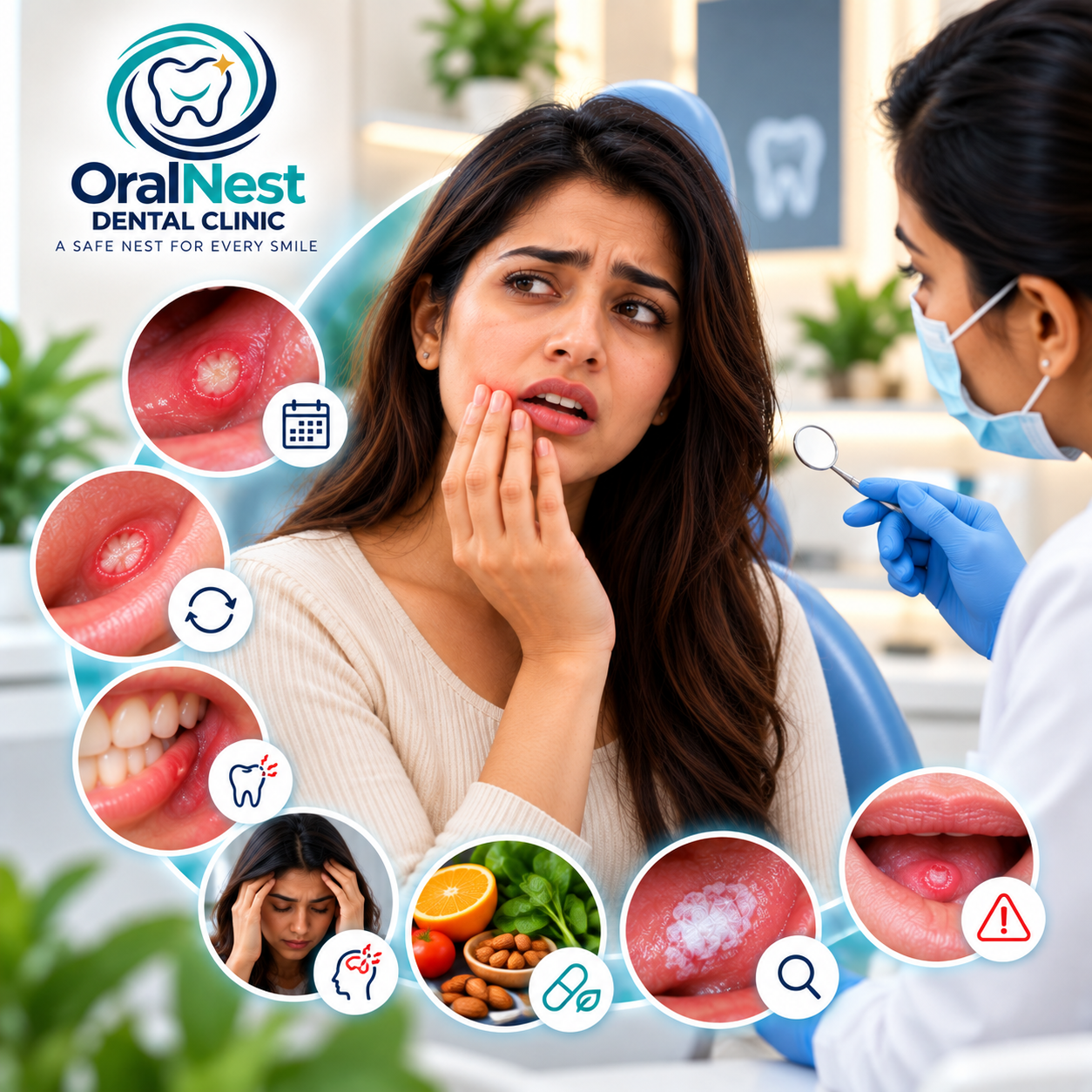
A dental or oral medicine consultation is worth considering when an ulcer:
does not heal as expected;
keeps returning frequently;
repeatedly appears in the same location;
becomes unusually large or painful;
is associated with persistent swelling;
appears alongside a white or red patch;
occurs with other unexplained oral changes;
continues despite removing an obvious source of irritation;
or simply looks or behaves differently from your previous ulcers.
These features do not automatically indicate a serious condition.
They indicate that the ulcer deserves to be understood rather than repeatedly ignored.
1. An Ulcer That Does Not Heal as Expected
Healing time can vary depending on the type, size, location and individual circumstances.
However, if an ulcer remains present longer than expected or does not appear to be improving, professional evaluation can be useful.
The important point is not to rely on an exact number of days as the only decision-making factor.
Instead, ask:
Is it improving?
Is it getting smaller?
Is the pain reducing?
Does the tissue appear to be healing?
Has something changed about the ulcer?
A lesion that is not following a normal healing pattern deserves attention.
2. An Ulcer That Keeps Coming Back
Occasional ulcers can happen.
But if you repeatedly find yourself saying:
“I get these all the time.”
it may be worth discussing the pattern with a dental professional.
The evaluation may consider:
frequency;
number of ulcers;
location;
duration;
triggers;
associated symptoms;
local irritation;
medications;
medical history;
and other relevant factors.
Recurrent ulcers do not necessarily mean that something serious is wrong.
But repeated episodes can sometimes provide useful clues about why they are occurring.
3. The Same Area Keeps Becoming an Ulcer
If an ulcer repeatedly appears in exactly the same location, local irritation should be considered.
Possible sources include:
a sharp tooth;
a fractured tooth;
a rough restoration;
repeated cheek or lip biting;
an irritating dental appliance;
or another source of mechanical trauma.
If the source remains, simply treating the ulcer may not prevent another episode.
Therefore, the question becomes:
What is repeatedly irritating this area?
Finding and addressing the source can be an important part of management.
4. The Ulcer Is Unusually Large or Painful
Some ulcers can be surprisingly painful despite being small.
However, an ulcer that is unusually large, extremely painful, or significantly interfering with eating and speaking may deserve evaluation.
The size and appearance of an ulcer need to be considered together with:
how long it has been present;
whether similar ulcers have occurred previously;
whether there are multiple lesions;
whether other oral symptoms are present;
and how the lesion is changing.
The objective is to understand the overall clinical picture.
5. There Is a White or Red Area Around or Near the Ulcer
An ulcer can sometimes occur alongside other changes in the oral tissues.
You may notice:
a white patch;
a red patch;
a mixed red-and-white area;
unusual thickening;
persistent roughness;
or another change that remains after the ulcer itself improves.
Such findings do not automatically indicate a serious problem.
But persistent or unexplained changes should be assessed rather than diagnosed from photographs alone.
6. There Is an Unexplained Lump or Swelling
If an ulcer occurs with a persistent lump, swelling or unusual thickening nearby, it is reasonable to have the area examined.
A swelling can have many possible causes, including local inflammation, trauma, infection, benign conditions or other oral conditions.
Its:
size;
location;
consistency;
duration;
symptoms;
and changes over time
can all be relevant.
A persistent swelling deserves an explanation.
7. The Ulcer Keeps Bleeding
An ulcer can bleed if it is repeatedly irritated or traumatised.
For example, biting or brushing over a painful ulcer may cause bleeding.
However, unexplained or persistent bleeding should not simply be dismissed.
The clinician can determine whether the bleeding is coming from the ulcer itself, surrounding tissue, local trauma or another source.
8. The Ulcer Appears With Other Symptoms
An ulcer becomes more clinically interesting when it occurs alongside other unexplained symptoms.
These might include:
persistent tongue discomfort;
multiple oral lesions;
unusual changes in oral tissues;
unexplained swelling;
persistent dry mouth;
difficulty swallowing;
recurrent oral pain;
or symptoms affecting other parts of the body.
This does not mean that the symptoms necessarily share one cause.
It means the overall pattern may be important.
9. The Ulcer Is Different From Your Usual Ulcers
Patients who experience recurrent ulcers often know what their usual ulcers look and feel like.
If a new lesion is:
in a different location;
much larger;
more painful;
slower to heal;
different in appearance;
associated with swelling;
or behaving differently
it is reasonable to have it checked.
A change from your usual pattern is useful clinical information.
Can You Diagnose a Mouth Ulcer From a Photograph?
Not reliably.
Photographs can help document how an oral lesion looks at a particular moment.
But a clinical diagnosis may require information that a photograph cannot provide.
For example:
exact duration;
recurrence;
tissue texture;
tenderness;
local trauma;
medical history;
medication history;
other oral findings.
Two lesions can appear similar in a photograph but have different causes.
Therefore, online images should be used for education—not as a substitute for an individual oral examination.
What Happens During an Oral Ulcer Consultation?
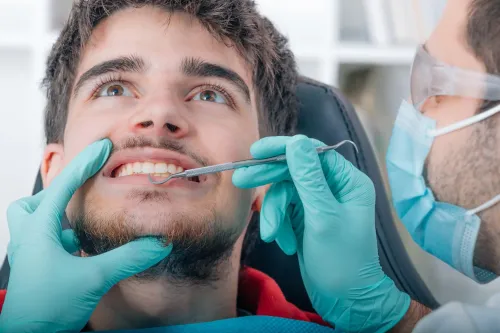
A consultation usually begins with the history.
You may be asked:
When did you first notice it?
Has it happened before?
How frequently does it recur?
Does it always occur in the same location?
How long does it normally take to heal?
Is it painful?
Does it interfere with eating?
Have you noticed any other oral changes?
Are you taking any medications?
Have you had any relevant medical or dental problems?
The oral tissues can then be examined carefully.
The aim is to understand whether the clinical findings fit the history.
Does Every Mouth Ulcer Need a Biopsy?
No.
A biopsy is not automatically required for every mouth ulcer.
The decision depends on the clinical findings.
Some ulcers can be diagnosed clinically and managed conservatively.
Some may simply require observation.
Some may need treatment for an identifiable cause.
Others may require further investigation if their appearance, persistence or behaviour warrants it.
The investigation should follow the clinical question.
What If the Ulcer Is Caused by a Sharp Tooth?
If a sharp tooth edge, broken restoration or another local factor is repeatedly traumatizing the tissue, treating the source may be important.
For example, if the same area is repeatedly rubbing against a sharp tooth, the ulcer may continue to recur until the irritation is addressed.
This is why an oral ulcer consultation should not focus only on the ulcer.
It should also consider:
What is happening around it?
Can Stress Be the Reason?
Stress can be associated with recurrent ulcers in some people.
However, saying:
“It is only stress.”
without considering the clinical pattern may overlook other contributing factors.
Stress, sleep, eating patterns, local trauma, medications, nutritional factors and other health circumstances can sometimes interact.
If ulcers are frequent or unusual, it is better to understand the pattern than to automatically assign one cause.
What About Vitamin Deficiency?
Certain nutritional deficiencies can be associated with recurrent oral ulcers.
If the history or clinical findings suggest this possibility, appropriate medical evaluation may be considered.
However, not every recurrent ulcer is caused by a vitamin deficiency.
Taking supplements without knowing whether a deficiency exists may not address the actual reason for recurrence.
The appropriate evaluation should guide the next step.
Should You Wait for the Ulcer to Become Painful?
Not necessarily.
Pain is only one feature of an oral lesion.
Some oral changes may be relatively painless.
Therefore, the absence of pain does not automatically mean that an oral change can be ignored.
Similarly, significant pain does not automatically indicate a serious condition.
Pain is one piece of information—not the entire diagnosis.
When You Should Not Keep Treating It Yourself
If an ulcer keeps returning despite repeated home treatment, it may be time to stop asking:
“Which gel should I apply this time?”
and start asking:
“Why does this keep happening?”
Repeated symptomatic treatment may reduce discomfort without explaining the underlying pattern.
A clinical evaluation can help determine whether there is:
a local irritant;
a recurrent ulcer pattern;
another oral condition;
a contributing health factor;
or a reason for further investigation.
Oral Medicine Can Be Particularly Useful for Persistent Oral Problems
Not every oral concern fits neatly into routine dental treatment.
Oral Medicine and Oral Diagnosis can be relevant when patients present with:
recurrent mouth ulcers;
persistent oral sores;
white or red patches;
tongue discomfort;
burning sensations;
dry mouth;
unexplained oral pain;
lumps or swelling;
or other persistent oral changes.
At OralNest Dental Clinic | Wakad, these concerns are approached through clinical history, examination and appropriate diagnostic reasoning.
Convenient Evening Consultation at OralNest
For patients with work and daytime commitments, OralNest follows an appointment-led evening practice schedule.
Monday–Saturday
5:30 PM – 9:00 PM
Sunday
10:00 AM – 1:00 PM
Prior appointment is convenient
Advance appointments are particularly useful when you are coming for an oral medicine consultation or a detailed evaluation of a persistent or recurrent oral problem.
If you have photographs of previous episodes, prescriptions, medical reports or previous dental records, bringing them can provide useful background.
What Should You Do If You Notice a Persistent Ulcer?
Do not panic.
Do not assume the worst.
But do not repeatedly ignore a lesion that is behaving differently from your usual ulcers.
Instead:
Observe the pattern.
Note when it appeared.
See whether it is healing.
Check whether it keeps recurring.
Look for other oral changes.
Arrange a professional evaluation if it persists, recurs frequently or behaves unusually.
This approach avoids both unnecessary fear and unnecessary neglect.
The Important Difference Between “Common” and “Always Harmless”
Mouth ulcers are common.
But “common” does not mean that every ulcer should be treated identically.
The clinical context matters.
A temporary ulcer that heals normally is different from a lesion that persists, repeatedly returns, changes appearance or occurs with other unexplained findings.
The goal is not to worry about every ulcer.
The goal is to recognise when an ulcer deserves a closer look.
OralNest Approach to Oral Ulcer Evaluation
At OralNest Dental Clinic | Wakad, the approach is centred on understanding:
What is the lesion?
How long has it been present?
Why might it be occurring?
Is there a local source of irritation?
Does the pattern suggest recurrence?
Are there other oral findings?
Does it require treatment, monitoring or further investigation?
Dr. Ashutosh Dighe's professional background includes BDS, MDS – Oral Medicine & Maxillofacial Radiology, PhD Scholar, Fellowship in Contemporary Endodontics and Certified Endodontist, supporting a diagnosis-focused approach to oral and dental concerns.
Final Thought
A mouth ulcer does not need to become a reason for anxiety.
But a persistent or repeatedly recurring ulcer should not simply become part of your normal routine without understanding why it happens.
If an ulcer is behaving differently, taking longer to heal, repeatedly returning, or appearing alongside other oral changes, a professional evaluation can help replace uncertainty with clarity.
Don't just keep treating the ulcer. Understand the pattern.
At OralNest Dental Clinic | Wakad:
Understand First. Diagnose Carefully. Decide With Clarity.
A small painful ulcer may appear suddenly, make eating uncomfortable for a few days, and then disappear without treatment.
So when should you simply wait for an ulcer to heal—and when should you have it checked?
The answer depends less on the word “ulcer” and more on its duration, appearance, recurrence, location, symptoms and healing pattern.
At OralNest Dental Clinic | Wakad, the goal of an oral ulcer consultation is not to create unnecessary concern. It is to determine whether the ulcer behaves like a typical self-limiting problem or whether its persistence or behaviour deserves closer evaluation.
The important question is not only “What does it look like?” but “How is it behaving?”
Most Mouth Ulcers Are Not an Emergency
A typical minor mouth ulcer can be painful but often heals on its own.
It may occur after:
accidental biting;
minor trauma;
irritation;
stress;
or without an obvious trigger.
The discomfort may be significant even when the ulcer itself is small.
If the ulcer follows a familiar pattern and heals normally, extensive investigation may not be necessary.
However, not every oral ulcer behaves this way.
That is when paying attention to the pattern becomes important.
When Should a Mouth Ulcer Be Checked?
A dental or oral medicine consultation is worth considering when an ulcer:
does not heal as expected;
keeps returning frequently;
repeatedly appears in the same location;
becomes unusually large or painful;
is associated with persistent swelling;
appears alongside a white or red patch;
occurs with other unexplained oral changes;
continues despite removing an obvious source of irritation;
or simply looks or behaves differently from your previous ulcers.
These features do not automatically indicate a serious condition.
They indicate that the ulcer deserves to be understood rather than repeatedly ignored.
1. An Ulcer That Does Not Heal as Expected
Healing time can vary depending on the type, size, location and individual circumstances.
However, if an ulcer remains present longer than expected or does not appear to be improving, professional evaluation can be useful.
The important point is not to rely on an exact number of days as the only decision-making factor.
Instead, ask:
Is it improving?
Is it getting smaller?
Is the pain reducing?
Does the tissue appear to be healing?
Has something changed about the ulcer?
A lesion that is not following a normal healing pattern deserves attention.
2. An Ulcer That Keeps Coming Back
Occasional ulcers can happen.
But if you repeatedly find yourself saying:
“I get these all the time.”
it may be worth discussing the pattern with a dental professional.
The evaluation may consider:
frequency;
number of ulcers;
location;
duration;
triggers;
associated symptoms;
local irritation;
medications;
medical history;
and other relevant factors.
Recurrent ulcers do not necessarily mean that something serious is wrong.
But repeated episodes can sometimes provide useful clues about why they are occurring.
3. The Same Area Keeps Becoming an Ulcer
If an ulcer repeatedly appears in exactly the same location, local irritation should be considered.
Possible sources include:
a sharp tooth;
a fractured tooth;
a rough restoration;
repeated cheek or lip biting;
an irritating dental appliance;
or another source of mechanical trauma.
If the source remains, simply treating the ulcer may not prevent another episode.
Therefore, the question becomes:
What is repeatedly irritating this area?
Finding and addressing the source can be an important part of management.
4. The Ulcer Is Unusually Large or Painful
Some ulcers can be surprisingly painful despite being small.
However, an ulcer that is unusually large, extremely painful, or significantly interfering with eating and speaking may deserve evaluation.
The size and appearance of an ulcer need to be considered together with:
how long it has been present;
whether similar ulcers have occurred previously;
whether there are multiple lesions;
whether other oral symptoms are present;
and how the lesion is changing.
The objective is to understand the overall clinical picture.
5. There Is a White or Red Area Around or Near the Ulcer
An ulcer can sometimes occur alongside other changes in the oral tissues.
You may notice:
a white patch;
a red patch;
a mixed red-and-white area;
unusual thickening;
persistent roughness;
or another change that remains after the ulcer itself improves.
Such findings do not automatically indicate a serious problem.
But persistent or unexplained changes should be assessed rather than diagnosed from photographs alone.
6. There Is an Unexplained Lump or Swelling
If an ulcer occurs with a persistent lump, swelling or unusual thickening nearby, it is reasonable to have the area examined.
A swelling can have many possible causes, including local inflammation, trauma, infection, benign conditions or other oral conditions.
Its:
size;
location;
consistency;
duration;
symptoms;
and changes over time
can all be relevant.
A persistent swelling deserves an explanation.
7. The Ulcer Keeps Bleeding
An ulcer can bleed if it is repeatedly irritated or traumatised.
For example, biting or brushing over a painful ulcer may cause bleeding.
However, unexplained or persistent bleeding should not simply be dismissed.
The clinician can determine whether the bleeding is coming from the ulcer itself, surrounding tissue, local trauma or another source.
8. The Ulcer Appears With Other Symptoms
An ulcer becomes more clinically interesting when it occurs alongside other unexplained symptoms.
These might include:
persistent tongue discomfort;
multiple oral lesions;
unusual changes in oral tissues;
unexplained swelling;
persistent dry mouth;
difficulty swallowing;
recurrent oral pain;
or symptoms affecting other parts of the body.
This does not mean that the symptoms necessarily share one cause.
It means the overall pattern may be important.
9. The Ulcer Is Different From Your Usual Ulcers
Patients who experience recurrent ulcers often know what their usual ulcers look and feel like.
If a new lesion is:
in a different location;
much larger;
more painful;
slower to heal;
different in appearance;
associated with swelling;
or behaving differently
it is reasonable to have it checked.
A change from your usual pattern is useful clinical information.
Can You Diagnose a Mouth Ulcer From a Photograph?
Not reliably.
Photographs can help document how an oral lesion looks at a particular moment.
But a clinical diagnosis may require information that a photograph cannot provide.
For example:
exact duration;
recurrence;
tissue texture;
tenderness;
local trauma;
medical history;
medication history;
other oral findings.
Two lesions can appear similar in a photograph but have different causes.
Therefore, online images should be used for education—not as a substitute for an individual oral examination.
What Happens During an Oral Ulcer Consultation?
A consultation usually begins with the history.
You may be asked:
When did you first notice it?
Has it happened before?
How frequently does it recur?
Does it always occur in the same location?
How long does it normally take to heal?
Is it painful?
Does it interfere with eating?
Have you noticed any other oral changes?
Are you taking any medications?
Have you had any relevant medical or dental problems?
The oral tissues can then be examined carefully.
The aim is to understand whether the clinical findings fit the history.
Does Every Mouth Ulcer Need a Biopsy?
No.
A biopsy is not automatically required for every mouth ulcer.
The decision depends on the clinical findings.
Some ulcers can be diagnosed clinically and managed conservatively.
Some may simply require observation.
Some may need treatment for an identifiable cause.
Others may require further investigation if their appearance, persistence or behaviour warrants it.
The investigation should follow the clinical question.
What If the Ulcer Is Caused by a Sharp Tooth?
If a sharp tooth edge, broken restoration or another local factor is repeatedly traumatizing the tissue, treating the source may be important.
For example, if the same area is repeatedly rubbing against a sharp tooth, the ulcer may continue to recur until the irritation is addressed.
This is why an oral ulcer consultation should not focus only on the ulcer.
It should also consider:
What is happening around it?
Can Stress Be the Reason?
Stress can be associated with recurrent ulcers in some people.
However, saying:
“It is only stress.”
without considering the clinical pattern may overlook other contributing factors.
Stress, sleep, eating patterns, local trauma, medications, nutritional factors and other health circumstances can sometimes interact.
If ulcers are frequent or unusual, it is better to understand the pattern than to automatically assign one cause.
What About Vitamin Deficiency?
Certain nutritional deficiencies can be associated with recurrent oral ulcers.
If the history or clinical findings suggest this possibility, appropriate medical evaluation may be considered.
However, not every recurrent ulcer is caused by a vitamin deficiency.
Taking supplements without knowing whether a deficiency exists may not address the actual reason for recurrence.
The appropriate evaluation should guide the next step.
Should You Wait for the Ulcer to Become Painful?
Not necessarily.
Pain is only one feature of an oral lesion.
Some oral changes may be relatively painless.
Therefore, the absence of pain does not automatically mean that an oral change can be ignored.
Similarly, significant pain does not automatically indicate a serious condition.
Pain is one piece of information—not the entire diagnosis.
When You Should Not Keep Treating It Yourself
If an ulcer keeps returning despite repeated home treatment, it may be time to stop asking:
“Which gel should I apply this time?”
and start asking:
“Why does this keep happening?”
Repeated symptomatic treatment may reduce discomfort without explaining the underlying pattern.
A clinical evaluation can help determine whether there is:
a local irritant;
a recurrent ulcer pattern;
another oral condition;
a contributing health factor;
or a reason for further investigation.
Oral Medicine Can Be Particularly Useful for Persistent Oral Problems
Not every oral concern fits neatly into routine dental treatment.
Oral Medicine and Oral Diagnosis can be relevant when patients present with:
recurrent mouth ulcers;
persistent oral sores;
white or red patches;
tongue discomfort;
burning sensations;
dry mouth;
unexplained oral pain;
lumps or swelling;
or other persistent oral changes.
At OralNest Dental Clinic | Wakad, these concerns are approached through clinical history, examination and appropriate diagnostic reasoning.
Convenient Evening Consultation at OralNest
For patients with work and daytime commitments, OralNest follows an appointment-led evening practice schedule.
Monday–Saturday
5:30 PM – 9:00 PM
Sunday
10:00 AM – 1:00 PM
Prior appointment is convenient
Advance appointments are particularly useful when you are coming for an oral medicine consultation or a detailed evaluation of a persistent or recurrent oral problem.
If you have photographs of previous episodes, prescriptions, medical reports or previous dental records, bringing them can provide useful background.
What Should You Do If You Notice a Persistent Ulcer?
Do not panic.
Do not assume the worst.
But do not repeatedly ignore a lesion that is behaving differently from your usual ulcers.
Instead:
Observe the pattern.
Note when it appeared.
See whether it is healing.
Check whether it keeps recurring.
Look for other oral changes.
Arrange a professional evaluation if it persists, recurs frequently or behaves unusually.
This approach avoids both unnecessary fear and unnecessary neglect.
The Important Difference Between “Common” and “Always Harmless”
Mouth ulcers are common.
But “common” does not mean that every ulcer should be treated identically.
The clinical context matters.
A temporary ulcer that heals normally is different from a lesion that persists, repeatedly returns, changes appearance or occurs with other unexplained findings.
The goal is not to worry about every ulcer.
The goal is to recognise when an ulcer deserves a closer look.
OralNest Approach to Oral Ulcer Evaluation
At OralNest Dental Clinic | Wakad, the approach is centred on understanding:
What is the lesion?
How long has it been present?
Why might it be occurring?
Is there a local source of irritation?
Does the pattern suggest recurrence?
Are there other oral findings?
Does it require treatment, monitoring or further investigation?
Dr. Ashutosh Dighe's professional background includes BDS, MDS – Oral Medicine & Maxillofacial Radiology, PhD Scholar, Fellowship in Contemporary Endodontics and Certified Endodontist, supporting a diagnosis-focused approach to oral and dental concerns.
Final Thought
A mouth ulcer does not need to become a reason for anxiety.
But a persistent or repeatedly recurring ulcer should not simply become part of your normal routine without understanding why it happens.
If an ulcer is behaving differently, taking longer to heal, repeatedly returning, or appearing alongside other oral changes, a professional evaluation can help replace uncertainty with clarity.
Don't just keep treating the ulcer. Understand the pattern.
At OralNest Dental Clinic | Wakad:
Understand First. Diagnose Carefully. Decide With Clarity.
Keywords