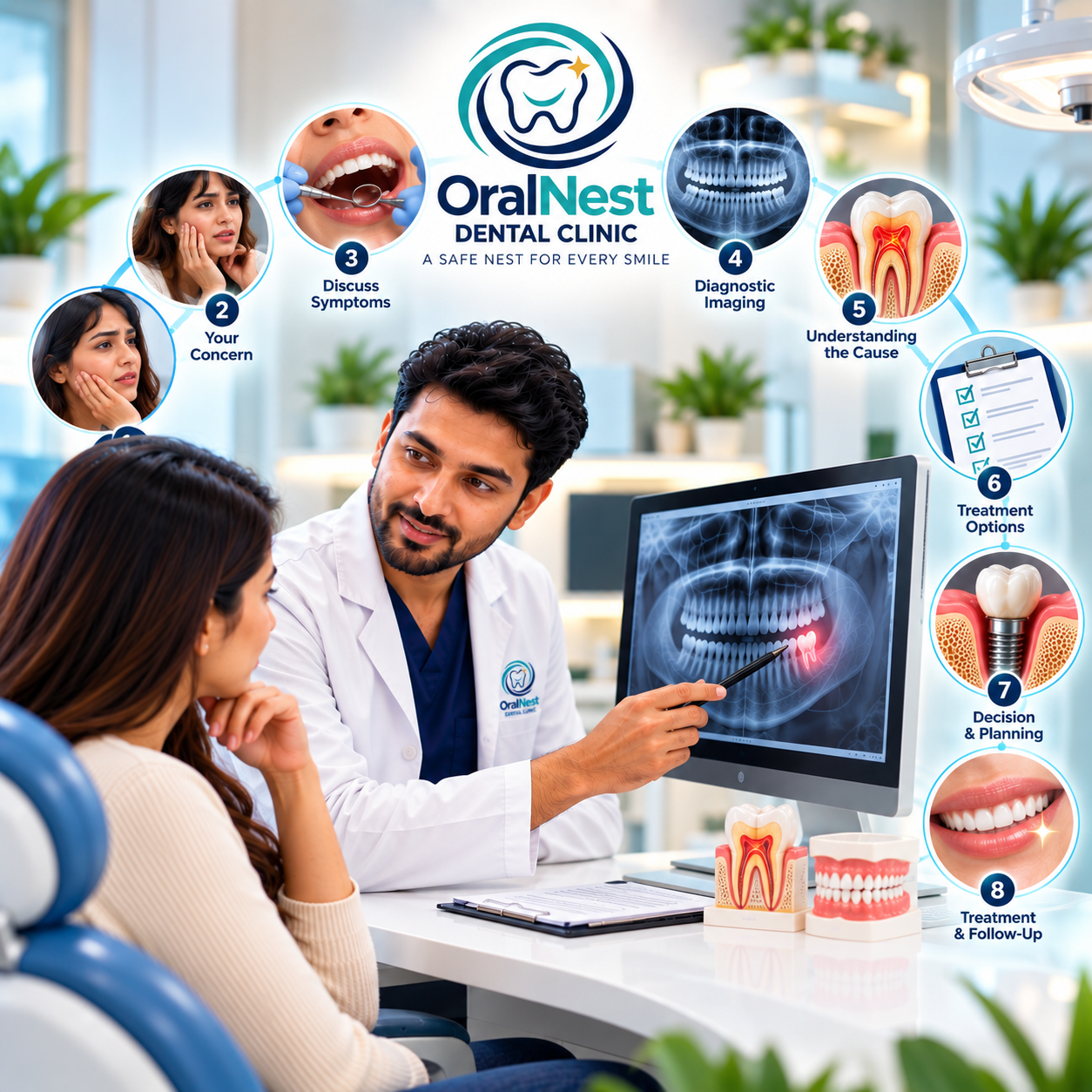
When you visit a dental clinic, you may expect the consultation to be simple:
Show the problem → get a diagnosis → receive treatment.
But not every dental problem is that straightforward.
Sometimes the tooth causing pain is not immediately obvious. Sometimes a patient has several symptoms at once. Sometimes an X-ray shows something that needs to be understood in context. Sometimes you have already received a treatment recommendation but still do not understand why it was suggested.
A comprehensive dental consultation is designed to look beyond the immediate complaint.
At OralNest Dental Clinic | Wakad, the objective is to understand the patient, symptoms, clinical findings and relevant diagnostic information together before deciding what should happen next.
What Is a Comprehensive Dental Consultation?
A comprehensive consultation is more than simply checking for cavities.
It is a structured evaluation designed to understand:
your main concern;
relevant symptoms;
dental history;
previous treatments;
current clinical findings;
possible causes;
relevant diagnostic information;
treatment needs;
available options;
and appropriate next steps.
Not every patient needs an extensive examination.
The depth of evaluation should depend on the concern.
A routine dental issue may require a straightforward assessment.
A complex or unexplained problem may require more detailed investigation.
The consultation should be as thorough as the problem requires.
1. Start With Your Main Concern
The consultation begins with the reason you came.
It may be:
“My tooth hurts.”
“My wisdom tooth is troubling me.”
“My jaw clicks.”
“My gums bleed.”
“I have a mouth ulcer that keeps returning.”
“I have been advised to get a root canal.”
“I have lost a tooth and want to know my options.”
“I want a second opinion.”
You do not need to know the diagnosis before coming.
In fact, one purpose of the consultation is to help determine what the complaint may represent.
2. Understanding Your Symptoms
Two patients can describe the same problem but have very different clinical conditions.
For example, “tooth pain” could mean:
pain with cold;
pain with hot food;
pain while biting;
spontaneous pain;
pain at night;
intermittent discomfort;
prolonged sensitivity;
or pain associated with swelling.
These details matter.
The same applies to jaw pain.
Is it present while chewing?
Does the jaw click?
Does it lock?
Is there restricted mouth opening?
Does the pain extend toward the ear or temple?
Similarly, with an oral ulcer:
How long has it been present?
Has it happened before?
Does it heal completely?
Does it recur in the same location?
The pattern of a symptom can provide important diagnostic clues.
3. Reviewing Your Dental History
Your current problem does not always exist in isolation.
Previous dental treatment can influence the way a problem is assessed.
For example, a tooth with:
a previous filling;
a crown;
root canal treatment;
previous trauma;
repeated dental procedures;
or a history of recurrent pain
may require a different evaluation from an untreated tooth.
If you have previous treatment records, X-rays or reports, they can provide useful background.
The history of a tooth can be as important as its current appearance.
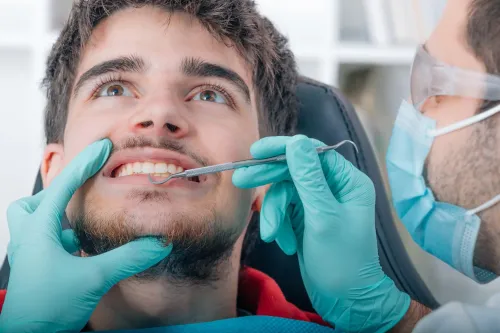
4. Clinical Examination
The next stage is an appropriate clinical examination.
Depending on your complaint, this may involve assessment of:
Teeth
Decay, cracks, restorations, sensitivity, mobility and other relevant findings.
Gums
Inflammation, bleeding, recession and supporting tissues.
Oral mucosa
Ulcers, colour changes, patches, swelling or other visible changes.
Jaw joints
Clicking, tenderness, movement and range of opening when relevant.
Muscles
Tenderness or discomfort in muscles involved in chewing when indicated.
Bite and function
How the teeth and jaw function together.
Surrounding structures
Other areas that may contribute to the symptoms.
The examination is guided by the clinical question.
5. Diagnostic Imaging When Required
Sometimes an examination alone is not enough.
Depending on the concern, appropriate dental imaging may help evaluate structures that cannot be adequately assessed clinically.
Imaging may provide useful information about:
tooth roots;
root canal anatomy;
bone;
impacted wisdom teeth;
infection-related changes;
previously treated teeth;
missing-tooth areas;
surrounding anatomical structures.
But imaging is not automatically required for every dental complaint.
The purpose of imaging is to answer a clinical question—not simply to produce an image.
6. Understanding What the Findings Mean
A comprehensive consultation should connect the findings rather than consider each one separately.
For example:
A patient may have tooth pain.
The examination may show a large cavity.
Imaging may show changes around the root.
The combination of symptoms, clinical findings and imaging can provide a clearer explanation of the problem.
Similarly, jaw pain may require consideration of the joint, muscles, teeth and other possible sources.
An oral lesion may need to be assessed according to its appearance, duration, location and clinical behaviour.
Diagnosis comes from connecting the evidence.
7. Considering Possible Causes
Sometimes the diagnosis is obvious.
Sometimes it is not.
When symptoms are unusual or persistent, more than one possibility may need to be considered.
This is particularly relevant when:
pain does not match the visible dental findings;
previous treatment has not resolved symptoms;
several teeth are involved;
jaw and facial pain have no obvious source;
an oral lesion persists or repeatedly returns;
a previously treated tooth develops new symptoms.
The purpose is not to make every consultation complicated.
It is to avoid assuming an answer before the available evidence supports it.
8. Determining Whether Treatment Is Needed
A comprehensive consultation should also answer:
Does this problem actually require treatment?
Depending on the diagnosis, the appropriate approach may be:
Treatment
When active disease or structural damage requires intervention.
Preventive care
When progression can be reduced through prevention and monitoring.
Observation
When immediate treatment is not necessary.
Further investigation
When the available information is insufficient.
Second opinion
When an important treatment decision requires additional perspective.
This is one of the key differences between simply identifying a procedure and properly assessing a dental problem.
9. Understanding Your Treatment Options
If treatment is needed, the next question is:
Which treatment is appropriate?
Depending on the condition, options may include:
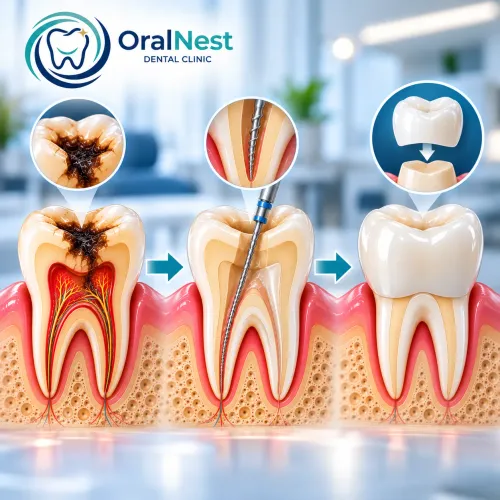
restoration;
root canal treatment;
crown;
extraction;
wisdom tooth removal;
implant;
bridge;
denture;
TMJ management;
oral lesion evaluation;
preventive management;
or a combination of treatments.
The appropriate option depends on the diagnosis and individual circumstances.
There is no single treatment that is correct for every patient with the same symptom.
10. Understanding Why a Treatment Is Recommended
One of the most valuable parts of a consultation is understanding the reasoning.
You should be able to ask:
Why do I need this treatment?
What is the treatment trying to achieve?
Can the tooth be preserved?
Are there alternatives?
What happens if I wait?
How urgent is the treatment?
What happens after the treatment?
These questions are particularly important when treatment is extensive or irreversible.
A treatment recommendation becomes much easier to understand when the reasoning behind it is clearly explained.
What If You Have Already Seen Another Dentist?
That is completely relevant information.
Bring the previous diagnosis and treatment recommendation with you.
A comprehensive consultation can review:
previous findings;
existing X-rays;
proposed treatment;
current symptoms;
changes since the previous consultation.
A second opinion does not necessarily mean the original recommendation was incorrect.
Sometimes it confirms the diagnosis.
Sometimes additional information changes the interpretation.
Sometimes several reasonable options exist.
The purpose is to understand the clinical situation more clearly.
What Should You Bring to Your Consultation?
If available, bring:
previous dental X-rays;
CBCT or other scans;
treatment reports;
prescriptions;
previous dental records;
information about previous root canal treatment;
implant planning reports;
photographs or other relevant documents.
You do not need to have every record.
Bring whatever you have.
Even a previous X-ray or treatment report can sometimes provide useful clinical history.
How Long Does a Comprehensive Consultation Take?
There is no single appropriate duration for every patient.
A straightforward concern may require a relatively focused consultation.
A patient seeking a second opinion for complex treatment may require more time.
Someone with unexplained oral pain may need a more detailed history and examination.
Someone planning multiple dental procedures may require a more comprehensive discussion.
The goal should not be:
“Finish the consultation as quickly as possible.”
The goal should be:
“Understand the clinical problem sufficiently to determine the appropriate next step.”
Does a Comprehensive Consultation Mean More Treatment?
No.
A thorough consultation does not mean that treatment must automatically follow.
Sometimes the conclusion may be:
“Treatment is required.”
Sometimes:
“This can be monitored.”
Sometimes:
“A preventive approach is appropriate.”
Sometimes:
“We need more information before deciding.”
And sometimes:
“A second opinion or additional specialist evaluation would be appropriate.”
The purpose of comprehensive evaluation is clarity, not increasing the number of procedures.
Complex Problems Need a Different Level of Attention
Some concerns may require more detailed diagnostic thinking.
These include:
unexplained oral symptoms;
persistent mouth ulcers;
oral mucosal changes;
TMJ disorders;
orofacial pain;
difficult tooth pain;
failed root canal treatment;
complex wisdom tooth problems;
dental implant planning;
extensive restorative treatment;
full-mouth rehabilitation;
and treatment decisions involving multiple teeth.
Dr. Ashutosh Dighe's professional background includes BDS, MDS in Oral Medicine & Maxillofacial Radiology, PhD Scholar, Fellowship in Contemporary Endodontics and Certified Endodontist.
This combination of training is relevant to a diagnosis-focused approach involving oral diagnosis, radiological evaluation, treatment planning and endodontic care.
A Consultation Should End With a Clear Next Step
You should ideally leave knowing:
What is happening?
A clear understanding of the clinical problem.
What is causing it?
The most likely explanation based on the available findings.
What needs to happen next?
Treatment, monitoring, prevention or further evaluation.
Why?
The reasoning behind the recommendation.
What happens afterward?
Follow-up, restoration, maintenance or reassessment where appropriate.
If these questions remain unclear, it is reasonable to ask for further explanation.
Convenient Evening Dental Consultations in Wakad
For patients with work and daytime commitments, OralNest follows an appointment-led evening practice schedule.
Monday–Saturday
5:30 PM – 9:00 PM
Sunday
10:00 AM – 1:00 PM
Prior appointment is convenient
Advance appointments are particularly helpful for:
comprehensive dental consultations;
second opinions;
tooth pain evaluation;
TMJ and jaw pain;
oral medicine concerns;
root canal assessment;
wisdom tooth evaluation;
implant planning;
complex treatment planning.
Patients travelling from Wakad, Hinjawadi, Tathawade, Pimple Saudagar, Pimple Gurav, Rahatani and nearby Pimpri-Chinchwad areas can plan their visit around the evening consultation schedule.
When Should You Consider a Comprehensive Consultation?
Consider a detailed dental consultation when:
you have a persistent dental problem;
symptoms keep returning;
you have received different treatment opinions;
you are unsure about a diagnosis;
extraction has been suggested;
root canal treatment has been recommended;
a previously treated tooth is painful again;
you have recurring oral ulcers;
you have unexplained mouth or tongue symptoms;
you have persistent jaw pain;
you are planning implants;
several teeth require treatment;
or you simply want to understand your dental condition better.
You do not have to wait for severe pain.
The Purpose of the First Visit
The first visit does not always need to end with a procedure.
Sometimes its most important outcome is:
“Now I understand what is happening.”
Once the diagnosis is clearer, the treatment decision becomes easier to understand.
That may mean treatment.
It may mean monitoring.
It may mean prevention.
It may mean further investigation.
What matters is that the next step follows the clinical understanding of the problem.
The OralNest Approach
At OralNest Dental Clinic | Wakad, a comprehensive consultation follows a simple philosophy:
Listen carefully.
Examine appropriately.
Use relevant diagnostic information.
Understand the cause.
Explain the findings.
Discuss the options.
Decide thoughtfully.
Treat when indicated.
Follow up when required.
Because a dental consultation should not simply tell you what procedure you need.
It should help you understand why that procedure—or no procedure—is appropriate for you.
Understand First. Decide Carefully. Treat Precisely.
Show the problem → get a diagnosis → receive treatment.
But not every dental problem is that straightforward.
Sometimes the tooth causing pain is not immediately obvious. Sometimes a patient has several symptoms at once. Sometimes an X-ray shows something that needs to be understood in context. Sometimes you have already received a treatment recommendation but still do not understand why it was suggested.
A comprehensive dental consultation is designed to look beyond the immediate complaint.
At OralNest Dental Clinic | Wakad, the objective is to understand the patient, symptoms, clinical findings and relevant diagnostic information together before deciding what should happen next.
What Is a Comprehensive Dental Consultation?
A comprehensive consultation is more than simply checking for cavities.
It is a structured evaluation designed to understand:
your main concern;
relevant symptoms;
dental history;
previous treatments;
current clinical findings;
possible causes;
relevant diagnostic information;
treatment needs;
available options;
and appropriate next steps.
Not every patient needs an extensive examination.
The depth of evaluation should depend on the concern.
A routine dental issue may require a straightforward assessment.
A complex or unexplained problem may require more detailed investigation.
The consultation should be as thorough as the problem requires.
1. Start With Your Main Concern
The consultation begins with the reason you came.
It may be:
“My tooth hurts.”
“My wisdom tooth is troubling me.”
“My jaw clicks.”
“My gums bleed.”
“I have a mouth ulcer that keeps returning.”
“I have been advised to get a root canal.”
“I have lost a tooth and want to know my options.”
“I want a second opinion.”
You do not need to know the diagnosis before coming.
In fact, one purpose of the consultation is to help determine what the complaint may represent.
2. Understanding Your Symptoms
Two patients can describe the same problem but have very different clinical conditions.
For example, “tooth pain” could mean:
pain with cold;
pain with hot food;
pain while biting;
spontaneous pain;
pain at night;
intermittent discomfort;
prolonged sensitivity;
or pain associated with swelling.
These details matter.
The same applies to jaw pain.
Is it present while chewing?
Does the jaw click?
Does it lock?
Is there restricted mouth opening?
Does the pain extend toward the ear or temple?
Similarly, with an oral ulcer:
How long has it been present?
Has it happened before?
Does it heal completely?
Does it recur in the same location?
The pattern of a symptom can provide important diagnostic clues.
3. Reviewing Your Dental History
Your current problem does not always exist in isolation.
Previous dental treatment can influence the way a problem is assessed.
For example, a tooth with:
a previous filling;
a crown;
root canal treatment;
previous trauma;
repeated dental procedures;
or a history of recurrent pain
may require a different evaluation from an untreated tooth.
If you have previous treatment records, X-rays or reports, they can provide useful background.
The history of a tooth can be as important as its current appearance.
4. Clinical Examination
The next stage is an appropriate clinical examination.
Depending on your complaint, this may involve assessment of:
Teeth
Decay, cracks, restorations, sensitivity, mobility and other relevant findings.
Gums
Inflammation, bleeding, recession and supporting tissues.
Oral mucosa
Ulcers, colour changes, patches, swelling or other visible changes.
Jaw joints
Clicking, tenderness, movement and range of opening when relevant.
Muscles
Tenderness or discomfort in muscles involved in chewing when indicated.
Bite and function
How the teeth and jaw function together.
Surrounding structures
Other areas that may contribute to the symptoms.
The examination is guided by the clinical question.
5. Diagnostic Imaging When Required
Sometimes an examination alone is not enough.
Depending on the concern, appropriate dental imaging may help evaluate structures that cannot be adequately assessed clinically.
Imaging may provide useful information about:
tooth roots;
root canal anatomy;
bone;
impacted wisdom teeth;
infection-related changes;
previously treated teeth;
missing-tooth areas;
surrounding anatomical structures.
But imaging is not automatically required for every dental complaint.
The purpose of imaging is to answer a clinical question—not simply to produce an image.
6. Understanding What the Findings Mean
A comprehensive consultation should connect the findings rather than consider each one separately.
For example:
A patient may have tooth pain.
The examination may show a large cavity.
Imaging may show changes around the root.
The combination of symptoms, clinical findings and imaging can provide a clearer explanation of the problem.
Similarly, jaw pain may require consideration of the joint, muscles, teeth and other possible sources.
An oral lesion may need to be assessed according to its appearance, duration, location and clinical behaviour.
Diagnosis comes from connecting the evidence.
7. Considering Possible Causes
Sometimes the diagnosis is obvious.
Sometimes it is not.
When symptoms are unusual or persistent, more than one possibility may need to be considered.
This is particularly relevant when:
pain does not match the visible dental findings;
previous treatment has not resolved symptoms;
several teeth are involved;
jaw and facial pain have no obvious source;
an oral lesion persists or repeatedly returns;
a previously treated tooth develops new symptoms.
The purpose is not to make every consultation complicated.
It is to avoid assuming an answer before the available evidence supports it.
8. Determining Whether Treatment Is Needed
A comprehensive consultation should also answer:
Does this problem actually require treatment?
Depending on the diagnosis, the appropriate approach may be:
Treatment
When active disease or structural damage requires intervention.
Preventive care
When progression can be reduced through prevention and monitoring.
Observation
When immediate treatment is not necessary.
Further investigation
When the available information is insufficient.
Second opinion
When an important treatment decision requires additional perspective.
This is one of the key differences between simply identifying a procedure and properly assessing a dental problem.
9. Understanding Your Treatment Options
If treatment is needed, the next question is:
Which treatment is appropriate?
Depending on the condition, options may include:
restoration;
root canal treatment;
crown;
extraction;
wisdom tooth removal;
implant;
bridge;
denture;
TMJ management;
oral lesion evaluation;
preventive management;
or a combination of treatments.
The appropriate option depends on the diagnosis and individual circumstances.
There is no single treatment that is correct for every patient with the same symptom.
10. Understanding Why a Treatment Is Recommended
One of the most valuable parts of a consultation is understanding the reasoning.
You should be able to ask:
Why do I need this treatment?
What is the treatment trying to achieve?
Can the tooth be preserved?
Are there alternatives?
What happens if I wait?
How urgent is the treatment?
What happens after the treatment?
These questions are particularly important when treatment is extensive or irreversible.
A treatment recommendation becomes much easier to understand when the reasoning behind it is clearly explained.
What If You Have Already Seen Another Dentist?
That is completely relevant information.
Bring the previous diagnosis and treatment recommendation with you.
A comprehensive consultation can review:
previous findings;
existing X-rays;
proposed treatment;
current symptoms;
changes since the previous consultation.
A second opinion does not necessarily mean the original recommendation was incorrect.
Sometimes it confirms the diagnosis.
Sometimes additional information changes the interpretation.
Sometimes several reasonable options exist.
The purpose is to understand the clinical situation more clearly.
What Should You Bring to Your Consultation?
If available, bring:
previous dental X-rays;
CBCT or other scans;
treatment reports;
prescriptions;
previous dental records;
information about previous root canal treatment;
implant planning reports;
photographs or other relevant documents.
You do not need to have every record.
Bring whatever you have.
Even a previous X-ray or treatment report can sometimes provide useful clinical history.
How Long Does a Comprehensive Consultation Take?
There is no single appropriate duration for every patient.
A straightforward concern may require a relatively focused consultation.
A patient seeking a second opinion for complex treatment may require more time.
Someone with unexplained oral pain may need a more detailed history and examination.
Someone planning multiple dental procedures may require a more comprehensive discussion.
The goal should not be:
“Finish the consultation as quickly as possible.”
The goal should be:
“Understand the clinical problem sufficiently to determine the appropriate next step.”
Does a Comprehensive Consultation Mean More Treatment?
No.
A thorough consultation does not mean that treatment must automatically follow.
Sometimes the conclusion may be:
“Treatment is required.”
Sometimes:
“This can be monitored.”
Sometimes:
“A preventive approach is appropriate.”
Sometimes:
“We need more information before deciding.”
And sometimes:
“A second opinion or additional specialist evaluation would be appropriate.”
The purpose of comprehensive evaluation is clarity, not increasing the number of procedures.
Complex Problems Need a Different Level of Attention
Some concerns may require more detailed diagnostic thinking.
These include:
unexplained oral symptoms;
persistent mouth ulcers;
oral mucosal changes;
TMJ disorders;
orofacial pain;
difficult tooth pain;
failed root canal treatment;
complex wisdom tooth problems;
dental implant planning;
extensive restorative treatment;
full-mouth rehabilitation;
and treatment decisions involving multiple teeth.
Dr. Ashutosh Dighe's professional background includes BDS, MDS in Oral Medicine & Maxillofacial Radiology, PhD Scholar, Fellowship in Contemporary Endodontics and Certified Endodontist.
This combination of training is relevant to a diagnosis-focused approach involving oral diagnosis, radiological evaluation, treatment planning and endodontic care.
A Consultation Should End With a Clear Next Step
You should ideally leave knowing:
What is happening?
A clear understanding of the clinical problem.
What is causing it?
The most likely explanation based on the available findings.
What needs to happen next?
Treatment, monitoring, prevention or further evaluation.
Why?
The reasoning behind the recommendation.
What happens afterward?
Follow-up, restoration, maintenance or reassessment where appropriate.
If these questions remain unclear, it is reasonable to ask for further explanation.
Convenient Evening Dental Consultations in Wakad
For patients with work and daytime commitments, OralNest follows an appointment-led evening practice schedule.
Monday–Saturday
5:30 PM – 9:00 PM
Sunday
10:00 AM – 1:00 PM
Prior appointment is convenient
Advance appointments are particularly helpful for:
comprehensive dental consultations;
second opinions;
tooth pain evaluation;
TMJ and jaw pain;
oral medicine concerns;
root canal assessment;
wisdom tooth evaluation;
implant planning;
complex treatment planning.
Patients travelling from Wakad, Hinjawadi, Tathawade, Pimple Saudagar, Pimple Gurav, Rahatani and nearby Pimpri-Chinchwad areas can plan their visit around the evening consultation schedule.
When Should You Consider a Comprehensive Consultation?
Consider a detailed dental consultation when:
you have a persistent dental problem;
symptoms keep returning;
you have received different treatment opinions;
you are unsure about a diagnosis;
extraction has been suggested;
root canal treatment has been recommended;
a previously treated tooth is painful again;
you have recurring oral ulcers;
you have unexplained mouth or tongue symptoms;
you have persistent jaw pain;
you are planning implants;
several teeth require treatment;
or you simply want to understand your dental condition better.
You do not have to wait for severe pain.
The Purpose of the First Visit
The first visit does not always need to end with a procedure.
Sometimes its most important outcome is:
“Now I understand what is happening.”
Once the diagnosis is clearer, the treatment decision becomes easier to understand.
That may mean treatment.
It may mean monitoring.
It may mean prevention.
It may mean further investigation.
What matters is that the next step follows the clinical understanding of the problem.
The OralNest Approach
At OralNest Dental Clinic | Wakad, a comprehensive consultation follows a simple philosophy:
Listen carefully.
Examine appropriately.
Use relevant diagnostic information.
Understand the cause.
Explain the findings.
Discuss the options.
Decide thoughtfully.
Treat when indicated.
Follow up when required.
Because a dental consultation should not simply tell you what procedure you need.
It should help you understand why that procedure—or no procedure—is appropriate for you.
Understand First. Decide Carefully. Treat Precisely.
Keywords