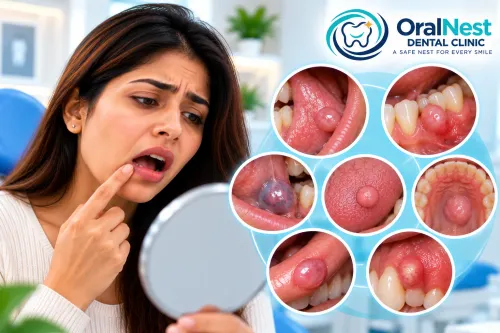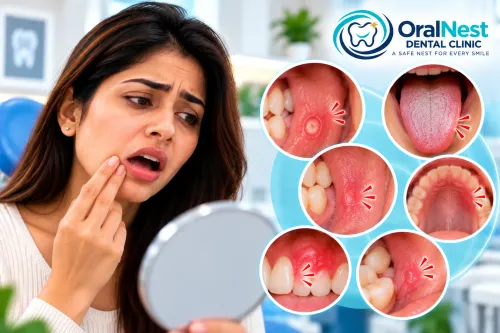
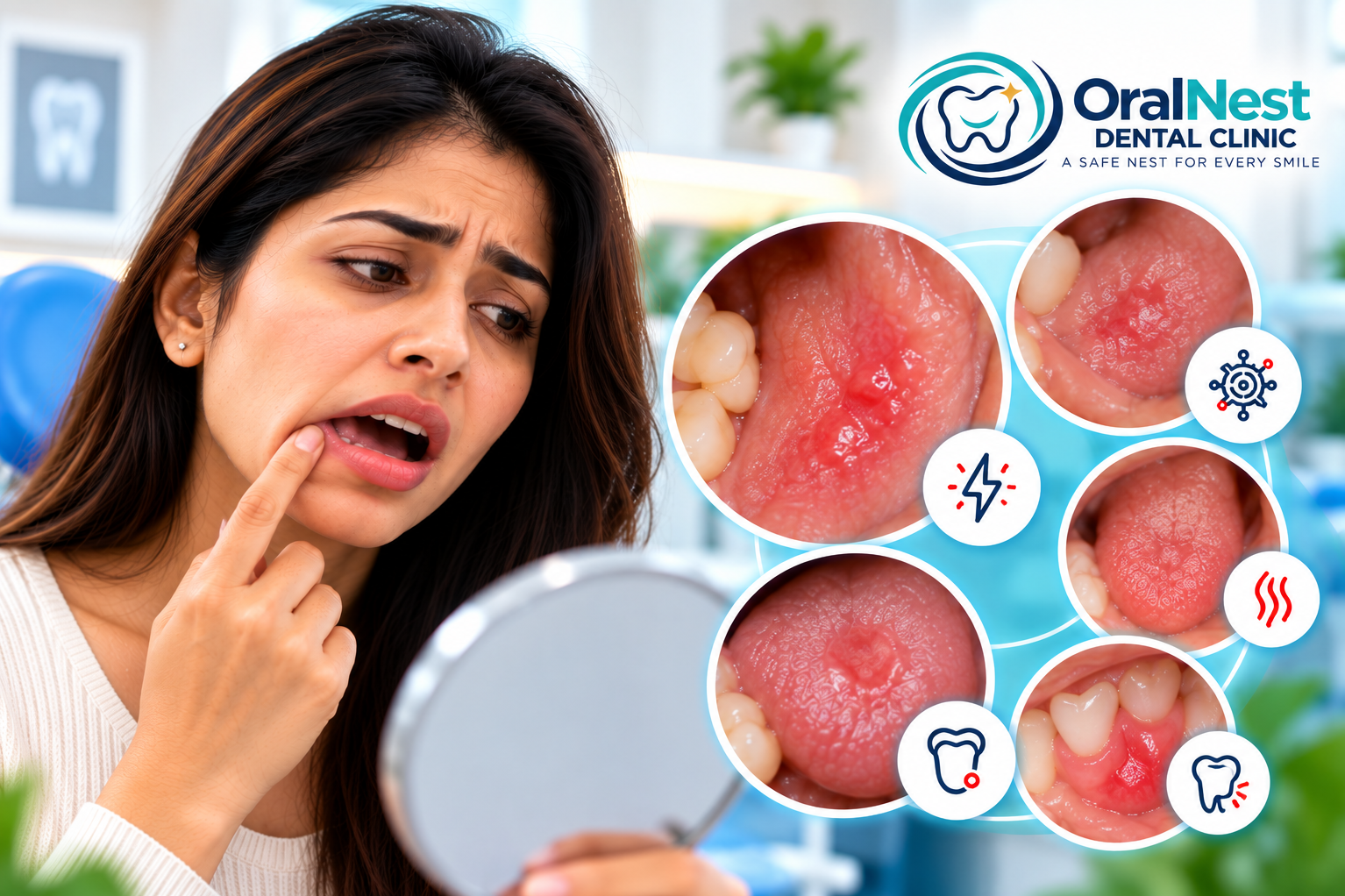
A red patch inside the mouth can be easy to overlook, especially when it is painless. It may appear on the cheek, tongue, gums, palate or another part of the oral lining and may be noticed accidentally while brushing or eating.
Sometimes a red area is simply the result of irritation, inflammation or minor trauma.
But a persistent or unexplained red patch should not be diagnosed by appearance alone.
The important question is:
“Why has this area become red, and does it need further evaluation?”
What does a red patch inside the mouth mean?
Redness generally indicates that the underlying oral tissue has changed in some way.
Possible explanations include:
accidental biting or trauma
irritation from a sharp tooth
inflammation
infection
burning or chemical irritation
certain oral mucosal conditions
nutritional or systemic factors
persistent tissue changes requiring further investigation
The appearance alone cannot reliably distinguish between these possibilities.
That is why the location, duration, texture, symptoms and behaviour of the lesion matter.
Can biting or trauma cause a red patch?
Yes.
A person may accidentally bite the cheek or tongue, eat very hot food, or repeatedly rub an area against a sharp tooth or rough dental restoration.
This can cause redness, soreness or an irritated patch.
In many situations, the tissue improves after the source of trauma is removed and the area is allowed to heal.
However, if the red patch does not settle after the suspected cause has been removed, it deserves another look.
Persistent irritation should not automatically be assumed to be the entire explanation.
Can a mouth infection cause redness?
Yes.
Several types of oral infection can produce red or inflamed areas.
For example, some fungal infections may produce red, tender tissue, sometimes alongside white patches or coating.
Other infections can produce localized inflammation.
The important point is that redness itself does not identify the infection.
Treatment should therefore be based on the clinical findings rather than simply assuming that every red patch needs an antimicrobial or antifungal medicine.
What is an erythematous oral lesion?
In clinical language, an area that appears unusually red may be described as an erythematous lesion.
This is a description—not a final diagnosis.
Some persistent red oral lesions require particular attention because certain tissue changes can present predominantly as redness rather than as a white patch.
One clinical term that may be encountered is erythroplakia, which refers to a distinct red patch that cannot be explained clinically as another condition.
This does not mean that every red patch is erythroplakia or cancer.
It means that certain persistent unexplained red lesions should be assessed carefully because their clinical significance can differ from ordinary temporary irritation.
Why can a red patch sometimes matter more than a white patch?
Patients often associate white patches with oral problems and assume that a red patch is simply inflammation.
But colour alone does not determine significance.
Some persistent red lesions may require more careful investigation because they can represent changes within the oral mucosa rather than simple surface coating.
This is one reason oral diagnosis focuses on:
What is the lesion?
rather than simply:
What colour is it?
Can a red patch be caused by spicy or acidic foods?
Yes.
Some foods can temporarily irritate sensitive oral tissues, particularly when the mucosa is already inflamed or injured.
A person may notice burning, redness or discomfort after consuming very spicy, acidic or otherwise irritating foods.
If the change resolves after the trigger is removed, that information can be useful.
But persistent redness should not automatically be attributed to diet.
If the area remains unchanged, repeatedly returns or develops other features, an oral examination may be appropriate.
What if the red patch does not hurt?
This is important.
A lack of pain does not prove that an oral lesion is harmless.
Some oral changes are completely asymptomatic and may only be discovered during routine examination.
Therefore, a painless red patch that persists should not be ignored simply because it does not cause discomfort.
Duration and appearance can be clinically important even when symptoms are absent.
Can a red patch occur because of dentures or dental appliances?
Yes.
Repeated friction or pressure from dentures, retainers, orthodontic appliances or other dental devices can irritate the oral tissues.
The location of the redness may correspond to the area of contact.
If the appliance is responsible, correcting the source of irritation may allow the tissue to recover.
However, persistent redness after the suspected irritation has been addressed may require further assessment.
What if a red patch keeps returning?
Recurrence is useful information.
A repeatedly appearing lesion may be associated with:
recurring trauma
dietary triggers
inflammatory conditions
infections
oral habits
systemic factors
specific mucosal disorders
Instead of repeatedly treating the visible redness, it is better to understand why the same area keeps changing.
Keeping track of when it appears, how long it lasts and what symptoms accompany it can help during consultation.
When should a red patch inside the mouth be checked?
Consider an oral examination when a red area:
persists without an obvious explanation
does not improve after removing a suspected irritant
repeatedly returns
becomes larger
changes in texture
bleeds
becomes painful or develops burning
occurs alongside a white patch
feels unusually firm or thickened
appears without any known injury
is associated with difficulty eating or swallowing
remains present despite normal oral care
A persistent lesion does not automatically mean something serious.
It means that its cause should be established rather than assumed.
Does every red patch need a biopsy?
No.
A biopsy is not automatically required whenever a red area is seen.
The decision depends on the clinical assessment.
If the appearance is clearly consistent with a temporary traumatic or inflammatory cause and the area resolves appropriately, further investigation may not be necessary.
If a lesion remains unexplained, persistent or clinically concerning, tissue sampling may sometimes be recommended.
The purpose is to obtain diagnostic information—not to assume the worst.
Why photographs from the internet can be misleading
Searching images online can create unnecessary anxiety because many different oral conditions can look similar.
At the same time, photographs may not show:
the complete lesion
its texture
whether it is soft or firm
how long it has been present
whether it changes
surrounding tissue
relevant medical or dental history
Two lesions that look similar in a photograph may therefore have very different clinical explanations.
A proper oral examination provides context that a photograph cannot.
What happens during an oral diagnosis?
An oral evaluation usually starts with the history.
You may be asked:
When did you first notice the red patch?
Has it changed in size or appearance?
Was there an injury or source of irritation?
Does it hurt, burn or bleed?
Does it come and go?
Have you noticed a similar change elsewhere?
Do you use tobacco or other oral products?
Have you recently started any medications?
The lesion is then examined carefully.
Its location, size, colour, borders, surface characteristics and relationship with surrounding tissues can all contribute to the clinical assessment.
Additional investigations are considered only when appropriate.
Red patch vs temporary redness
Not every red area is a lesion requiring extensive investigation.
For example, temporary redness after biting the cheek or burning the mouth with hot food may naturally improve as the tissue heals.
The important distinction is persistence without a clear explanation.
A short-lived change that resolves normally is different from an unexplained area that remains for weeks or repeatedly returns.
That is why observing the course of the lesion can be as important as observing its colour.
The right response is neither panic nor neglect
Seeing a red patch inside the mouth can understandably create worry.
But the most useful response is neither:
“It must be something serious.”
nor:
“It is probably nothing.”
The better question is:
“What is causing it?”
Once the cause is understood, the appropriate next step becomes much clearer.
This is the essence of diagnosis-focused oral care.
Oral Medicine & Oral Diagnosis at OralNest Dental Clinic | Wakad
Persistent red patches and unexplained changes in the oral lining fall within the broader field of oral medicine and oral diagnosis.
At OralNest Dental Clinic | Wakad, the approach begins with understanding the patient's concern, examining the lesion carefully and considering relevant dental, medical and habit-related factors before deciding whether treatment or further investigation is appropriate.
The goal is not to label every unusual-looking area as a disease.
It is to recognise what is normal, identify what is explainable, and investigate what remains unexplained.
For patients from Wakad and nearby areas including Hinjawadi, Tathawade, Punawale, Pimple Saudagar, Pimple Gurav and Rahatani, persistent or unexplained oral changes can be evaluated through a structured oral diagnosis.
Clinic Timings
Monday–Saturday: 5:30 PM–9:00 PM
Sunday: 10:00 AM–1:00 PM
Prior appointment is convenient.
At OralNest Dental Clinic | Wakad
Understand First. Diagnose Carefully. Decide With Clarity.
Keywords