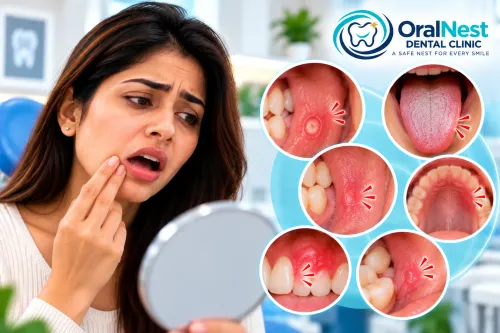
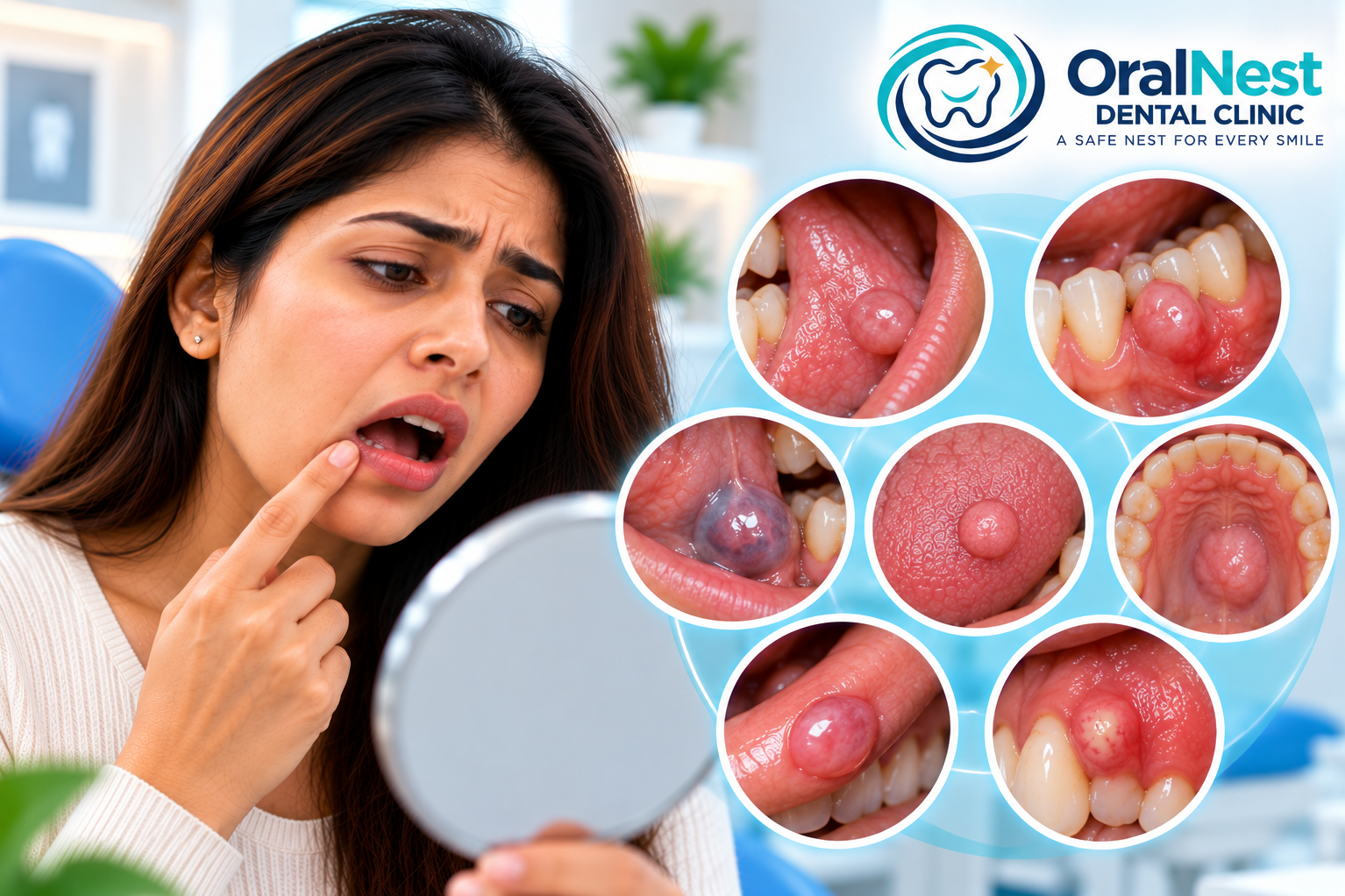
Finding a lump inside the mouth can immediately create concern.
It may be noticed while brushing, eating, touching the cheek with the tongue, or simply looking in the mirror. Sometimes it is small and painless. Sometimes it is tender. It may feel soft, firm, movable or fixed.
The important point is that “lump” describes what you can feel or see—it does not tell you what the lump is.
Many oral lumps are caused by relatively simple conditions. Others may require closer evaluation.
So the useful first question is not:
“Is this dangerous?”
It is:
“What is causing this lump?”
Where can a lump occur inside the mouth?
An unexplained lump can appear in many locations, including:
inside the cheek
gums
tongue
underneath the tongue
palate
lips
around a tooth
near a salivary gland opening
the floor of the mouth
areas around partially erupted teeth
The location itself can provide important clues.
For example, a swelling near a tooth may have a completely different explanation from a lump occurring in the cheek or underneath the tongue.
This is why the exact location should be identified before drawing conclusions.
What are some common causes of a lump in the mouth?
There are many possibilities.
A lump may be associated with:
accidental trauma
repeated cheek or lip biting
irritation from a tooth
an inflammatory response
a dental infection
a blocked or altered salivary gland
a benign soft-tissue growth
a cyst
enlargement of normal tissue
an oral mucosal condition
other less common causes requiring investigation
The appearance of a lump alone cannot reliably distinguish between these possibilities.
Can repeatedly biting the cheek create a lump?
Yes.
Repeated trauma can produce local swelling or thickening.
Some people also develop a small, smooth area of thickened tissue because they repeatedly bite or chew the same part of the cheek.
The patient may notice:
“There is something there, and I keep biting it.”
This can create a cycle where the swelling makes the area easier to bite, and repeated biting maintains the irritation.
If the suspected source of trauma is removed and the tissue improves, that can support a local traumatic explanation.
But a lump that persists despite removing the suspected irritant deserves reassessment.
Can a dental infection cause a lump?
Yes.
A swelling near a tooth can sometimes be related to infection arising from the tooth or surrounding tissues.
Patients may describe it as:
a small bump on the gum
a pimple-like swelling
a tender area
a recurring swelling that occasionally drains
A dental infection may not always produce severe tooth pain.
This is important because the absence of significant pain does not necessarily exclude a dental source.
If a lump is located near a tooth, the tooth and surrounding structures should be evaluated rather than treating the swelling alone.
What about a lump on the gum?
A gum swelling can have several possible causes.
It may be related to:
local irritation
periodontal inflammation
an infection
a tooth-related problem
trauma
an eruption-related process
a soft-tissue growth
The appearance and location matter.
For example, a swelling around a partially erupted wisdom tooth may have a different explanation from a swelling that develops beside a heavily restored tooth.
A clinical examination helps determine whether the source is the gum, tooth or surrounding tissue.
Can salivary glands cause a lump?
Yes.
The mouth contains several major and minor salivary glands.
Changes involving saliva flow can sometimes produce swelling or a lump.
One example is a mucocele, a mucus-filled swelling that can occur when a minor salivary gland duct is injured or blocked. These commonly occur on the lower lip and may appear as a soft, sometimes bluish or translucent swelling.
Other salivary-related swellings can occur in different areas of the mouth.
The location, consistency and history of the swelling help determine whether a salivary origin is likely.
What if the lump is painless?
A painless lump should not automatically be considered harmless.
Many benign oral growths and other tissue changes may produce little or no discomfort.
At the same time, the absence of pain does not mean that a lesion is necessarily concerning.
The important factors include:
how long it has been present
whether it is growing
whether its surface is changing
whether it is firm or soft
whether it is fixed or movable
whether it bleeds
whether there are associated colour changes
whether there are other symptoms
Pain is only one part of the clinical picture.
What if the lump is growing?
A lump that is clearly increasing in size deserves evaluation.
Growth does not automatically mean that the lesion is dangerous.
Some benign conditions can enlarge.
However, a change in size is an important clinical observation and can help determine whether further investigation is appropriate.
If you notice that a previously stable lump is becoming larger, do not rely only on home observation.
What if the lump comes and goes?
A swelling that repeatedly appears and disappears can provide useful diagnostic information.
Possible explanations can include:
salivary duct-related changes
recurrent inflammation
intermittent irritation
dental infection with periodic drainage
trauma
other local processes
The timing can be particularly useful.
For example:
Does it appear during meals?
Does it become larger and then reduce?
Does it recur in exactly the same location?
Does it change after biting or chewing?
These details can help guide the evaluation.
Can a lump be related to a wisdom tooth?
Yes.
A partially erupted wisdom tooth can sometimes be associated with swelling of the surrounding gum.
Food accumulation, local inflammation and difficulty cleaning the area may contribute.
However, not every swelling at the back of the mouth is caused by a wisdom tooth.
The position of the tooth, surrounding gum and adjacent structures should be assessed before deciding on treatment.
What if the lump is under the tongue?
The floor of the mouth contains important anatomical structures, including salivary glands and ducts.
A lump under the tongue can therefore have several possible causes.
Because this area contains important structures and because different conditions can produce similar-looking swellings, unexplained lumps in the floor of the mouth deserve appropriate clinical assessment.
This is especially relevant if the swelling changes with eating, persists, enlarges or is associated with other symptoms.
What if the lump is hard?
The consistency of a lump can provide useful information.
A clinician may assess whether it feels:
soft
firm
fluctuant
rubbery
hard
movable
fixed
But consistency alone does not establish a diagnosis.
A hard lump can have several possible explanations, including normal anatomical structures, bone-related changes, benign growths or other conditions.
That is why examination involves more than simply asking whether the lump feels hard.
What if there is a lump with a red or white patch?
A lump accompanied by a persistent red, white or mixed-colour change may require closer evaluation.
The combination of:
swelling + tissue colour change
can provide more information than either finding alone.
This does not mean that such a combination automatically indicates a serious condition.
It means that the clinical picture is more complex and should be assessed rather than repeatedly self-treated.
When should an unexplained oral lump be checked?
Consider an oral examination if a lump:
persists without an obvious explanation
continues to grow
repeatedly returns
becomes firm or fixed
bleeds
develops a red or white surface change
becomes painful
causes difficulty chewing
interferes with swallowing or speech
is associated with unexplained numbness
is accompanied by persistent ulceration
does not improve after removing an obvious source of irritation
A short-lived swelling after an obvious injury may simply require observation.
But an unexplained or persistent lump deserves an explanation.
Does every oral lump require a biopsy?
No.
Biopsy is not automatically necessary for every swelling.
The decision depends on the clinical findings and the level of diagnostic certainty.
Some lumps can be identified clinically or managed by addressing the obvious cause.
Others may require imaging, laboratory investigation, referral or tissue sampling.
If tissue sampling is recommended, the purpose is to obtain a more definitive diagnosis.
It should not be interpreted automatically as an indication that something serious has been found.
Why should you avoid squeezing or repeatedly touching the lump?
Repeatedly pressing, squeezing or scratching an oral swelling can irritate the surrounding tissue.
It can also make it more difficult to determine how the lesion naturally behaves.
If the lump changes, it is more useful to observe:
its size
location
duration
colour
tenderness
relation to eating or chewing
whether it changes over time
If possible, noting when you first discovered it can also help during consultation.
What does a diagnosis-focused examination involve?
An oral evaluation may include examination of:
The lump itself
Its size, location, surface, colour, consistency and mobility.
Surrounding tissues
The cheek, tongue, gums, palate and nearby structures may provide additional clues.
Teeth
A nearby tooth may sometimes be responsible for an inflammatory or infectious swelling.
Salivary structures
This becomes particularly relevant when the swelling changes with eating or is located near a salivary gland or duct.
Medical and dental history
Previous dental treatment, medications, habits, trauma and other relevant factors can influence the diagnostic possibilities.
Additional investigations are considered when the clinical findings indicate that they would provide useful information.
Why diagnosis should come before treatment
A lump is not a diagnosis.
Therefore, treatment should not automatically be based on its appearance.
For example:
A swelling caused by trauma
may require removal of the source of irritation.
A tooth-related swelling
may require treatment of the underlying tooth.
A salivary-related swelling
may require a different approach altogether.
A persistent unexplained lesion
may require further investigation.
The treatment makes sense only after the underlying cause has been understood.
Don't panic—but don't ignore it either
Discovering a lump inside the mouth can be frightening.
But the appropriate response is not to assume the worst.
It is also not to ignore it indefinitely.
A practical approach is:
Notice it → observe its behaviour → identify possible causes → seek evaluation if it persists or is unexplained.
This allows common, manageable causes to be recognised while persistent abnormalities receive the attention they deserve.
Oral Medicine & Oral Diagnosis at OralNest Dental Clinic | Wakad
At OralNest Dental Clinic | Wakad, an unexplained oral lump is approached by first identifying where it is, how it behaves and which structures could be contributing to it.
The examination considers the oral tissues, teeth, gums, salivary structures and relevant clinical history before deciding whether the swelling can be clinically explained or requires further investigation.
The objective is not to assume that every lump is serious.
It is to avoid assuming that every lump is harmless.
Understand the finding first. Then decide what it needs.
For patients from Wakad and nearby areas including Hinjawadi, Tathawade, Punawale, Pimple Saudagar, Pimple Gurav and Rahatani, persistent or unexplained oral swellings can be evaluated through a structured oral diagnosis.
Clinic Timings
Monday–Saturday: 5:30 PM–9:00 PM
Sunday: 10:00 AM–1:00 PM
Prior appointment is convenient.
At OralNest Dental Clinic | Wakad
Understand First. Diagnose Carefully. Decide With Clarity.
Keywords