Not every toothache requires an emergency visit—but persistent or changing pain should not be ignored.
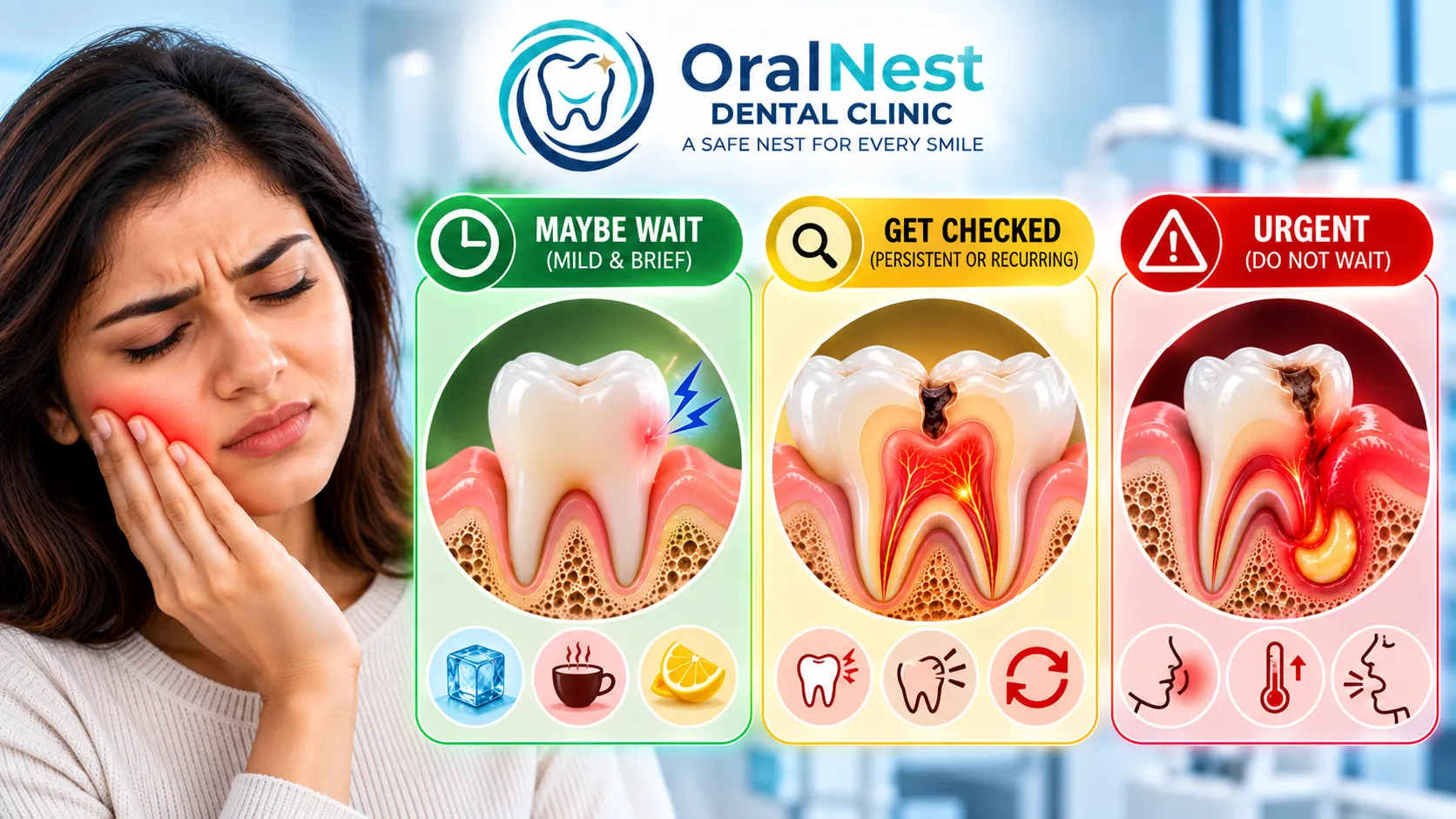
Mild, brief sensitivity that occurs only with a specific trigger and disappears quickly may sometimes be monitored, particularly if it is not recurring. However, pain that repeatedly returns, lasts longer, occurs spontaneously, or is associated with biting discomfort deserves a dental evaluation.
Certain symptoms require more urgent attention. Facial or gum swelling, fever, rapidly increasing pain, difficulty opening the mouth, or difficulty swallowing or breathing can indicate a more serious infection and should not be managed by simply waiting for the pain to settle.
The most important point is that pain intensity does not always reflect the seriousness of the underlying problem. A relatively mild toothache can still have a significant cause, while severe pain may sometimes have a more straightforward explanation.
If you are unsure, an examination can help determine whether the tooth needs observation, further investigation or timely treatment.
Do not judge a tooth only by how much it hurts. Understand what is causing the pain.
Content Written & Clinically Reviewed by
Dr. Ashutosh Dighe
BDS | MDS – Oral Medicine & Maxillofacial Radiology | PhD Scholar | Fellowship in Contemporary Endodontics | Certified Endodontist
OralNest DENTAL CLINIC
A SAFE NEST FOR EVERY SMILE
Mild, brief sensitivity that occurs only with a specific trigger and disappears quickly may sometimes be monitored, particularly if it is not recurring. However, pain that repeatedly returns, lasts longer, occurs spontaneously, or is associated with biting discomfort deserves a dental evaluation.
Certain symptoms require more urgent attention. Facial or gum swelling, fever, rapidly increasing pain, difficulty opening the mouth, or difficulty swallowing or breathing can indicate a more serious infection and should not be managed by simply waiting for the pain to settle.
The most important point is that pain intensity does not always reflect the seriousness of the underlying problem. A relatively mild toothache can still have a significant cause, while severe pain may sometimes have a more straightforward explanation.
If you are unsure, an examination can help determine whether the tooth needs observation, further investigation or timely treatment.
Do not judge a tooth only by how much it hurts. Understand what is causing the pain.
Content Written & Clinically Reviewed by
Dr. Ashutosh Dighe
BDS | MDS – Oral Medicine & Maxillofacial Radiology | PhD Scholar | Fellowship in Contemporary Endodontics | Certified Endodontist
OralNest DENTAL CLINIC
A SAFE NEST FOR EVERY SMILE
Keywords