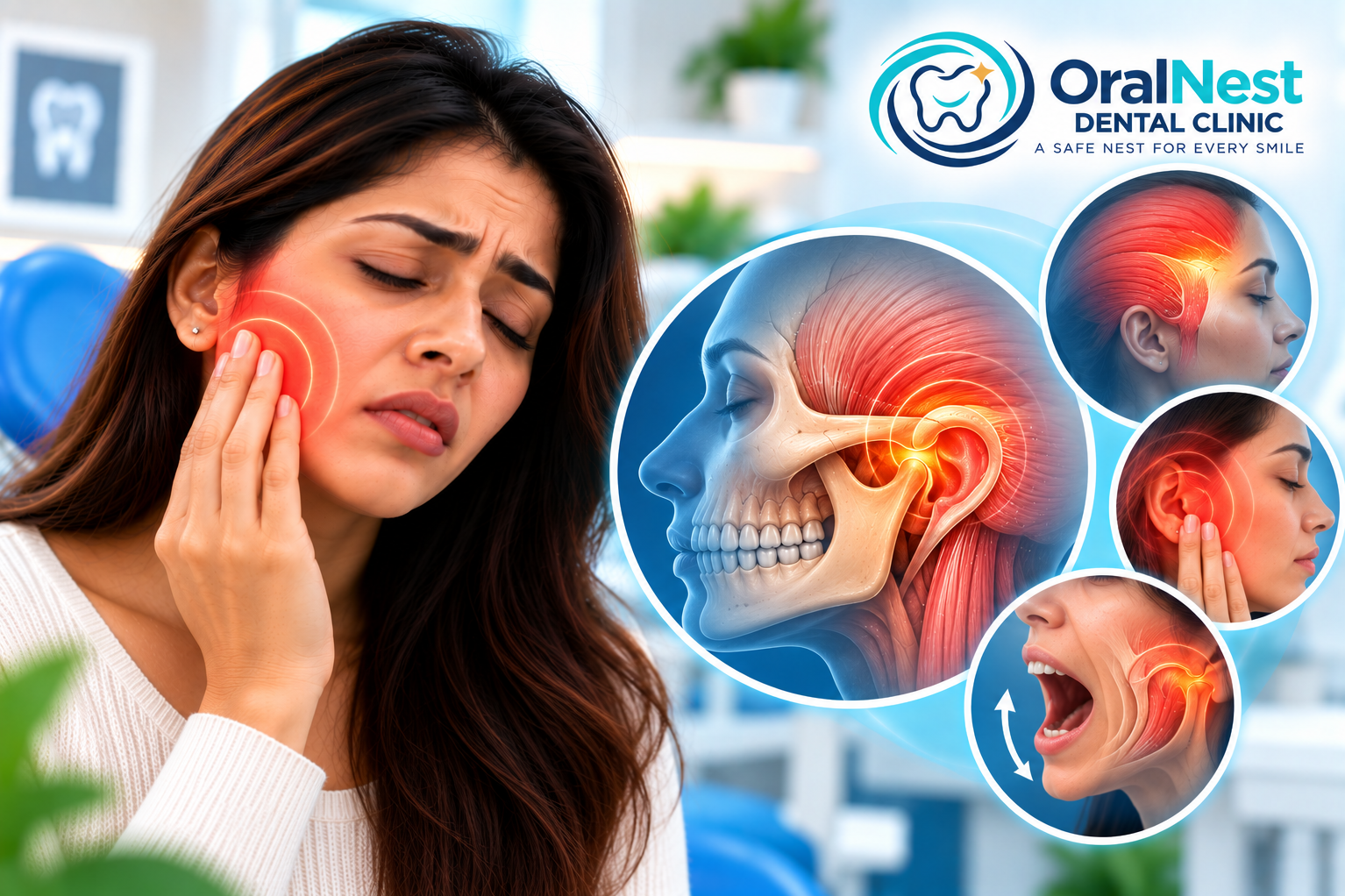
Jaw pain is often casually called a “TMJ problem.” But clinically, the situation can be much more complex.
The temporomandibular joints (TMJs) connect the lower jaw to the skull, allowing us to open the mouth, chew, speak and move the jaw. Temporomandibular disorders (TMDs) are not one single disease; they represent a group of conditions affecting the jaw joints, chewing muscles and related structures. Current evidence recognises more than 30 different TMD conditions.
This distinction matters because jaw pain is a symptom, not a diagnosis.
What Are TMJ Disorders?
The term TMJ refers to the joint itself.
TMD refers to disorders involving the TMJ, the muscles that control jaw movement, or both.
Broadly, TMDs may involve:
The jaw joint and its internal structures
The muscles used for chewing
Inflammatory or degenerative joint conditions
Headaches associated with TMD
A combination of more than one problem
One person may therefore experience clicking without significant pain, while another may have muscle tenderness, restricted opening, joint pain or locking.
This is why two patients describing their problem as “TMJ pain” may actually have very different clinical conditions.
What Does TMJ-Related Pain Feel Like?
Patients may experience:
Pain in front of or around the ear
Jaw joint tenderness
Cheek or chewing-muscle pain
Pain while chewing
Jaw stiffness
Difficulty opening the mouth
Jaw locking
Painful clicking or popping
Pain extending toward the temple, face or neck
Headaches associated with jaw symptoms
Changes in how the upper and lower teeth meet
Some patients may also report ear-related symptoms such as ringing or dizziness. However, these symptoms do not automatically mean that the TMJ is the cause.
Does Every Jaw Click Mean You Have a TMJ Disorder?
No.
Clicking or popping sounds from the jaw joint can occur without pain and are relatively common. When a joint sound occurs without pain or functional difficulty, it does not necessarily require treatment.
The more important questions are:
Is there pain?
Is jaw movement becoming restricted?
Is the jaw locking?
Is chewing becoming difficult?
Is the symptom changing or worsening?
The answers can make a significant difference in determining whether further evaluation is appropriate.
Why Is TMJ Diagnosis Sometimes Difficult?
There is no single universally accepted test that can diagnose every TMD.
Diagnosis usually begins with understanding the patient's history and symptoms, followed by a clinical examination of the jaw, face, muscles and surrounding structures. Depending on the findings, imaging such as radiographs, CT or MRI may sometimes be considered.
This is particularly important because pain in the jaw, face or mouth may have causes other than TMD.
For example, dental conditions, muscle-related pain and other orofacial conditions can produce overlapping symptoms.
Therefore, simply identifying the location of pain is not always enough.
What Is Orofacial Pain?
Orofacial pain is a broader clinical area involving pain affecting the mouth, jaw, face and related structures.
TMJ disorders can form one part of this larger picture.
A patient with facial pain may therefore need an evaluation that considers:
Teeth → gums → jaw muscles → TMJ → oral tissues → facial pain patterns → associated symptoms
This broader perspective can be particularly useful when the patient's symptoms do not fit a straightforward dental problem.
Can Stress or Clenching Be Related to Jaw Problems?
Jaw clenching, teeth grinding and other repetitive jaw behaviours may contribute to symptoms in some patients.
However, TMD is not necessarily caused by one single factor. Current understanding points toward a combination of biological, psychological and environmental influences, with considerable variation between patients.
This is another reason why assuming that every jaw problem is caused by “stress” or “grinding” can oversimplify the situation.
The patient's actual symptoms and clinical findings should guide the assessment.
Does Every TMJ Problem Need Treatment?
No.
Many TMD symptoms are temporary and may improve without extensive treatment. Current guidance generally supports beginning with conservative and reversible approaches when appropriate rather than immediately moving toward irreversible procedures.
Depending on the diagnosis, management may include:
Self-care and habit modification
Temporary dietary modification
Jaw exercises
Physical therapy
Pain management
Behavioural approaches
Selected oral appliances
Other treatment when a specific condition requires it
More invasive procedures are generally considered only when clinically indicated and after simpler approaches have been appropriately considered.
Why Should You Avoid Choosing Treatment Before Diagnosis?
One of the most important principles in managing jaw pain is:
The treatment should follow the diagnosis—not replace it.
For example, permanently changing the bite, extensive dental reconstruction or surgical procedures should not automatically be considered simply because a patient has jaw pain.
NIDCR specifically advises discussing simpler alternatives and the potential benefits, risks and alternatives before irreversible procedures are considered.
This makes a properly structured evaluation particularly important.
When Should Jaw or Facial Pain Be Evaluated?
Consider professional evaluation when you experience:
Persistent or recurring jaw pain
Pain while chewing
Painful clicking or popping
Restricted mouth opening
Jaw locking
Recurrent headaches associated with jaw symptoms
Facial or cheek pain without an obvious cause
Ear-area pain associated with jaw movement
Difficulty eating because of jaw discomfort
A noticeable change in jaw movement or bite
The purpose of evaluation is not simply to label the problem as “TMJ.”
It is to understand what structure may be involved and whether the symptoms actually fit a TMD or another orofacial condition.
How Dr. Ashutosh Dighe Approaches TMJ & Orofacial Pain
At OralNest Dental Clinic | Wakad, TMJ and orofacial pain are approached from a diagnostic perspective.
Dr. Ashutosh Dighe — BDS, MDS – Oral Medicine & Maxillofacial Radiology, PhD Scholar, Fellowship in Contemporary Endodontics, and Certified Endodontist — evaluates jaw, facial and oral symptoms by considering the patient's history, clinical findings and, when indicated, appropriate radiographic evaluation.
His background in Oral Medicine & Maxillofacial Radiology is particularly relevant when a patient's symptoms extend beyond a straightforward tooth-related complaint.
The objective is not to assume that every jaw pain is a TMJ disorder.
It is to determine:
What is the patient experiencing?
Where may the pain be originating?
What clinical findings support that possibility?
Is imaging or further evaluation necessary?
What treatment, if any, is appropriate?
That sequence can help patients understand their condition before making decisions about treatment.
TMJ Problems Are Not Always About the Joint
This is perhaps the most important concept for a patient to understand.
Jaw pain does not automatically mean joint damage.
Clicking does not automatically mean disease.
Facial pain does not automatically mean a dental problem.
And a diagnosis of TMD does not automatically mean surgery or extensive dental treatment.
TMD represents a broad group of conditions, and treatment needs to correspond to the specific clinical situation.
For someone experiencing unexplained jaw or facial pain in Wakad, the first meaningful step may therefore be a careful diagnosis rather than immediately choosing a treatment.
Frequently Asked Questions
Is TMJ the same as TMD?
No. TMJ refers to the temporomandibular joint. TMD refers to disorders affecting the joint, chewing muscles or related structures.
Is jaw clicking always abnormal?
No. Clicking without pain or functional problems can be common and may not require treatment.
Can TMJ problems cause headaches?
Certain headache patterns can be associated with TMD, but not every headache originates from the jaw. A proper evaluation is important.
Can jaw pain come from a tooth?
Yes. Dental and non-dental conditions can produce overlapping jaw or facial pain, which is why the source should be assessed rather than assumed.
Does every TMD require surgery?
No. Many TMD problems are managed conservatively, and invasive treatment is generally reserved for selected situations.
Where can I get TMJ and orofacial pain consultation in Wakad?
Patients in Wakad, Kaspate Wasti, Pimple Saudagar, Rahatani, Pimple Gurav, Hinjawadi, Tathawade and nearby areas of Pune can seek a structured dental evaluation when jaw or facial pain persists or interferes with daily activities.
At OralNest Dental Clinic | Wakad
Understand First. Diagnose Carefully. Decide With Clarity.
Mon–Sat: 5:30 PM–9:00 PM
Sunday: 10:00 AM–1:00 PM
Prior appointment is convenient.
Keywords