Root Canal Treatment in Wakad, Pune: A Diagnosis-First Approach to Saving a Natural Tooth
A tooth starts hurting. You search “root canal treatment near me”. Within minutes, you may find dozens of clinics offering root canals with different prices, techniques and promises.
But before asking “Where should I get a root canal?”, there is a more important question:
“Does this tooth actually need a root canal—and can it be predictably saved?”
That is where good endodontic care begins.
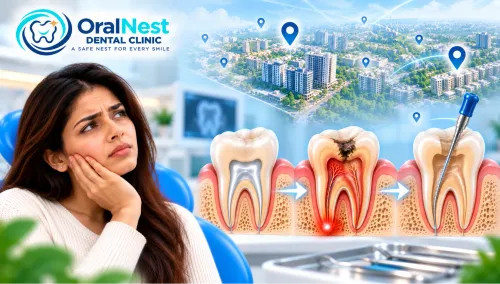
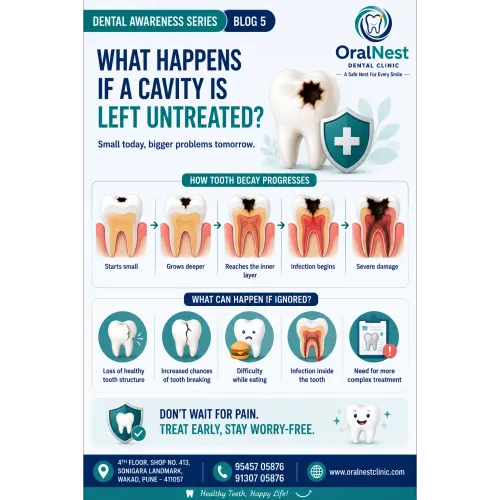
Root canal treatment is performed when the pulp—the living tissue inside a tooth—becomes inflamed or infected. Deep decay, cracks, trauma, repeated dental procedures and problems beneath existing restorations can all contribute to pulpal disease. If the affected pulp is not appropriately treated, infection may progress and an abscess can develop.
At OralNest Dental Clinic | Wakad, Root Canal Treatment is approached as a diagnostic and tooth-preservation decision, rather than simply a procedure to be performed whenever a tooth hurts.
Does Every Toothache Need a Root Canal?
No.
This is one of the most important things a patient should understand.
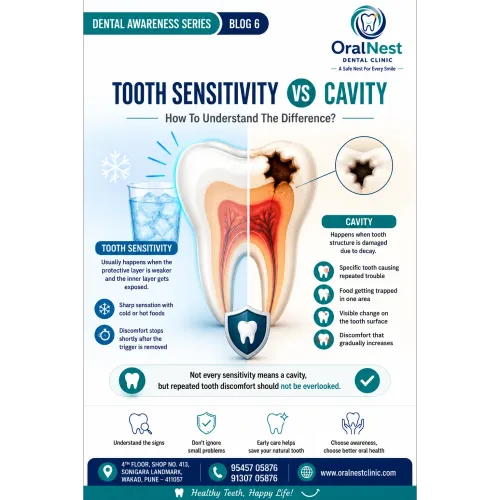
Tooth pain can originate from several different problems. A deep cavity may involve the pulp, but pain can also be related to a crack, trauma, exposed dentin, periodontal problems, an occlusal issue, a neighbouring tooth or other sources of oral and facial pain.
Even the intensity of pain does not always tell you how serious the underlying condition is.
Some teeth with significant pulpal disease can produce surprisingly little pain. Conversely, a very painful tooth does not automatically mean that root canal treatment is required.
Therefore, treatment should follow diagnosis—not the other way around.
What Does Root Canal Treatment Actually Do?
Inside a healthy tooth is a soft tissue called the pulp, containing nerves, blood vessels and connective tissue.
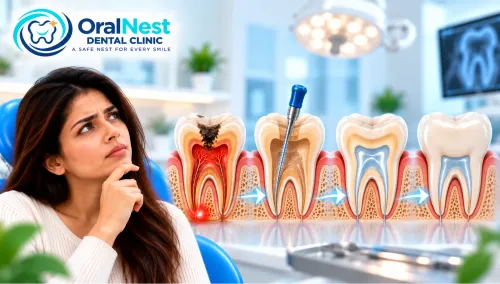
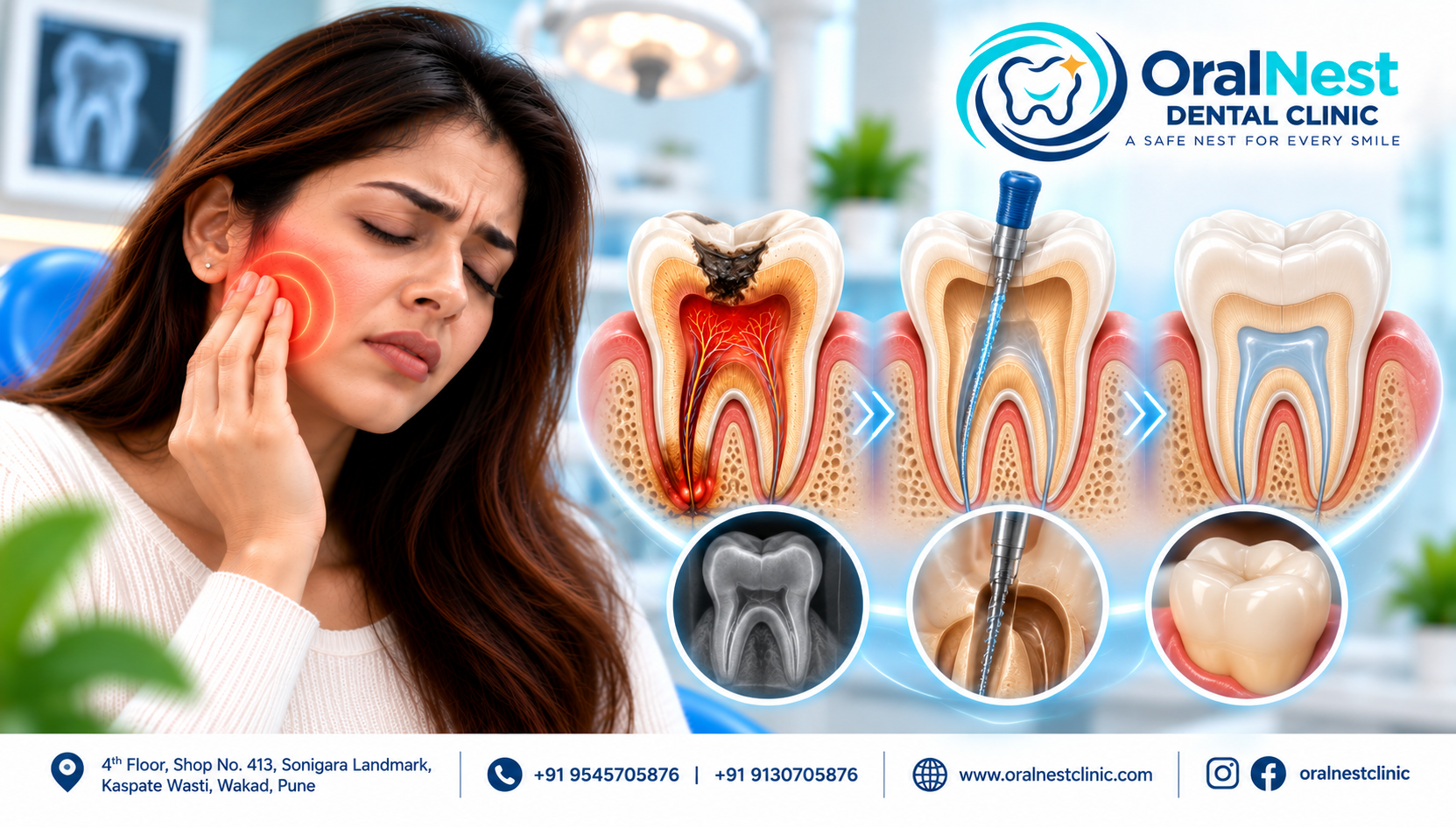
When the pulp becomes irreversibly inflamed or infected, root canal treatment removes the affected tissue, cleans and disinfects the internal canal system, and then fills and seals it. The tooth is subsequently restored so that it can return to function.
The objective is therefore not simply:
“Remove the nerve.”
The broader objective is:
Control the disease inside the tooth while preserving the natural tooth whenever predictable restoration is possible.
That distinction changes how the entire treatment should be planned.
When Might a Tooth Need Root Canal Treatment?
Root canal treatment may be considered when examination and diagnostic findings indicate significant pulpal disease or infection.
Possible symptoms include:
lingering sensitivity to hot or cold
spontaneous toothache
pain while biting or chewing
recurring tooth pain
tenderness around a particular tooth
swelling around the tooth or gum
a recurring pimple or draining point on the gum
deep decay
a cracked or fractured tooth
trauma to a tooth
discoloration associated with previous injury
However, these symptoms are not a diagnosis by themselves.
A proper evaluation is required to determine which tooth is responsible and what is actually happening.
The American Association of Endodontists specifically notes that ongoing tooth pain, sensitivity, swelling, cracks and traumatic injuries warrant dental assessment, while endodontic diagnosis considers the individual case and available treatment options.
Why Diagnosis Comes Before Root Canal Treatment
Imagine two patients arriving with the same complaint:
“My tooth hurts when I bite.”
One may have a cracked tooth.
Another may have pulpal disease.
Another may have a periodontal problem.
Another may have pain referred from a different tooth.
The symptom is similar.
The treatment may be completely different.
This is why a diagnosis-first approach asks:
Which tooth is causing the problem?
What tissue is affected?
Is the pulp inflamed or infected?
Is there evidence of disease around the root?
Is the tooth structurally restorable?
Can the tooth be predictably maintained after treatment?
Only after these questions are considered does the treatment decision become meaningful.
What Happens During a Root Canal Evaluation?
A root canal consultation is more than simply looking at the cavity.
1. Your Pain History Is Understood
The timing and behaviour of your symptoms can provide important clues.
You may be asked:
When did the pain begin?
Is it continuous or intermittent?
Does hot or cold trigger it?
How long does the pain remain after the stimulus?
Does biting cause pain?
Does the tooth hurt spontaneously?
Does the pain disturb sleep?
Have you already taken medication?
Has the tooth received previous treatment?
These details help build the diagnostic picture.
2. The Suspected Tooth Is Examined
Clinical examination can include assessment of the tooth, surrounding tissues and neighbouring teeth.
Depending on the case, the clinician may evaluate responses to thermal stimuli, percussion, palpation and biting.
The purpose is not simply to confirm that “something hurts.”
It is to determine which tooth and which tissues are actually involved.
3. Dental Imaging Is Used When It Adds Diagnostic Information
An X-ray or other imaging does not replace clinical examination.
It complements it.
Radiographs can help reveal information about:
the depth and extent of decay
root anatomy
bone surrounding the tooth
previous root canal treatment
changes around the root
anatomical complexity
In selected cases, additional three-dimensional imaging may be appropriate when conventional information is insufficient for the clinical question.
The principle should be simple:
The scan should answer a question—not simply become part of a routine package.
Can a Tooth Be Saved Instead of Extracted?
Whenever reasonably possible, preserving a natural tooth is an important treatment consideration.
A natural tooth provides function, sensation and a biological relationship with the surrounding tissues that cannot simply be duplicated by an artificial replacement.
The American Association of Endodontists describes endodontic treatment as a way to preserve natural teeth when disease or infection affects the pulp.
But there is an equally important principle:
Not every tooth is predictably restorable.
A tooth may have extensive structural destruction, an unfavorable fracture, inadequate remaining tooth structure or other factors that make long-term preservation uncertain.
In those situations, extraction may need to be discussed.
The correct goal is therefore not:
“Save every tooth at any cost.”
It is:
Preserve the natural tooth when the clinical situation gives it a reasonable and predictable chance of functioning long term.
Root Canal Treatment vs Tooth Extraction
Patients sometimes think:
“Why not simply remove the painful tooth?”
Extraction removes the immediate tooth, but it creates a missing-tooth situation.
Depending on the location and circumstances, replacement may later require an implant, bridge, removable prosthesis or another restorative solution.
That means the decision is not necessarily:
Root canal vs nothing.
It may actually be:
Preserve and restore the natural tooth
versus
Remove the tooth and plan its replacement.
This is why a treatment decision should consider the entire future of the tooth, rather than only the immediate pain.
Why Are Some Root Canals More Complex Than Others?
Not every root canal is the same.
A relatively straightforward tooth may have a simpler internal anatomy, while a molar can have multiple canals, curvature, calcification or anatomical variations.
Treatment complexity can be affected by:
number of canals
canal curvature
calcification
unusual anatomy
deep decay
previous restorations
previous root canal treatment
broken instruments
perforations
persistent infection
structural cracks or fractures
limited remaining tooth structure
This is one reason a blanket statement such as “every root canal takes the same time” does not accurately represent clinical reality.
The tooth determines much of the treatment plan.
What If I Have Already Had a Root Canal?
A previously treated tooth can sometimes develop symptoms again.
That does not automatically mean the tooth must be extracted.
The first question should be:
Why is the tooth having a problem again?
Possible causes may include:
persistent or recurrent infection
untreated or missed anatomy
inadequate previous treatment
leakage around a restoration
new decay
fracture
problems involving the surrounding tissues
Depending on the findings, treatment options may include nonsurgical retreatment, endodontic surgery, restorative treatment or extraction.
The appropriate option depends on the diagnosis and the restorability of the tooth.
Why Is the Crown or Final Restoration Important?
Root canal treatment deals primarily with the internal disease of the tooth.
The tooth still needs an appropriate final restoration.
Depending on how much tooth structure remains and which tooth is involved, this may involve a filling, onlay, crown or another restoration.
The purpose is to restore function and help protect the treated tooth from further structural damage.
So the treatment journey should not be viewed as:
Root canal → finished.
It is better understood as:
Diagnosis → Endodontic treatment when indicated → Appropriate restoration → Long-term maintenance
That is the complete tooth-preservation pathway.
Root Canal Treatment in Wakad: What Patients Should Actually Look For
If you are searching for:
Root Canal Treatment in Wakad
Root Canal Dentist in Wakad
Tooth Pain Treatment in Wakad
Endodontic Treatment near Kaspate Wasti
Root Canal near Bhumkar Chowk
Root Canal near Wakad Chowk
the most useful question is not simply:
“Who offers root canals?”
Many dental practices do.
A better question is:
“Who will first determine exactly why my tooth hurts and whether the tooth is suitable for preservation?”
That distinction becomes particularly important when the diagnosis is uncertain, the tooth has unusual anatomy, previous treatment has failed, or the structural condition of the tooth is questionable.
OralNest Dental Clinic | Wakad: Building a Diagnosis-Led Dental Identity
OralNest is located in Wakad, and Wakad remains the clinic's primary geographic identity.
The surrounding patient ecosystem is much larger than one road or one society.
Patients looking for dental care may come from different parts of Wakad and nearby western Pune and PCMC areas, including:
Wakad micro-areas
Kaspate Wasti • Vishnu Dev Nagar • Shankar Kalat Nagar • Wakad Chowk • Bhumkar Chowk • Dange Chowk • Datta Mandir Road • Mankar Chowk
Nearby growth areas
Tathawade • Punawale • Hinjawadi • Rahatani • Pimple Saudagar • Pimple Nilakh • Balewadi • Sangvi • Pimpri-Chinchwad
The website strategy should therefore not be built around repeating the same locality name dozens of times.
Instead, each area should gradually become associated with useful, original answers to real dental questions.
That is much stronger for long-term search visibility than artificial keyword repetition.
Why Pimple Gurav Matters to the Long-Term Strategy
There is also a strategic geographic opportunity in Pimple Gurav.
Pimple Gurav is a separate established locality within the wider Pimpri-Chinchwad region, with neighbouring areas including Sangvi, Pimple Saudagar, Pimple Nilakh, Dapodi and Kasarwadi.
For a future geographic expansion, the important distinction is:
Wakad is today's physical clinic location.
Pimple Gurav can become tomorrow's geographic growth territory.
That means the website can gradually create genuinely useful content relevant to people searching from:
Pimple Gurav • Jawalkar Nagar • Bhalekar Nagar • Kate Puram • Kate Puram Chowk • Kashid Park • Prabhat Nagar • New Sangvi • surrounding Pimple Gurav–Sangvi areas
without claiming that OralNest is currently located in Pimple Gurav.
This is important.
Strong local SEO should create relevance, not manufacture a location.
The Long-Term OralNest SEO Strategy
The objective is not to build a website that ranks only for:
“Dentist in Wakad.”
The larger objective is to establish OralNest as a useful dental information entity across a broad cluster of patient questions.
For example:
A patient searches:
“Why does my tooth hurt when I drink cold water?”
They find an educational OralNest article.
Then:
“Does this mean I need root canal treatment?”
They find another relevant OralNest article.
Then:
“Root canal treatment in Wakad.”
They reach the dedicated Root Canal Treatment page.
Then:
“What happens during root canal treatment?”
They find an explanatory article.
Then:
“Why does my root canal tooth need a crown?”
They find another supporting article.
This creates a connected topical authority system rather than hundreds of disconnected blog posts.
The Same Strategy Should Extend Across Local Micro-Areas
A patient in Kaspate Wasti may search differently from someone in Pimple Gurav.
A resident near Bhumkar Chowk may search “tooth pain dentist near me.”
Someone in Tathawade may search “root canal treatment near Tathawade.”
A patient from Punawale may search “root canal specialist near Punawale.”
Someone in Pimple Saudagar may search for “dental second opinion.”
And someone in Hinjawadi may search after work for an evening dental consultation in Wakad.
The website should gradually answer these real-world search behaviours while maintaining one clear entity:
OralNest Dental Clinic | Wakad
The Role of Dr. Ashutosh Dighe
At OralNest, diagnosis is particularly relevant because Dr. Ashutosh Dighe is BDS, MDS – Oral Medicine & Maxillofacial Radiology, PhD Scholar, Fellowship in Contemporary Endodontics and Certified Endodontist.
His clinical role brings together two important aspects relevant to complex dental problems:
diagnostic evaluation
and
endodontic treatment planning.
For a patient with tooth pain, the objective is therefore not simply to begin a root canal.
The objective is to establish:
What is causing the pain?
Which tooth is responsible?
Is the pulp involved?
Can the tooth be predictably restored?
What treatment is appropriate?
What will protect the tooth afterward?
That is the difference between simply performing a procedure and planning treatment around the individual tooth.
Root Canal Treatment: Questions Patients Should Ask
Before agreeing to treatment, patients can reasonably ask:
“Why does this tooth need a root canal?”
You should understand the diagnosis.
“Is the tooth definitely the source of my pain?”
This can be particularly important when pain is difficult to localise.
“Can the tooth be restored after treatment?”
The structural condition matters.
“Are there alternatives?”
Depending on the diagnosis, alternatives may exist.
“What happens if I extract the tooth instead?”
Understand the replacement implications.
“Will the tooth require a crown or another restoration?”
The final restoration is part of the treatment plan.
“Is this a straightforward or complex root canal?”
The anatomy and previous treatment history can influence complexity.
“What is the long-term plan for this tooth?”
The goal should extend beyond today's pain.
Root Canal Treatment in Wakad: The OralNest Philosophy
At OralNest Dental Clinic | Wakad, the philosophy can be expressed simply:
**Not Every Toothache Needs a Root Canal.
But Every Root Canal Should Begin With the Right Diagnosis.**
The objective is not to make root canal treatment sound frightening.
Nor is it to make every case sound identical.
It is to help patients understand that the tooth, the disease, the anatomy and the restorability of that individual tooth determine the treatment plan.
When the natural tooth can be predictably preserved, endodontic treatment can provide a pathway to retaining it. When it cannot, the patient deserves an equally clear explanation of the alternatives.
That is what diagnosis-first dentistry should mean.
Frequently Asked Questions
Is root canal treatment only for severe tooth pain?
No. Some teeth requiring endodontic treatment may have mild or intermittent symptoms, while some painful teeth may have another cause.
Can a deep cavity always be treated without a root canal?
Not necessarily. Once the pulp becomes significantly inflamed or infected, root canal treatment may be required.
Can an infected tooth be saved?
In many situations, endodontic treatment can help preserve an infected tooth when the tooth is appropriately restorable.
Is extraction always easier than root canal treatment?
Extraction removes the tooth but may create a need for replacement. The appropriate choice depends on the condition and restorability of the tooth.
Can a previously root-canal-treated tooth be treated again?
Sometimes. The cause of failure or recurrent symptoms needs to be identified first.
Does every root canal need a crown?
Not necessarily the same restoration in every case. The appropriate final restoration depends on the tooth, remaining structure, functional demands and clinical situation.
How do I know whether I need a root canal?
You need a proper dental evaluation. Persistent pain, sensitivity, swelling, pain on biting or a suspected cracked/injured tooth warrants assessment.
OralNest Dental Clinic | Wakad
Understand First. Diagnose Carefully. Decide With Clarity.
For patients from Wakad, Kaspate Wasti, Vishnu Dev Nagar, Shankar Kalat Nagar, Wakad Chowk, Bhumkar Chowk, Dange Chowk, Datta Mandir Road, Mankar Chowk, Tathawade, Punawale, Hinjawadi, Rahatani, Pimple Saudagar, Pimple Nilakh, Balewadi, Sangvi and surrounding areas, OralNest's website is being built around one long-term principle:
Useful dental information first. Local relevance naturally follows.
And for the future, Pimple Gurav and its surrounding micro-areas can be developed as a separate geographic content cluster without compromising the clinic's current Wakad identity.
Clinic timings:
Monday–Saturday: 5:30 PM–9:00 PM
Sunday: 10:00 AM–1:00 PM
Prior appointment is convenient.
Keywords