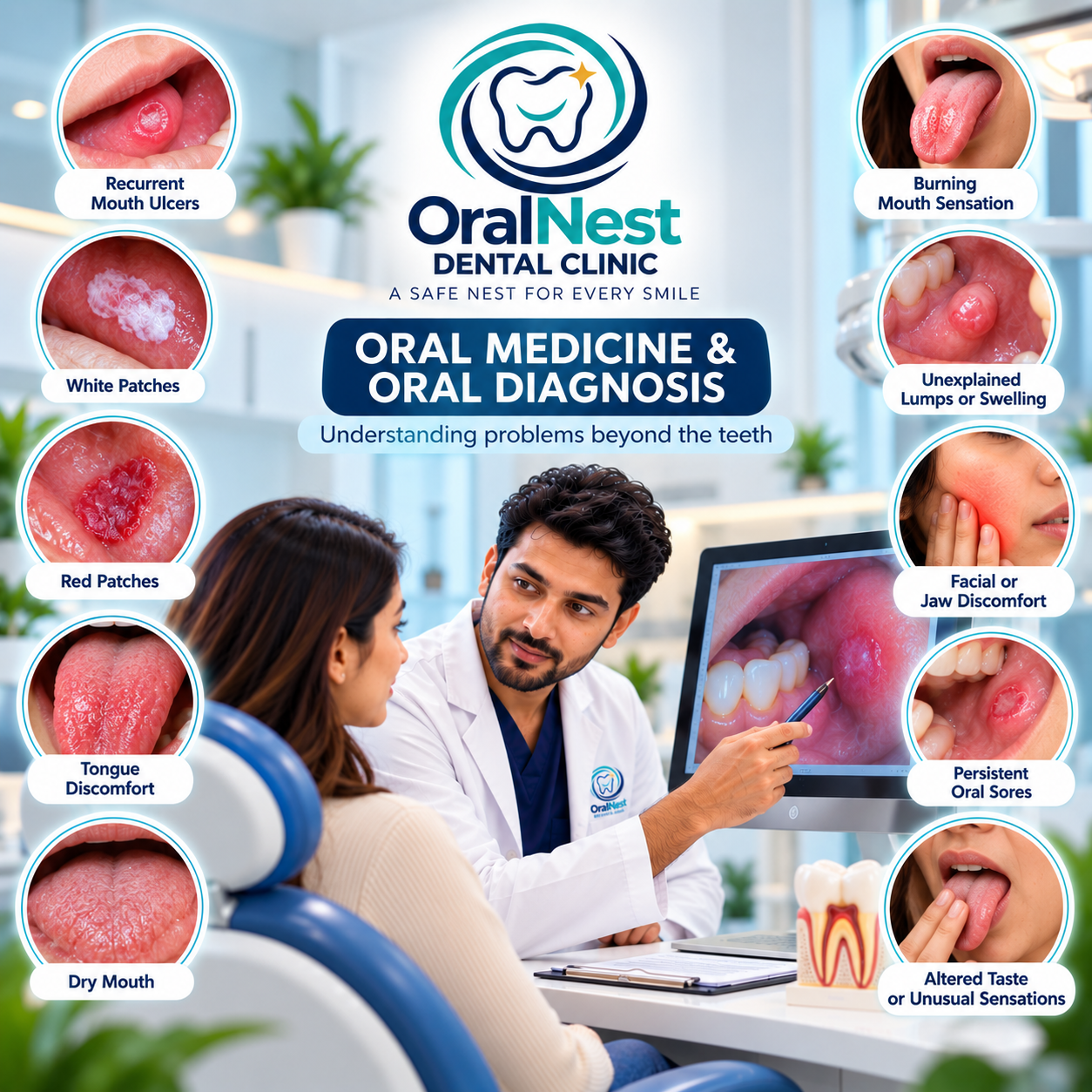
Not every problem inside the mouth is a tooth problem.
Sometimes the concern is a recurring mouth ulcer.
Sometimes there is a white or red patch that does not seem to go away.
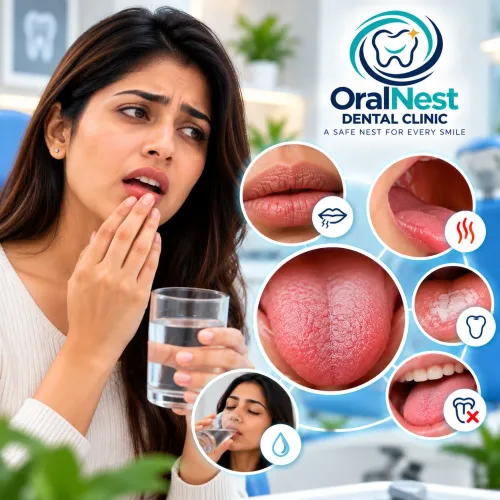
Sometimes the tongue burns, feels sore or changes in appearance.
Sometimes the mouth feels unusually dry.
Sometimes there is persistent facial or jaw discomfort even though the teeth appear normal.
These situations can be confusing because the symptoms are real, but the cause may not be immediately obvious.
This is where Oral Medicine and Oral Diagnosis become particularly important.
At OralNest Dental Clinic | Wakad, oral diagnosis is approached with the understanding that the mouth includes much more than teeth. The teeth, gums, tongue, oral mucosa, jaw joints, muscles and surrounding structures can all contribute to a patient's symptoms.
The first step is not always treatment. Sometimes it is understanding what the mouth is telling you.
What Is Oral Medicine?
Oral Medicine is a dental field concerned with the diagnosis and management of conditions affecting the mouth and related structures, particularly problems that may not fit into a routine tooth-treatment category.
Patients may seek evaluation for concerns such as:
recurrent mouth ulcers;
persistent oral sores;
white patches;
red patches;
burning sensations;
tongue discomfort;
unexplained oral pain;
dry mouth;
changes in oral tissues;
unexplained swelling or lumps;
facial or jaw discomfort;
persistent bad taste or unusual oral sensations;
oral changes associated with systemic or medication-related conditions.
The important point is that these symptoms can have different possible causes.
Therefore, the same symptom does not necessarily mean the same diagnosis.
Why Oral Diagnosis Is Different From a Routine Dental Check-Up
A routine dental examination often focuses on common dental concerns such as:
cavities;
gum health;
plaque and calculus;
tooth wear;
damaged restorations;
missing teeth;
general oral health.
These are important.
But some patients arrive with a different question:
“Something has changed inside my mouth, but I don't know what it is.”
That question may require a different diagnostic approach.
The clinician may need to consider the:
appearance of the lesion or affected area;
location;
duration;
recurrence;
associated symptoms;
patient's medical and dental history;
medications where relevant;
habits and exposures;
surrounding oral structures;
and any other findings that may help explain the condition.
The objective is to understand the pattern—not simply identify what is visible.
A Mouth Ulcer Is Not Always “Just an Ulcer”
Mouth ulcers are extremely common.
Many are temporary and resolve without specific treatment.
But patients often ask:
“Why does my ulcer keep coming back?”
or:
“Why has this ulcer not healed?”
These are important questions.
A clinical evaluation can consider:
how long the ulcer has been present;
whether it has occurred before;
how frequently it returns;
whether it occurs in the same location;
whether there are multiple ulcers;
whether there is associated pain;
whether there are other oral changes;
whether there is an obvious local irritant;
and whether further evaluation is appropriate.
The point is not to create anxiety around every ulcer.
It is to understand when an ordinary-looking symptom is behaving differently from what would normally be expected.
White Patches Inside the Mouth
A white area inside the mouth can have many possible explanations.
It may be associated with local irritation, changes in the oral tissues, an infection, a benign variation, a habit, or another oral condition.
The appearance alone may not always provide the complete answer.
Important questions can include:
Where is the patch located?
How long has it been present?
Has its appearance changed?
Does it come and go?
Can it be removed?
Is there associated discomfort?
Is there irritation from a tooth, restoration or habit?
Are there other changes elsewhere in the mouth?
This is why persistent or unexplained oral changes deserve appropriate clinical assessment rather than self-diagnosis from internet photographs.
Red Patches Also Deserve Context
A red area inside the mouth can similarly have different possible causes.
The significance of a red patch depends on its clinical appearance and context.
A clinician may consider:
its exact location;
size and appearance;
duration;
whether it is associated with pain;
whether there is local trauma or irritation;
whether it has changed over time;
whether similar changes are present elsewhere.
The objective is not simply to label the colour.
The objective is to understand why the tissue looks different.
Why Does My Tongue Hurt?
Tongue discomfort can be surprisingly difficult to describe.
Patients may report:
burning;
soreness;
tingling;
sensitivity;
a feeling of swelling;
altered taste;
discomfort while eating;
or a sensation that the tongue feels different.
The cause may not always be obvious from a quick examination.
Depending on the situation, the assessment may need to consider the tongue itself, surrounding oral tissues, local irritation, oral habits, medications, nutritional or systemic factors and other possible contributors.
The important first step is to determine what pattern the symptoms follow.
What About Burning Mouth?
Some patients describe a persistent burning sensation even when there is little or no obvious visible abnormality.
They may say:
“My mouth feels like it is burning.”
or:
“My tongue feels like it has been scalded.”
This type of complaint can be particularly frustrating because the intensity of the sensation may not always correspond to what is visible clinically.
A careful assessment can help determine whether there is an identifiable local cause or whether other contributing factors need to be considered.
A symptom does not become less real simply because it is difficult to see.
Persistent Dry Mouth
A dry mouth can affect comfort, eating, speaking and overall oral health.
Patients may notice:
difficulty swallowing dry foods;
frequent thirst;
sticky saliva;
altered taste;
increased sensitivity;
difficulty speaking for long periods;
or a persistent feeling of dryness.
Dry mouth can have multiple possible causes, including medication-related factors and other health-related circumstances.
A consultation can help determine the nature of the complaint and whether further evaluation is appropriate.
When the Mouth Feels Sore but the Teeth Look Fine
This is a particularly common source of confusion.
A patient may experience significant oral discomfort while the teeth appear relatively normal.
In such situations, repeatedly treating teeth without establishing the source of the symptoms may not address the actual problem.
The assessment may need to consider:
oral mucosa;
tongue;
gums;
jaw muscles;
TMJ;
nerves and pain patterns;
local irritation;
previous treatment;
and other possible sources.
Not all oral pain originates from a tooth.
That is one of the most important concepts in oral diagnosis.
What Is an Unexplained Lump or Swelling?
Patients sometimes discover a small lump, swelling or unusual area inside the mouth.
It may be associated with:
local irritation;
an anatomical variation;
a cyst or other benign condition;
inflammation;
infection;
a salivary-related problem;
or another condition requiring clinical assessment.
A lump should not be diagnosed based solely on its appearance in a photograph.
Its location, consistency, duration, size, symptoms and clinical behaviour may all be relevant.
When an oral swelling persists or is unexplained, professional evaluation can help determine what should happen next.
Oral Diagnosis Often Depends on Time
One of the most useful pieces of information in oral diagnosis is duration.
A symptom that appeared yesterday may need to be approached differently from a lesion that has remained unchanged for several weeks.
Similarly:
a single ulcer;
a recurrent ulcer;
a lesion that is gradually changing;
and a lesion that persists without healing
represent different clinical situations.
This is why patients should be prepared to explain:
When did you first notice it?
Has it changed?
Has it happened before?
Does it completely disappear between episodes?
Is it getting better, worse or staying the same?
Time provides context.
Recurrence Is Also Important
A symptom that repeatedly returns deserves a different kind of attention from an isolated episode.
For example:
“I occasionally get a mouth ulcer.”
is different from:
“The same area keeps developing an ulcer.”
Similarly:
“My tongue felt sore once.”
is different from:
“My tongue has been uncomfortable repeatedly for months.”
Recurrence does not automatically mean that something serious is happening.
But it can be clinically useful information.
The pattern of a symptom can be as important as the symptom itself.
Why Medical and Dental History Matters
The mouth does not exist separately from the rest of the body.
Certain oral symptoms may be influenced by:
medications;
nutritional factors;
systemic conditions;
immune-related factors;
hormonal changes;
allergies;
lifestyle factors;
oral habits;
or other health circumstances.
This does not mean that every oral symptom has a systemic cause.
It means that a comprehensive oral diagnosis may sometimes require understanding the patient's broader clinical history.
This is one reason it is useful to tell your dentist about relevant medical conditions, medications and previous diagnoses.
Why Self-Diagnosis Can Be Misleading
Searching online can help you understand terminology.
But it can also create confusion.
A photograph of a white patch may resemble several different conditions.
A painful area may look similar to another problem.
A tongue change may have multiple possible explanations.
The difficulty is that online information cannot reliably account for:
your complete history;
clinical examination;
duration;
exact location;
tissue characteristics;
associated symptoms;
previous treatment;
or other findings.
Therefore:
Use online information to ask better questions—not to replace clinical diagnosis.
What Happens During an Oral Medicine Consultation?
The consultation may involve several stages.
1. Detailed History
Understanding when the problem started, how it has changed and whether it has occurred previously.
2. Oral Examination
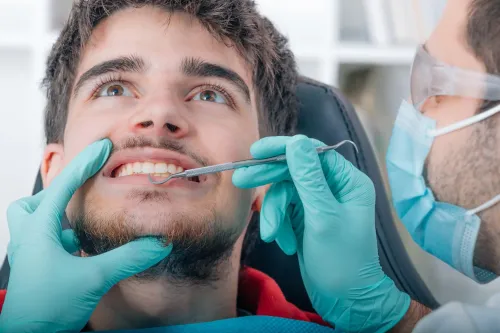
Careful examination of the relevant tissues and surrounding structures.
3. Clinical Correlation
Connecting the symptoms with the visible and clinical findings.
4. Diagnostic Assessment
Determining whether the available information is sufficient to establish a likely diagnosis.
5. Additional Investigation When Indicated
If the findings require further clarification, additional diagnostic steps may be considered.
6. Explanation
The patient is informed about what has been found and what it may mean.
7. Management or Follow-Up
Depending on the diagnosis, this may involve treatment, monitoring, prevention, further investigation or another appropriate clinical pathway.
Does Every Oral Lesion Need a Test or Procedure?
No.
This is an important part of diagnosis-focused care.
A clinical examination may provide enough information in some situations.
Some conditions may simply require observation.
Some may require treatment.
Some may need further investigation because the diagnosis cannot be confidently established from the initial assessment.
The appropriate next step depends on the clinical findings.
Further investigation should have a reason.
When Should You Consider an Oral Medicine Consultation?
Consider seeking professional evaluation if you have:
a mouth ulcer that keeps returning;
a persistent oral sore;
a white patch that does not resolve;
an unexplained red patch;
persistent tongue discomfort;
burning sensations in the mouth;
unexplained oral pain;
persistent dry mouth;
an unexplained lump or swelling;
recurring changes inside the mouth;
symptoms that continue despite previous treatment;
or an oral condition whose diagnosis remains unclear.
This does not mean that every such symptom represents a serious disease.
It means that persistent, recurrent or unexplained changes deserve appropriate assessment.
Oral Medicine and TMJ Can Sometimes Overlap
The mouth, jaw and face are closely connected.
A patient may present with:
jaw pain;
facial pain;
tongue discomfort;
muscle tenderness;
ear-region pain;
difficulty opening the mouth;
or unusual oral sensations.
The source may not always be immediately obvious.
This is why a diagnosis-focused approach can be valuable when symptoms do not fit neatly into a single category.
The objective is to determine which structures are involved and what explanation best fits the clinical findings.
Oral Medicine and Dental Treatment Are Not Separate Worlds
A patient may initially visit for an oral symptom and later require dental treatment.
For example, a patient with persistent tooth discomfort may need endodontic evaluation.
A patient with a problematic wisdom tooth may need surgical assessment.
A patient with jaw pain may require TMJ-focused management.
A patient with an oral lesion may require further diagnostic evaluation.
The point is not to separate every problem into a rigid category.
It is to identify where the problem actually belongs before deciding what should be done.
Specialist-Led Oral Diagnosis at OralNest
OralNest Dental Clinic | Wakad places particular emphasis on diagnosis when patients present with symptoms that may not fit into a routine dental complaint.
Dr. Ashutosh Dighe's professional background includes:
BDS
MDS – Oral Medicine & Maxillofacial Radiology
PhD Scholar
Fellowship in Contemporary Endodontics
Certified Endodontist
This clinical background supports an approach involving oral diagnosis, oral medicine, radiological evaluation, treatment planning and endodontic care.
The goal is not to make every patient undergo extensive evaluation.
The goal is to recognise when a symptom deserves closer attention and determine the appropriate next step.
Convenient Evening Consultations in Wakad
For patients with work and daytime commitments, OralNest follows an appointment-led evening practice model.
Monday–Saturday
5:30 PM – 9:00 PM
Sunday
10:00 AM – 1:00 PM
Prior appointment is convenient
Advance scheduling is particularly useful for patients coming with:
persistent oral symptoms;
recurrent mouth ulcers;
oral mucosal changes;
tongue complaints;
unexplained mouth pain;
TMJ or facial pain;
second-opinion requirements;
complex diagnostic concerns.
If you have previous reports, X-rays, prescriptions or photographs related to the problem, bringing them can provide useful clinical context.
Oral Diagnosis Is About More Than Naming a Condition
The true purpose of diagnosis is to answer a much more important question:
“What should happen next?”
Sometimes the answer is treatment.
Sometimes it is observation.
Sometimes it is prevention.
Sometimes it is additional investigation.
And sometimes the most important outcome is reassurance that no immediate intervention is necessary.
That decision should follow the clinical understanding of the problem.
The OralNest Approach to Oral Diagnosis
At OralNest Dental Clinic | Wakad, the approach is:
Listen to the concern.
Understand the history.
Examine the mouth carefully.
Consider the possible causes.
Use diagnostic information when appropriate.
Explain what the findings mean.
Decide whether treatment, monitoring or further evaluation is appropriate.
Because when something changes inside your mouth, the most useful first question is not:
“What treatment should I take?”
It is:
“What is causing this, and how can we understand it properly?”
Understand First. Diagnose Carefully. Decide With Clarity.
Sometimes the concern is a recurring mouth ulcer.
Sometimes there is a white or red patch that does not seem to go away.
Sometimes the tongue burns, feels sore or changes in appearance.
Sometimes the mouth feels unusually dry.
Sometimes there is persistent facial or jaw discomfort even though the teeth appear normal.
These situations can be confusing because the symptoms are real, but the cause may not be immediately obvious.
This is where Oral Medicine and Oral Diagnosis become particularly important.
At OralNest Dental Clinic | Wakad, oral diagnosis is approached with the understanding that the mouth includes much more than teeth. The teeth, gums, tongue, oral mucosa, jaw joints, muscles and surrounding structures can all contribute to a patient's symptoms.
The first step is not always treatment. Sometimes it is understanding what the mouth is telling you.
What Is Oral Medicine?
Oral Medicine is a dental field concerned with the diagnosis and management of conditions affecting the mouth and related structures, particularly problems that may not fit into a routine tooth-treatment category.
Patients may seek evaluation for concerns such as:
recurrent mouth ulcers;
persistent oral sores;
white patches;
red patches;
burning sensations;
tongue discomfort;
unexplained oral pain;
dry mouth;
changes in oral tissues;
unexplained swelling or lumps;
facial or jaw discomfort;
persistent bad taste or unusual oral sensations;
oral changes associated with systemic or medication-related conditions.
The important point is that these symptoms can have different possible causes.
Therefore, the same symptom does not necessarily mean the same diagnosis.
Why Oral Diagnosis Is Different From a Routine Dental Check-Up
A routine dental examination often focuses on common dental concerns such as:
cavities;
gum health;
plaque and calculus;
tooth wear;
damaged restorations;
missing teeth;
general oral health.
These are important.
But some patients arrive with a different question:
“Something has changed inside my mouth, but I don't know what it is.”
That question may require a different diagnostic approach.
The clinician may need to consider the:
appearance of the lesion or affected area;
location;
duration;
recurrence;
associated symptoms;
patient's medical and dental history;
medications where relevant;
habits and exposures;
surrounding oral structures;
and any other findings that may help explain the condition.
The objective is to understand the pattern—not simply identify what is visible.
A Mouth Ulcer Is Not Always “Just an Ulcer”
Mouth ulcers are extremely common.
Many are temporary and resolve without specific treatment.
But patients often ask:
“Why does my ulcer keep coming back?”
or:
“Why has this ulcer not healed?”
These are important questions.
A clinical evaluation can consider:
how long the ulcer has been present;
whether it has occurred before;
how frequently it returns;
whether it occurs in the same location;
whether there are multiple ulcers;
whether there is associated pain;
whether there are other oral changes;
whether there is an obvious local irritant;
and whether further evaluation is appropriate.
The point is not to create anxiety around every ulcer.
It is to understand when an ordinary-looking symptom is behaving differently from what would normally be expected.
White Patches Inside the Mouth
A white area inside the mouth can have many possible explanations.
It may be associated with local irritation, changes in the oral tissues, an infection, a benign variation, a habit, or another oral condition.
The appearance alone may not always provide the complete answer.
Important questions can include:
Where is the patch located?
How long has it been present?
Has its appearance changed?
Does it come and go?
Can it be removed?
Is there associated discomfort?
Is there irritation from a tooth, restoration or habit?
Are there other changes elsewhere in the mouth?
This is why persistent or unexplained oral changes deserve appropriate clinical assessment rather than self-diagnosis from internet photographs.
Red Patches Also Deserve Context
A red area inside the mouth can similarly have different possible causes.
The significance of a red patch depends on its clinical appearance and context.
A clinician may consider:
its exact location;
size and appearance;
duration;
whether it is associated with pain;
whether there is local trauma or irritation;
whether it has changed over time;
whether similar changes are present elsewhere.
The objective is not simply to label the colour.
The objective is to understand why the tissue looks different.
Why Does My Tongue Hurt?
Tongue discomfort can be surprisingly difficult to describe.
Patients may report:
burning;
soreness;
tingling;
sensitivity;
a feeling of swelling;
altered taste;
discomfort while eating;
or a sensation that the tongue feels different.
The cause may not always be obvious from a quick examination.
Depending on the situation, the assessment may need to consider the tongue itself, surrounding oral tissues, local irritation, oral habits, medications, nutritional or systemic factors and other possible contributors.
The important first step is to determine what pattern the symptoms follow.
What About Burning Mouth?
Some patients describe a persistent burning sensation even when there is little or no obvious visible abnormality.
They may say:
“My mouth feels like it is burning.”
or:
“My tongue feels like it has been scalded.”
This type of complaint can be particularly frustrating because the intensity of the sensation may not always correspond to what is visible clinically.
A careful assessment can help determine whether there is an identifiable local cause or whether other contributing factors need to be considered.
A symptom does not become less real simply because it is difficult to see.
Persistent Dry Mouth
A dry mouth can affect comfort, eating, speaking and overall oral health.
Patients may notice:
difficulty swallowing dry foods;
frequent thirst;
sticky saliva;
altered taste;
increased sensitivity;
difficulty speaking for long periods;
or a persistent feeling of dryness.
Dry mouth can have multiple possible causes, including medication-related factors and other health-related circumstances.
A consultation can help determine the nature of the complaint and whether further evaluation is appropriate.
When the Mouth Feels Sore but the Teeth Look Fine
This is a particularly common source of confusion.
A patient may experience significant oral discomfort while the teeth appear relatively normal.
In such situations, repeatedly treating teeth without establishing the source of the symptoms may not address the actual problem.
The assessment may need to consider:
oral mucosa;
tongue;
gums;
jaw muscles;
TMJ;
nerves and pain patterns;
local irritation;
previous treatment;
and other possible sources.
Not all oral pain originates from a tooth.
That is one of the most important concepts in oral diagnosis.
What Is an Unexplained Lump or Swelling?
Patients sometimes discover a small lump, swelling or unusual area inside the mouth.
It may be associated with:
local irritation;
an anatomical variation;
a cyst or other benign condition;
inflammation;
infection;
a salivary-related problem;
or another condition requiring clinical assessment.
A lump should not be diagnosed based solely on its appearance in a photograph.
Its location, consistency, duration, size, symptoms and clinical behaviour may all be relevant.
When an oral swelling persists or is unexplained, professional evaluation can help determine what should happen next.
Oral Diagnosis Often Depends on Time
One of the most useful pieces of information in oral diagnosis is duration.
A symptom that appeared yesterday may need to be approached differently from a lesion that has remained unchanged for several weeks.
Similarly:
a single ulcer;
a recurrent ulcer;
a lesion that is gradually changing;
and a lesion that persists without healing
represent different clinical situations.
This is why patients should be prepared to explain:
When did you first notice it?
Has it changed?
Has it happened before?
Does it completely disappear between episodes?
Is it getting better, worse or staying the same?
Time provides context.
Recurrence Is Also Important
A symptom that repeatedly returns deserves a different kind of attention from an isolated episode.
For example:
“I occasionally get a mouth ulcer.”
is different from:
“The same area keeps developing an ulcer.”
Similarly:
“My tongue felt sore once.”
is different from:
“My tongue has been uncomfortable repeatedly for months.”
Recurrence does not automatically mean that something serious is happening.
But it can be clinically useful information.
The pattern of a symptom can be as important as the symptom itself.
Why Medical and Dental History Matters
The mouth does not exist separately from the rest of the body.
Certain oral symptoms may be influenced by:
medications;
nutritional factors;
systemic conditions;
immune-related factors;
hormonal changes;
allergies;
lifestyle factors;
oral habits;
or other health circumstances.
This does not mean that every oral symptom has a systemic cause.
It means that a comprehensive oral diagnosis may sometimes require understanding the patient's broader clinical history.
This is one reason it is useful to tell your dentist about relevant medical conditions, medications and previous diagnoses.
Why Self-Diagnosis Can Be Misleading
Searching online can help you understand terminology.
But it can also create confusion.
A photograph of a white patch may resemble several different conditions.
A painful area may look similar to another problem.
A tongue change may have multiple possible explanations.
The difficulty is that online information cannot reliably account for:
your complete history;
clinical examination;
duration;
exact location;
tissue characteristics;
associated symptoms;
previous treatment;
or other findings.
Therefore:
Use online information to ask better questions—not to replace clinical diagnosis.
What Happens During an Oral Medicine Consultation?
The consultation may involve several stages.
1. Detailed History
Understanding when the problem started, how it has changed and whether it has occurred previously.
2. Oral Examination
Careful examination of the relevant tissues and surrounding structures.
3. Clinical Correlation
Connecting the symptoms with the visible and clinical findings.
4. Diagnostic Assessment
Determining whether the available information is sufficient to establish a likely diagnosis.
5. Additional Investigation When Indicated
If the findings require further clarification, additional diagnostic steps may be considered.
6. Explanation
The patient is informed about what has been found and what it may mean.
7. Management or Follow-Up
Depending on the diagnosis, this may involve treatment, monitoring, prevention, further investigation or another appropriate clinical pathway.
Does Every Oral Lesion Need a Test or Procedure?
No.
This is an important part of diagnosis-focused care.
A clinical examination may provide enough information in some situations.
Some conditions may simply require observation.
Some may require treatment.
Some may need further investigation because the diagnosis cannot be confidently established from the initial assessment.
The appropriate next step depends on the clinical findings.
Further investigation should have a reason.
When Should You Consider an Oral Medicine Consultation?
Consider seeking professional evaluation if you have:
a mouth ulcer that keeps returning;
a persistent oral sore;
a white patch that does not resolve;
an unexplained red patch;
persistent tongue discomfort;
burning sensations in the mouth;
unexplained oral pain;
persistent dry mouth;
an unexplained lump or swelling;
recurring changes inside the mouth;
symptoms that continue despite previous treatment;
or an oral condition whose diagnosis remains unclear.
This does not mean that every such symptom represents a serious disease.
It means that persistent, recurrent or unexplained changes deserve appropriate assessment.
Oral Medicine and TMJ Can Sometimes Overlap
The mouth, jaw and face are closely connected.
A patient may present with:
jaw pain;
facial pain;
tongue discomfort;
muscle tenderness;
ear-region pain;
difficulty opening the mouth;
or unusual oral sensations.
The source may not always be immediately obvious.
This is why a diagnosis-focused approach can be valuable when symptoms do not fit neatly into a single category.
The objective is to determine which structures are involved and what explanation best fits the clinical findings.
Oral Medicine and Dental Treatment Are Not Separate Worlds
A patient may initially visit for an oral symptom and later require dental treatment.
For example, a patient with persistent tooth discomfort may need endodontic evaluation.
A patient with a problematic wisdom tooth may need surgical assessment.
A patient with jaw pain may require TMJ-focused management.
A patient with an oral lesion may require further diagnostic evaluation.
The point is not to separate every problem into a rigid category.
It is to identify where the problem actually belongs before deciding what should be done.
Specialist-Led Oral Diagnosis at OralNest
OralNest Dental Clinic | Wakad places particular emphasis on diagnosis when patients present with symptoms that may not fit into a routine dental complaint.
Dr. Ashutosh Dighe's professional background includes:
BDS
MDS – Oral Medicine & Maxillofacial Radiology
PhD Scholar
Fellowship in Contemporary Endodontics
Certified Endodontist
This clinical background supports an approach involving oral diagnosis, oral medicine, radiological evaluation, treatment planning and endodontic care.
The goal is not to make every patient undergo extensive evaluation.
The goal is to recognise when a symptom deserves closer attention and determine the appropriate next step.
Convenient Evening Consultations in Wakad
For patients with work and daytime commitments, OralNest follows an appointment-led evening practice model.
Monday–Saturday
5:30 PM – 9:00 PM
Sunday
10:00 AM – 1:00 PM
Prior appointment is convenient
Advance scheduling is particularly useful for patients coming with:
persistent oral symptoms;
recurrent mouth ulcers;
oral mucosal changes;
tongue complaints;
unexplained mouth pain;
TMJ or facial pain;
second-opinion requirements;
complex diagnostic concerns.
If you have previous reports, X-rays, prescriptions or photographs related to the problem, bringing them can provide useful clinical context.
Oral Diagnosis Is About More Than Naming a Condition
The true purpose of diagnosis is to answer a much more important question:
“What should happen next?”
Sometimes the answer is treatment.
Sometimes it is observation.
Sometimes it is prevention.
Sometimes it is additional investigation.
And sometimes the most important outcome is reassurance that no immediate intervention is necessary.
That decision should follow the clinical understanding of the problem.
The OralNest Approach to Oral Diagnosis
At OralNest Dental Clinic | Wakad, the approach is:
Listen to the concern.
Understand the history.
Examine the mouth carefully.
Consider the possible causes.
Use diagnostic information when appropriate.
Explain what the findings mean.
Decide whether treatment, monitoring or further evaluation is appropriate.
Because when something changes inside your mouth, the most useful first question is not:
“What treatment should I take?”
It is:
“What is causing this, and how can we understand it properly?”
Understand First. Diagnose Carefully. Decide With Clarity.
Keywords