Impacted Wisdom Tooth: What It Means, Symptoms & Treatment Options
Not every wisdom tooth comes into the mouth in a straightforward way. Sometimes there is not enough space for the tooth to erupt normally, causing it to remain partly or completely trapped beneath the gum or bone. This is known as an impacted wisdom tooth.
An impacted wisdom tooth may cause no symptoms at all, or it may become noticeable through pain, swelling or repeated problems at the back of the mouth.
What does an impacted wisdom tooth look like?
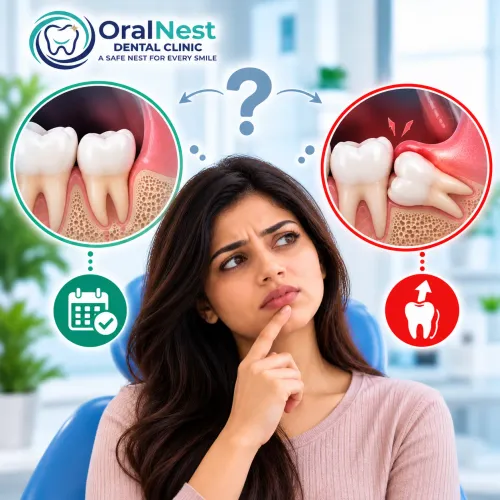
A wisdom tooth can become impacted in different ways. It may remain completely covered by gum, appear only partially, or grow at an unusual angle because of limited space. Some teeth may press against the molar in front of them.
The position of the tooth is important because it can affect how easily the area can be cleaned and whether problems develop around it.
What problems can an impacted wisdom tooth cause?
Some patients experience repeated gum inflammation, food getting trapped around the partially erupted tooth, bad taste or bad breath. Others may develop decay involving the wisdom tooth or the neighbouring molar.
Pain and swelling can occur when the surrounding gum becomes inflamed or infected. In some cases, an impacted tooth may be associated with other changes around the tooth that require assessment.
However, an important point is often missed: an impacted wisdom tooth does not automatically mean that removal is necessary.
How is an impacted wisdom tooth diagnosed?
A dental examination provides information about the visible tooth and surrounding gum. Dental imaging may then be recommended to understand the tooth's position, angulation, depth and relationship with nearby structures.
The decision about treatment is based on the complete clinical picture rather than the X-ray alone.
Does every impacted wisdom tooth need removal?
No. A symptom-free impacted wisdom tooth may sometimes be monitored when there are no concerning clinical findings. Removal may be considered when the tooth is causing recurrent infection, significant decay, damage to a neighbouring tooth, persistent symptoms or other clinically important problems.
At OralNest Dental Clinic | Wakad, wisdom tooth evaluation begins with diagnosis rather than assuming that every impacted tooth requires extraction. When removal or surgical treatment is indicated, the procedure is performed at the clinic with appropriate aftercare guidance.
Frequently Asked Questions
Can an impacted wisdom tooth cause problems without pain?
Yes. Some problems may develop without obvious symptoms, which is why assessment can be useful when an impacted tooth is identified.
Can an impacted wisdom tooth erupt later?
Some wisdom teeth may continue to change position or erupt, but this depends on factors such as available space and tooth position.
Is an impacted wisdom tooth always removed surgically?
Not necessarily. The type of treatment depends on the tooth's position and clinical condition.
Can an impacted wisdom tooth affect the tooth next to it?
It can, particularly when its position creates pressure or makes the neighbouring area difficult to clean.
For wisdom tooth evaluation and treatment in Wakad, Hinjawadi, Tathawade, Baner, Balewadi and nearby Pimpri-Chinchwad areas, OralNest Dental Clinic provides clinical assessment, imaging when required, and extraction or surgical removal when clinically indicated.
Keywords