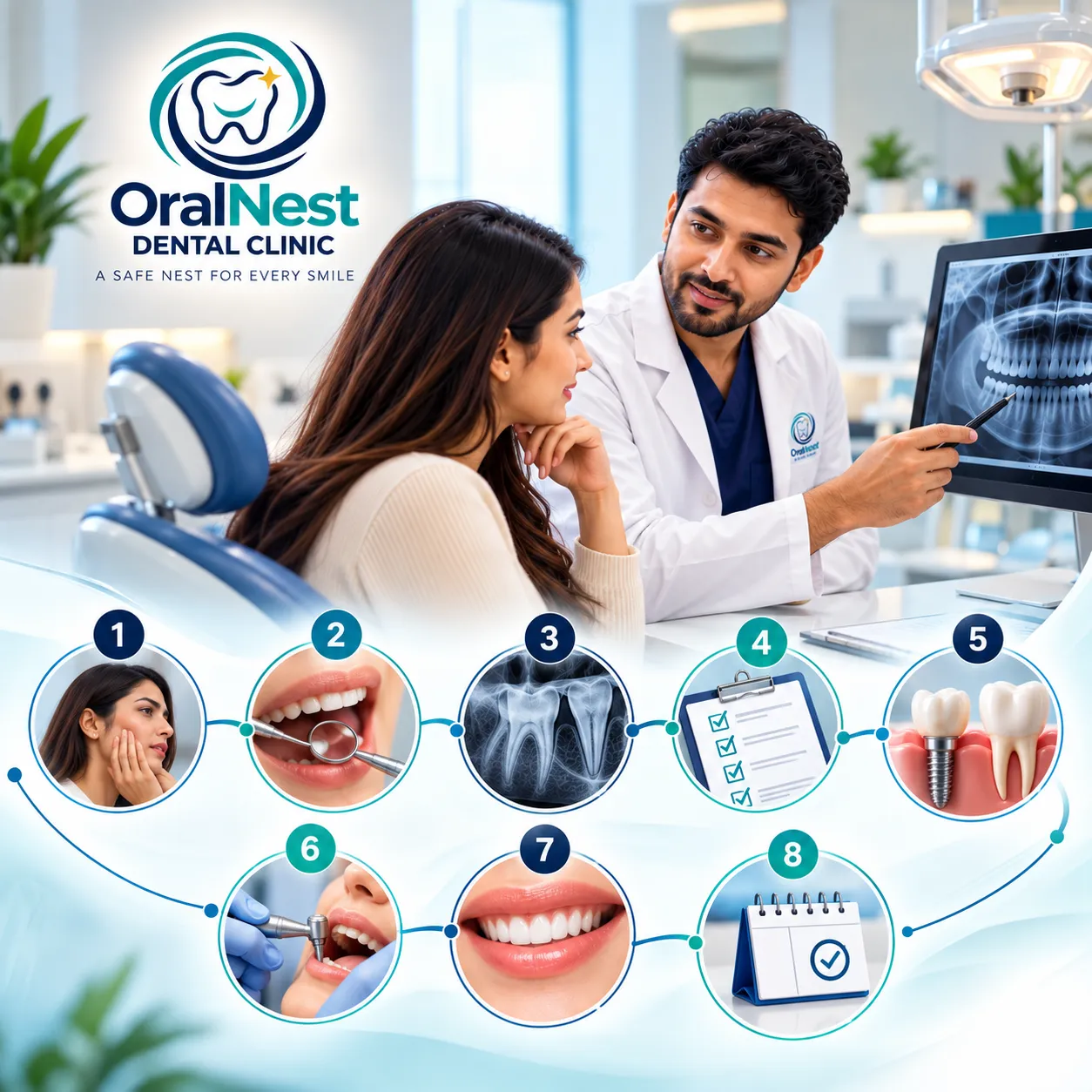
How OralNest Approaches a Dental Problem
A dental problem rarely begins with a treatment name.
It begins with a concern.
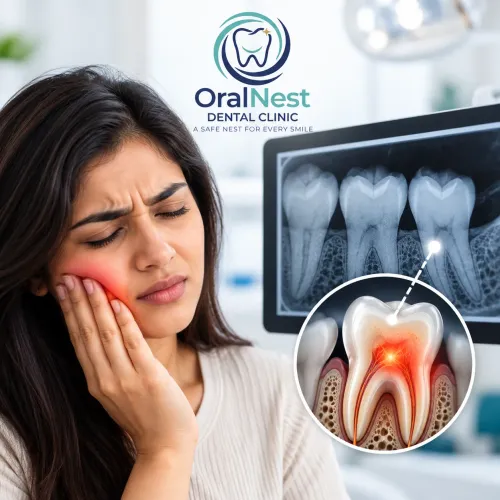
“My tooth is hurting.”
“My jaw is clicking.”
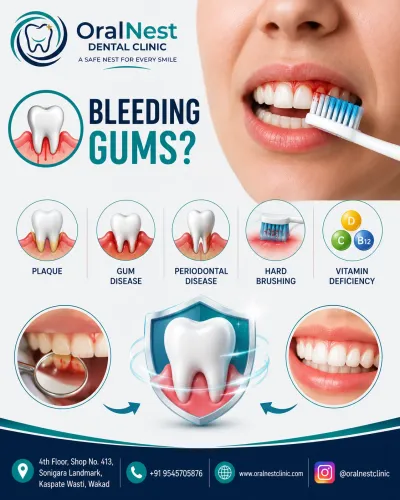
“My gums are bleeding.”
“I have a mouth ulcer.”
“My wisdom tooth keeps troubling me.”
“I was told I need a root canal.”
“Can this tooth still be saved?”
The first step should not always be deciding which procedure to perform.
The first step is understanding what is actually happening.
At OralNest Dental Clinic | Wakad, our approach is built around this simple sequence:
Understand → Evaluate → Diagnose → Discuss → Decide → Treat → Follow Up
This helps keep the patient's problem—not the procedure—at the centre of dental care.
1. Understand the Patient's Concern
Every dental consultation begins with the patient's story.
Pain is not just “pain.”
We want to understand:
When did it begin?
Is it constant or intermittent?
What makes it worse?
What makes it better?
Does it occur while eating?
Is it triggered by hot or cold?
Does it occur spontaneously?
Has the problem happened before?
Have you already received treatment?
Has the problem changed recently?
The same symptom can mean different things in different situations.
That is why listening carefully is an important part of diagnosis.
The patient's experience provides the starting point for the clinical investigation.
2. Evaluate the Problem
Once the concern is understood, the next step is appropriate clinical evaluation.
Depending on the problem, this may involve examining:
the affected tooth;
neighbouring teeth;
gums and supporting tissues;
oral mucosa;
jaw joints;
chewing muscles;
bite and function;
surrounding anatomical structures.
Previous dental treatment can also be important.
A tooth that has already undergone a filling, crown or root canal may need to be assessed differently from a tooth that has never been treated.
3. Use Diagnostic Information When It Is Needed
Sometimes clinical examination provides enough information.
Sometimes additional diagnostic information is necessary.
This may include appropriate dental radiographs or other imaging depending on the clinical question.
The important principle is:
Imaging should answer a clinical question.
An X-ray should not simply be taken because an X-ray is available.
It should help clarify something relevant to the diagnosis or treatment plan.
For example, imaging may help assess:
root and canal anatomy;
bone levels;
impacted wisdom teeth;
infection-related changes;
the condition around a previously treated tooth;
missing-tooth areas before implant planning;
other structures that cannot be adequately assessed clinically.
4. Connect the Findings
This is where diagnosis becomes more than simply collecting information.
Symptoms, clinical findings and diagnostic information need to be considered together.
Imagine a patient with tooth pain.
The patient may report sensitivity to cold.
Clinical examination may reveal decay.
Imaging may show changes involving the tooth.
These findings together may provide a clearer explanation than any single observation alone.
Similarly, a patient with jaw pain may have symptoms that require assessment of the joint, muscles, teeth and other possible sources.
A patient with an oral lesion may require consideration of its appearance, duration, recurrence, location and associated symptoms.
Good diagnosis connects the pieces.
5. Consider More Than One Possibility
Not every dental problem has an obvious answer immediately.
Sometimes several possible causes need to be considered.
This is particularly relevant when:
symptoms are unusual;
pain does not correspond to an obvious dental finding;
previous treatment has not resolved the problem;
multiple structures could be involved;
an oral lesion persists or recurs;
jaw or facial pain has several possible sources.
The aim is not to make the situation unnecessarily complicated.
It is to avoid making a treatment decision before the important possibilities have been considered.
6. Explain the Diagnosis Clearly
A diagnosis is useful only when the patient understands what it means.
Patients should be able to ask:
What is happening?
Why is it happening?
How certain is the diagnosis?
What needs treatment?
What can be monitored?
Are there alternatives?
What happens if I wait?
At OralNest, explaining the reasoning behind a treatment recommendation is an important part of the consultation.
The goal is not simply to give a procedure name.
The goal is to help the patient understand why that procedure is being considered.
7. Decide Whether Treatment Is Actually Necessary
Not every problem needs immediate treatment.
Depending on the diagnosis, the appropriate approach may be:
Treatment
When active disease or damage requires intervention.
Prevention
When the condition can be managed before it progresses.
Monitoring
When immediate treatment is not necessary and observation is appropriate.
Further Evaluation
When there is not yet enough information to make a confident decision.
Second Opinion
When a significant or irreversible treatment decision needs additional clinical perspective.
This is why diagnosis-first dentistry is not simply about identifying treatment.
It is also about recognising when treatment should not be rushed.
8. Choose the Appropriate Treatment
When treatment is required, the choice should be based on the clinical situation.
For example:
A damaged tooth
May require a restoration, crown, root canal treatment or extraction depending on its condition.
A missing tooth
May be considered for an implant, bridge, denture or another appropriate replacement option.
A wisdom tooth
May require removal—or may be suitable for monitoring depending on its position and condition.
Jaw pain
May require different management depending on whether the source involves the joint, muscles, teeth or another cause.
Oral lesion
May require observation, treatment, investigation or referral depending on the clinical findings.
There is no universal treatment that is appropriate for every patient with the same symptom.
9. Consider the Long-Term Picture
A dental procedure should not be viewed in isolation.
The question should also be:
What happens after this treatment?
For example, root canal treatment addresses the internal condition of a tooth, but the tooth may subsequently require appropriate restoration depending on the remaining structure and functional demands.
An implant is not simply a surgical procedure; it is part of a broader tooth-replacement plan.
A wisdom tooth removal decision should consider the surrounding tooth and tissues.
A full-mouth treatment plan needs appropriate sequencing.
Good treatment planning therefore considers both the immediate problem and the condition that follows.
10. Follow Up
Treatment does not necessarily end when the procedure is completed.
Depending on the condition, follow-up may help assess:
healing;
symptoms;
function;
restoration;
recurrence;
oral hygiene;
long-term maintenance.
The appropriate follow-up depends on the treatment and individual circumstances.
The objective is to ensure that the patient understands what to expect after treatment and when further assessment may be required.
What Makes This Approach Different?
The difference is not that every dental problem is treated in a complicated way.
It is that the level of evaluation should match the problem.
A straightforward dental issue should not become unnecessarily complicated.
But a difficult-to-diagnose problem should not be treated as though it were straightforward.
This distinction is particularly important in areas such as:
Oral Medicine;
oral mucosal conditions;
TMJ disorders;
orofacial pain;
complex tooth pain;
endodontic treatment;
wisdom tooth problems;
dental implants;
and second-opinion consultations.
Examples of the OralNest Approach
Example 1: Tooth Pain
The question is not immediately:
“Should we perform a root canal?”
The process is:
Pain → Clinical Evaluation → Diagnosis → Determine Pulp/Tooth Status → Treatment Decision
Only when the diagnosis supports root canal treatment should RCT become the treatment being considered.
Example 2: Wisdom Tooth Pain
The question is not simply:
“Should the wisdom tooth be removed?”
Instead:
Symptoms → Examination → Position & Condition → Surrounding Structures → Risk/Benefit Consideration → Remove or Monitor
The decision belongs to the individual clinical situation.
Example 3: Jaw Pain
Instead of assuming that all jaw pain is TMJ-related:
Pain → History → Joint/Muscle/Dental Evaluation → Diagnostic Assessment → Identify Likely Source → Appropriate Management
This helps avoid automatically treating the wrong structure.
Example 4: Persistent Mouth Ulcer
Instead of assuming:
“It is just an ulcer.”
The important questions may include:
How long has it been present?
Has it happened before?
Where is it located?
Has it changed?
Are there other oral symptoms?
Does it require further evaluation?
The answer depends on the clinical findings.
When a Second Opinion Can Be Helpful
A second opinion can be particularly useful when the proposed treatment is significant or irreversible.
For example:
before extraction of a questionable tooth;
before complex implant treatment;
when a root canal has failed;
when symptoms continue despite treatment;
when different dentists have suggested different approaches;
when you do not understand why a treatment has been recommended;
when you want greater clarity before making a major dental decision.
A second opinion should ideally add clinical understanding, not simply another treatment quote.
Convenient Evening Consultations at OralNest
Dental care can be difficult to schedule for people with busy workdays.
OralNest follows an appointment-led evening practice model.
Monday–Saturday
5:30 PM – 9:00 PM
Sunday
10:00 AM – 1:00 PM
Prior appointment is convenient
Advance appointments are particularly useful for consultations involving:
tooth pain;
oral diagnosis;
TMJ and jaw pain;
second opinions;
root canal evaluation;
wisdom tooth assessment;
dental implant planning;
complex treatment planning.
If you already have previous X-rays, scans, reports or treatment records, bringing them can help provide useful background during the consultation.
A Consultation Should Give You Clarity
A successful dental consultation is not simply one in which a procedure is booked.
It should help you understand:
What is happening?
Why is it happening?
What needs to be done?
What does not need to be done?
What are the alternatives?
What happens next?
That clarity is valuable because dental decisions can affect your teeth, function, comfort, appearance and long-term oral health.
The OralNest Principle
At OralNest Dental Clinic | Wakad, our approach can be summarised simply:
Understand the concern.
Evaluate the evidence.
Identify the cause.
Explain the options.
Decide thoughtfully.
Treat appropriately.
Follow up when needed.
Because the best starting point for dental treatment is not always a procedure.
It is understanding the problem correctly.
A dental problem rarely begins with a treatment name.
It begins with a concern.
“My tooth is hurting.”
“My jaw is clicking.”
“My gums are bleeding.”
“I have a mouth ulcer.”
“My wisdom tooth keeps troubling me.”
“I was told I need a root canal.”
“Can this tooth still be saved?”
The first step should not always be deciding which procedure to perform.
The first step is understanding what is actually happening.
At OralNest Dental Clinic | Wakad, our approach is built around this simple sequence:
Understand → Evaluate → Diagnose → Discuss → Decide → Treat → Follow Up
This helps keep the patient's problem—not the procedure—at the centre of dental care.
1. Understand the Patient's Concern
Every dental consultation begins with the patient's story.
Pain is not just “pain.”
We want to understand:
When did it begin?
Is it constant or intermittent?
What makes it worse?
What makes it better?
Does it occur while eating?
Is it triggered by hot or cold?
Does it occur spontaneously?
Has the problem happened before?
Have you already received treatment?
Has the problem changed recently?
The same symptom can mean different things in different situations.
That is why listening carefully is an important part of diagnosis.
The patient's experience provides the starting point for the clinical investigation.
2. Evaluate the Problem
Once the concern is understood, the next step is appropriate clinical evaluation.
Depending on the problem, this may involve examining:
the affected tooth;
neighbouring teeth;
gums and supporting tissues;
oral mucosa;
jaw joints;
chewing muscles;
bite and function;
surrounding anatomical structures.
Previous dental treatment can also be important.
A tooth that has already undergone a filling, crown or root canal may need to be assessed differently from a tooth that has never been treated.
3. Use Diagnostic Information When It Is Needed
Sometimes clinical examination provides enough information.
Sometimes additional diagnostic information is necessary.
This may include appropriate dental radiographs or other imaging depending on the clinical question.
The important principle is:
Imaging should answer a clinical question.
An X-ray should not simply be taken because an X-ray is available.
It should help clarify something relevant to the diagnosis or treatment plan.
For example, imaging may help assess:
root and canal anatomy;
bone levels;
impacted wisdom teeth;
infection-related changes;
the condition around a previously treated tooth;
missing-tooth areas before implant planning;
other structures that cannot be adequately assessed clinically.
4. Connect the Findings
This is where diagnosis becomes more than simply collecting information.
Symptoms, clinical findings and diagnostic information need to be considered together.
Imagine a patient with tooth pain.
The patient may report sensitivity to cold.
Clinical examination may reveal decay.
Imaging may show changes involving the tooth.
These findings together may provide a clearer explanation than any single observation alone.
Similarly, a patient with jaw pain may have symptoms that require assessment of the joint, muscles, teeth and other possible sources.
A patient with an oral lesion may require consideration of its appearance, duration, recurrence, location and associated symptoms.
Good diagnosis connects the pieces.
5. Consider More Than One Possibility
Not every dental problem has an obvious answer immediately.
Sometimes several possible causes need to be considered.
This is particularly relevant when:
symptoms are unusual;
pain does not correspond to an obvious dental finding;
previous treatment has not resolved the problem;
multiple structures could be involved;
an oral lesion persists or recurs;
jaw or facial pain has several possible sources.
The aim is not to make the situation unnecessarily complicated.
It is to avoid making a treatment decision before the important possibilities have been considered.
6. Explain the Diagnosis Clearly
A diagnosis is useful only when the patient understands what it means.
Patients should be able to ask:
What is happening?
Why is it happening?
How certain is the diagnosis?
What needs treatment?
What can be monitored?
Are there alternatives?
What happens if I wait?
At OralNest, explaining the reasoning behind a treatment recommendation is an important part of the consultation.
The goal is not simply to give a procedure name.
The goal is to help the patient understand why that procedure is being considered.
7. Decide Whether Treatment Is Actually Necessary
Not every problem needs immediate treatment.
Depending on the diagnosis, the appropriate approach may be:
Treatment
When active disease or damage requires intervention.
Prevention
When the condition can be managed before it progresses.
Monitoring
When immediate treatment is not necessary and observation is appropriate.
Further Evaluation
When there is not yet enough information to make a confident decision.
Second Opinion
When a significant or irreversible treatment decision needs additional clinical perspective.
This is why diagnosis-first dentistry is not simply about identifying treatment.
It is also about recognising when treatment should not be rushed.
8. Choose the Appropriate Treatment
When treatment is required, the choice should be based on the clinical situation.
For example:
A damaged tooth
May require a restoration, crown, root canal treatment or extraction depending on its condition.
A missing tooth
May be considered for an implant, bridge, denture or another appropriate replacement option.
A wisdom tooth
May require removal—or may be suitable for monitoring depending on its position and condition.
Jaw pain
May require different management depending on whether the source involves the joint, muscles, teeth or another cause.
Oral lesion
May require observation, treatment, investigation or referral depending on the clinical findings.
There is no universal treatment that is appropriate for every patient with the same symptom.
9. Consider the Long-Term Picture
A dental procedure should not be viewed in isolation.
The question should also be:
What happens after this treatment?
For example, root canal treatment addresses the internal condition of a tooth, but the tooth may subsequently require appropriate restoration depending on the remaining structure and functional demands.
An implant is not simply a surgical procedure; it is part of a broader tooth-replacement plan.
A wisdom tooth removal decision should consider the surrounding tooth and tissues.
A full-mouth treatment plan needs appropriate sequencing.
Good treatment planning therefore considers both the immediate problem and the condition that follows.
10. Follow Up
Treatment does not necessarily end when the procedure is completed.
Depending on the condition, follow-up may help assess:
healing;
symptoms;
function;
restoration;
recurrence;
oral hygiene;
long-term maintenance.
The appropriate follow-up depends on the treatment and individual circumstances.
The objective is to ensure that the patient understands what to expect after treatment and when further assessment may be required.
What Makes This Approach Different?
The difference is not that every dental problem is treated in a complicated way.
It is that the level of evaluation should match the problem.
A straightforward dental issue should not become unnecessarily complicated.
But a difficult-to-diagnose problem should not be treated as though it were straightforward.
This distinction is particularly important in areas such as:
Oral Medicine;
oral mucosal conditions;
TMJ disorders;
orofacial pain;
complex tooth pain;
endodontic treatment;
wisdom tooth problems;
dental implants;
and second-opinion consultations.
Examples of the OralNest Approach
Example 1: Tooth Pain
The question is not immediately:
“Should we perform a root canal?”
The process is:
Pain → Clinical Evaluation → Diagnosis → Determine Pulp/Tooth Status → Treatment Decision
Only when the diagnosis supports root canal treatment should RCT become the treatment being considered.
Example 2: Wisdom Tooth Pain
The question is not simply:
“Should the wisdom tooth be removed?”
Instead:
Symptoms → Examination → Position & Condition → Surrounding Structures → Risk/Benefit Consideration → Remove or Monitor
The decision belongs to the individual clinical situation.
Example 3: Jaw Pain
Instead of assuming that all jaw pain is TMJ-related:
Pain → History → Joint/Muscle/Dental Evaluation → Diagnostic Assessment → Identify Likely Source → Appropriate Management
This helps avoid automatically treating the wrong structure.
Example 4: Persistent Mouth Ulcer
Instead of assuming:
“It is just an ulcer.”
The important questions may include:
How long has it been present?
Has it happened before?
Where is it located?
Has it changed?
Are there other oral symptoms?
Does it require further evaluation?
The answer depends on the clinical findings.
When a Second Opinion Can Be Helpful
A second opinion can be particularly useful when the proposed treatment is significant or irreversible.
For example:
before extraction of a questionable tooth;
before complex implant treatment;
when a root canal has failed;
when symptoms continue despite treatment;
when different dentists have suggested different approaches;
when you do not understand why a treatment has been recommended;
when you want greater clarity before making a major dental decision.
A second opinion should ideally add clinical understanding, not simply another treatment quote.
Convenient Evening Consultations at OralNest
Dental care can be difficult to schedule for people with busy workdays.
OralNest follows an appointment-led evening practice model.
Monday–Saturday
5:30 PM – 9:00 PM
Sunday
10:00 AM – 1:00 PM
Prior appointment is convenient
Advance appointments are particularly useful for consultations involving:
tooth pain;
oral diagnosis;
TMJ and jaw pain;
second opinions;
root canal evaluation;
wisdom tooth assessment;
dental implant planning;
complex treatment planning.
If you already have previous X-rays, scans, reports or treatment records, bringing them can help provide useful background during the consultation.
A Consultation Should Give You Clarity
A successful dental consultation is not simply one in which a procedure is booked.
It should help you understand:
What is happening?
Why is it happening?
What needs to be done?
What does not need to be done?
What are the alternatives?
What happens next?
That clarity is valuable because dental decisions can affect your teeth, function, comfort, appearance and long-term oral health.
The OralNest Principle
At OralNest Dental Clinic | Wakad, our approach can be summarised simply:
Understand the concern.
Evaluate the evidence.
Identify the cause.
Explain the options.
Decide thoughtfully.
Treat appropriately.
Follow up when needed.
Because the best starting point for dental treatment is not always a procedure.
It is understanding the problem correctly.
Keywords