You have tooth pain, but there is no obvious cavity. Your X-ray may look normal. Perhaps the pain comes and goes, occurs only when biting, reacts to hot or cold, or seems to spread toward your jaw or ear.
So how does a dentist actually find the cause?
The answer is not based on pain intensity alone. Unexplained tooth pain requires a structured diagnostic process that combines your symptoms, clinical examination, dental tests and appropriate imaging.
Why Can Tooth Pain Be Difficult to Diagnose?
Not every dental problem is visible by simply looking at the tooth.
A small crack, early nerve inflammation, bite-related problem, inflammation around the root or referred pain may not be obvious during a routine examination. Sometimes more than one problem can produce similar symptoms.
That is why the location and pattern of pain are important clues.
Your dentist may ask:
When did the pain begin?
Is it constant or intermittent?
Does cold or hot trigger it?
Does the pain continue after the stimulus is removed?
Does it hurt when you bite or release your bite?
Does it occur without any obvious trigger?
Does the pain spread toward your jaw, ear or face?
Have you recently had a filling, crown or other dental treatment?
These details help narrow down the possible source.
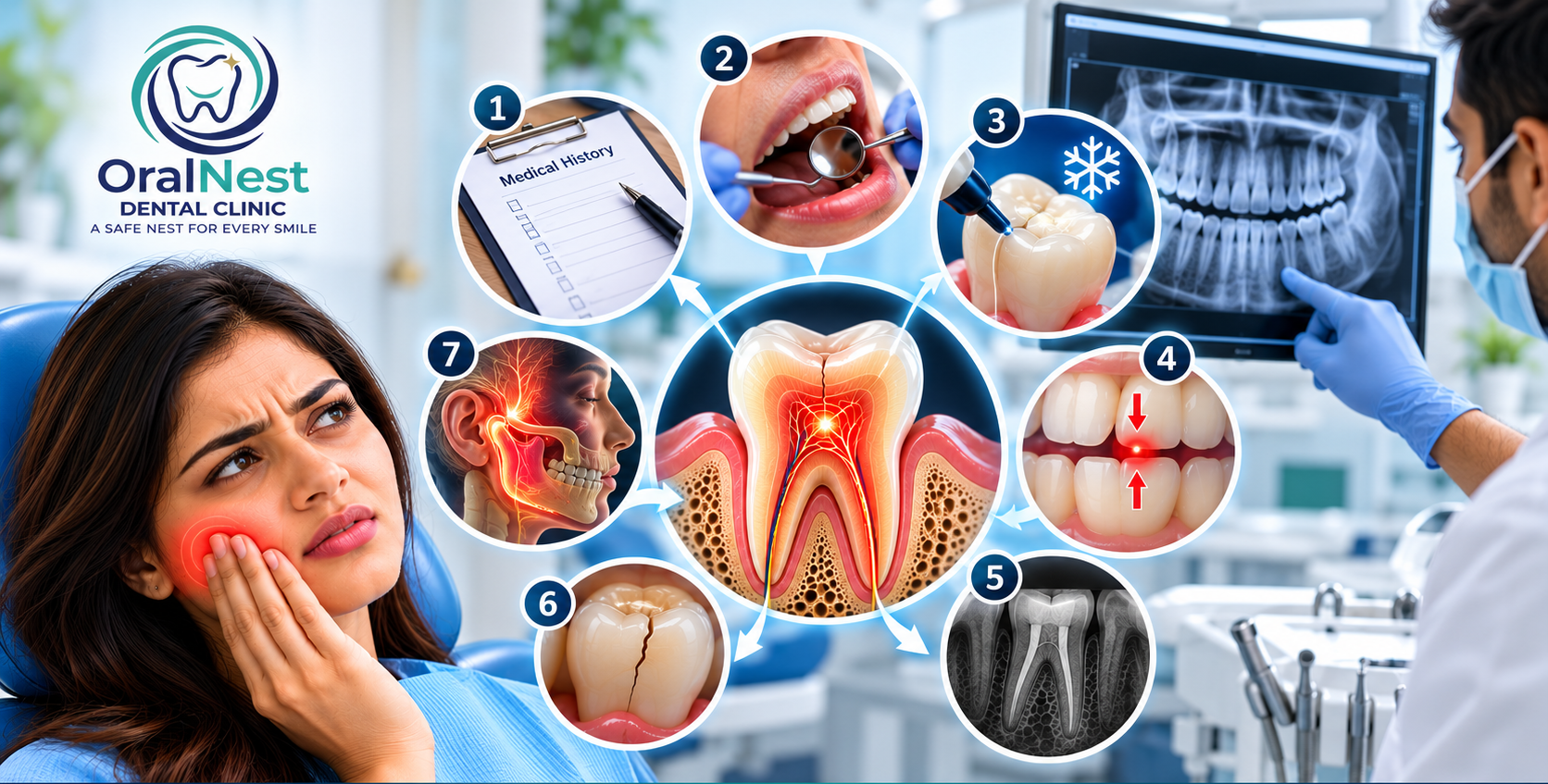
Step 1: Understanding Your Symptoms
The first part of diagnosis is listening carefully to what you are experiencing.
For example, brief sensitivity to cold may have a different significance from pain that continues for a prolonged period after the cold stimulus is removed.
Similarly, pain specifically associated with biting may point toward a different group of possible causes than spontaneous throbbing pain.
The pattern of pain can sometimes be as important as the presence of pain itself.
Step 2: Clinical Examination
The teeth, gums, surrounding tissues and bite are examined carefully.
The examination may look for:
Visible decay
Cracks or fractures
Defective fillings or crowns
Gum recession
Swelling
Tenderness
Changes around the gums
Abnormal tooth mobility
Bite-related problems
Signs of infection
The goal is not simply to find something that looks abnormal.
The goal is to determine whether the findings actually explain the symptoms.
Step 3: Testing the Tooth's Nerve
When the source of pain may involve the dental pulp, specific sensitivity tests can provide valuable information.
Depending on the situation, a dentist may assess how the tooth responds to cold or other stimuli and compare the response with neighbouring teeth.
This comparison is important because a patient may not always be able to identify the exact tooth responsible for the pain.
A tooth that feels painful to you may not necessarily be the tooth causing the problem.
Step 4: Checking the Bite
Some tooth problems become noticeable mainly when chewing.
The dentist may therefore evaluate how the upper and lower teeth contact each other.
Pain related to biting can sometimes be associated with excessive bite forces, a crack, inflammation around the root or problems involving an existing restoration.
This is one reason why “it only hurts when I bite” should not be dismissed simply because the tooth looks normal.
Step 5: Dental Imaging
X-rays can provide important information about the teeth and surrounding structures.
They may help identify decay, changes around the root, bone changes, previous root canal treatment and other abnormalities.
However, a normal-looking X-ray does not necessarily rule out every possible cause of tooth pain.
Some problems may be too early, too small or located in a way that is not clearly visible on a routine image.
When clinically appropriate, additional imaging may sometimes be considered.
Step 6: Putting the Findings Together
This is where diagnosis becomes more than simply identifying symptoms.
The dentist combines:
Your history + pain pattern + clinical findings + dental tests + imaging
to determine the most likely source.
Sometimes the evidence clearly points toward one tooth.
Sometimes the findings suggest that the pain may not be coming from the tooth at all.
And sometimes further observation or investigation is needed before making a treatment decision.
Does Unexplained Tooth Pain Automatically Mean Root Canal Treatment?
No.
Tooth pain can have many possible causes, and Root Canal Treatment is appropriate only when the diagnosis indicates that the tooth's pulp requires that treatment.
Depending on the findings, management may involve observation, restorative treatment, bite adjustment, treatment of gum-related problems, Root Canal Treatment, retreatment of a previously treated tooth, or investigation of another source of pain.
The treatment should follow the diagnosis—not the other way around.
When Should You Get a Second Opinion?
A second opinion can be worth considering when:
The source of pain remains unclear
The recommended treatment is extensive
Extraction has been suggested
Root Canal Treatment has been recommended but you are uncertain why
Pain continues after dental treatment
Different teeth have been identified as the possible source
Your symptoms do not match the diagnosis you were given
A second opinion should not simply mean getting another treatment recommendation. Its real value is understanding why the pain is occurring and what evidence supports the proposed treatment.
When Should Tooth Pain Be Evaluated?
Do not wait for pain to become unbearable before seeking evaluation.
Persistent or recurring tooth pain, swelling, pain while biting, prolonged hot/cold sensitivity, or symptoms returning after previous dental treatment deserve attention.
Urgent dental assessment is particularly important when pain is accompanied by significant swelling, fever, difficulty swallowing or difficulty breathing.
Unexplained Tooth Pain in Wakad and Nearby Areas
If you are experiencing unexplained tooth pain in Wakad, Kaspate Wasti, Pimple Gurav, Rahatani, Pimple Saudagar, Hinjawadi, Tathawade or nearby Pimpri-Chinchwad areas, the first step should be understanding the source of the pain.
At OralNest Dental Clinic, the focus is on evaluating the symptoms, clinical findings and appropriate imaging before deciding what treatment is actually required.
The key message
Tooth pain is a symptom—not a diagnosis.
A painful tooth does not automatically mean a cavity.
A normal X-ray does not automatically mean everything is fine.
Severe pain is not the only sign of a serious dental problem.
And tooth pain does not automatically mean you need a Root Canal Treatment.
When the cause of tooth pain is unclear, accurate diagnosis should come before treatment.
This final article can serve as the pillar page for the entire Unexplained Tooth Pain cluster, linking to your individual articles on cold sensitivity, biting pain, pain after fillings/crowns, referred pain, failed or painful root canal treatment, and RCT decision-making.
Keywords