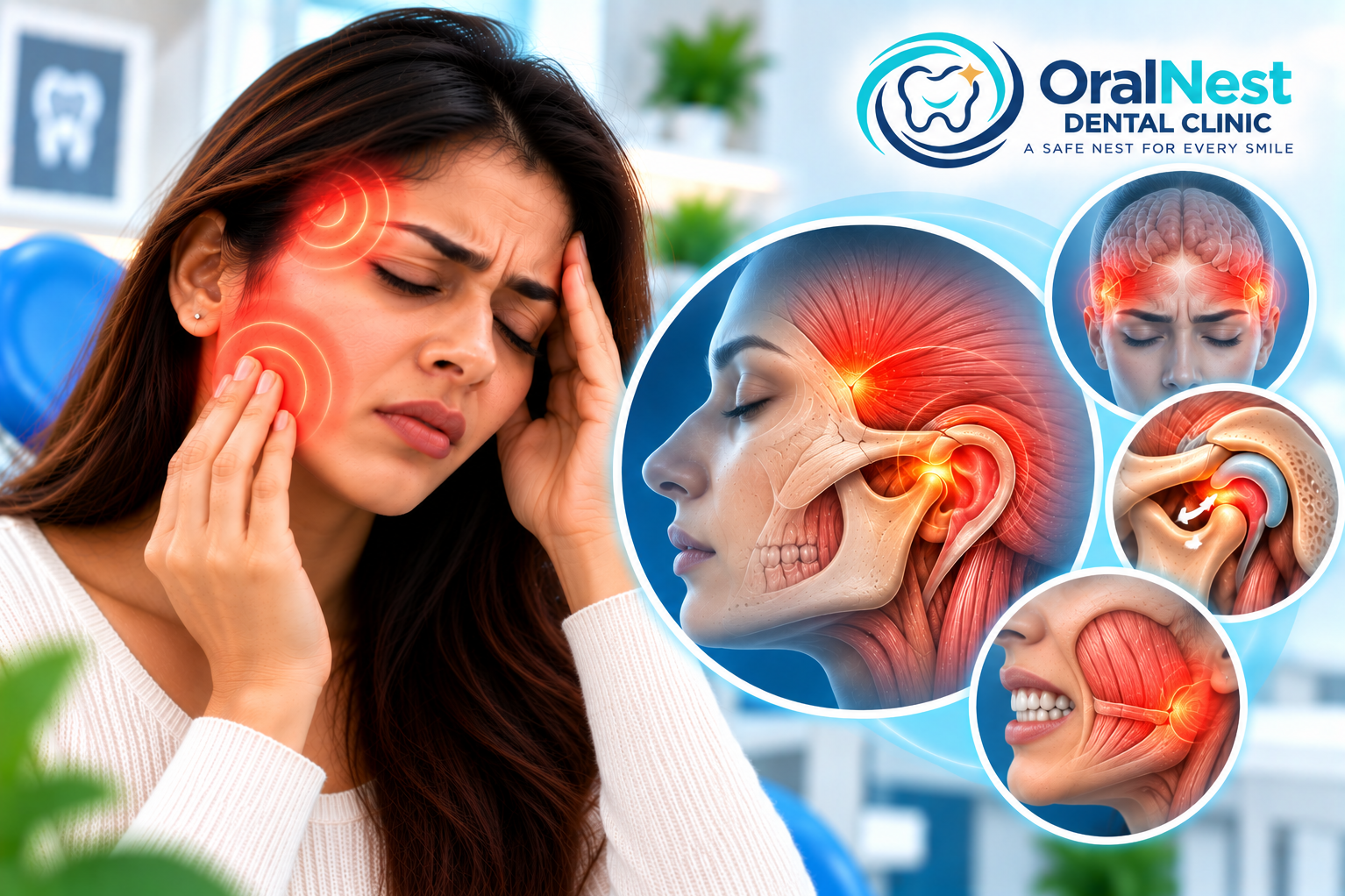
A headache can sometimes feel as though it is coming from the temples, forehead or around the ear. If you also experience jaw pain, clicking, clenching or difficulty opening your mouth, you may wonder:
“Could my jaw be causing my headache?”
The answer is sometimes—but not every headache is related to the TMJ.
Temporomandibular disorders (TMDs) include several conditions involving the jaw joints, chewing muscles and related structures. Headaches associated with a painful TMD are recognised as one category within the broader TMD spectrum.
This makes the distinction between a headache that happens alongside jaw symptoms and a headache actually associated with a TMD clinically important.
How Can a Jaw Problem Be Connected With Head Pain?
The jaw is surrounded by muscles that are heavily involved in chewing and jaw movement.
Some of these muscles extend across areas around the temples and face. When these muscles or the jaw joint become painful or overloaded, discomfort may be experienced beyond the immediate joint area.
Patients may describe:
Temple pain
Facial aching
Pain around the ear
Jaw soreness
Headache associated with chewing
Morning facial or jaw discomfort
Head pain occurring together with jaw symptoms
TMD-related pain can spread to the face or neck, and headaches can occur as part of the clinical picture.
But this does not mean that every headache originates from the jaw.
Does Every Headache With Jaw Pain Mean TMJ?
No.
This is one of the most important points for patients to understand.
Headaches have many possible causes. A person can have both a headache disorder and a jaw disorder without one necessarily causing the other.
NIDCR notes that TMDs may occur together with other conditions, including headaches and migraine.
Therefore, simply noticing:
“My temple hurts and my jaw clicks.”
is not enough to conclude:
“My TMJ is causing my headache.”
The relationship needs to be evaluated clinically.
What Clues May Suggest a Jaw-Related Component?
A jaw-related contribution becomes more relevant when head pain occurs alongside other jaw symptoms.
For example:
Headache + jaw pain
You experience temple or facial pain together with tenderness around the jaw joint or chewing muscles.
Headache + painful chewing
The discomfort becomes more noticeable while chewing or using the jaw.
Headache + restricted movement
You notice that your mouth does not open as widely as it normally does.
Headache + jaw locking
Your jaw catches or locks during opening or closing.
Headache + clenching
You frequently notice that your teeth are tightly together when you are not eating.
Headache + morning jaw soreness
You wake with jaw or temple discomfort, particularly if you also notice signs of clenching or grinding.
These patterns do not prove that TMD is responsible, but they can provide useful information during a clinical evaluation.
Why Do the Temples Sometimes Hurt?
The temporalis muscle is one of the major muscles involved in closing and moving the jaw.
It extends over the side of the skull in the temple region.
If chewing muscles become painful or overloaded, patients may perceive discomfort in areas beyond the jaw itself.
This is one reason a patient may say:
“My jaw doesn't hurt much, but my temples keep aching.”
A broader orofacial assessment can help determine whether the jaw muscles are clinically relevant—or whether another headache or facial-pain condition needs to be considered.
Can Teeth Grinding Cause Headaches?
Clenching and grinding can be associated with jaw muscle symptoms in some individuals.
However, it is important not to assume:
“I have a headache, therefore I grind my teeth.”
or:
“I grind my teeth, therefore every headache is from my jaw.”
The relationship between jaw symptoms, muscle activity, pain and other factors is more complex.
A proper evaluation considers the complete symptom pattern rather than attributing every headache to bruxism.
What If My Headache Gets Worse When I Chew?
This is useful information to mention during a consultation.
If jaw movement, prolonged chewing or clenching consistently aggravates pain around the temples or jaw, the chewing muscles and TMJ may deserve evaluation.
However, this still does not establish a diagnosis by itself.
The clinician may need to distinguish between:
Jaw-muscle pain
TMJ pain
A headache disorder
Dental pain
Other facial-pain conditions
or a combination of these.
Can TMJ Problems Cause Migraine?
This requires careful wording.
A person with TMD may also experience migraine or another primary headache disorder. NIDCR specifically notes that TMD can occur alongside migraine and other pain conditions.
That does not mean every migraine is caused by the TMJ.
Therefore, if someone has established migraine, treating the jaw alone should not automatically be expected to eliminate the headaches.
The correct approach is to determine whether there is a jaw-related component and whether another headache condition also requires attention.
Why Is This Sometimes Called Orofacial Pain?
Orofacial pain refers broadly to pain involving the mouth, jaw, face and related structures.
This becomes particularly relevant when a patient's complaint does not fit neatly into:
“It's a tooth.”
or
“It's the TMJ.”
A patient may have pain involving several overlapping structures, and the location where pain is felt does not always identify its source.
This is why a diagnostic approach can be particularly valuable for persistent or unexplained facial and jaw pain.
What Happens During a TMJ & Orofacial Pain Evaluation?
A useful evaluation begins with your story.
You may be asked:
Where exactly is the pain?
When did it begin?
How often does it occur?
How long does each episode last?
Does chewing make it worse?
Does opening the mouth trigger pain?
Do you experience clicking or locking?
Do you clench your teeth?
Is the pain worse in the morning?
Do you experience facial or ear symptoms?
Have you previously received treatment?
Do you have a history of headaches or migraine?
The clinician may then examine the:
TMJ → chewing muscles → jaw movement → teeth → oral structures → face and neck
depending on the symptoms.
NIDCR notes that TMD diagnosis can be challenging because symptoms may overlap with other conditions; evaluation may include history, examination and, when appropriate, imaging.
Does Every TMJ-Related Headache Need a Scan?
No.
Imaging is not automatically necessary for every patient with headache and jaw symptoms.
The decision depends on the clinical findings and whether imaging is likely to answer an important diagnostic question.
Possible imaging modalities may include radiographs, CT or MRI in selected cases.
The principle should be:
Investigate when the clinical question requires investigation.
Not simply because a patient has a headache.
Does Treating the TMJ Automatically Cure the Headache?
Not necessarily.
If a headache has a jaw-related component, managing the underlying TMD may help the associated pain.
But headaches can have multiple causes, and TMD may coexist with migraine or other headache disorders.
Therefore, a responsible clinical approach avoids promising:
“Treat your TMJ and your headaches will disappear.”
Instead, the more useful question is:
“Is there evidence that your jaw condition is contributing to your particular headache pattern?”
Does TMJ Treatment Always Mean a Night Guard?
No.
An oral appliance may be considered in selected patients, but the presence of headache or jaw clicking alone does not automatically mean that a night guard is appropriate.
NIDCR recommends starting with conservative approaches for many TMD problems and notes that evidence for the effectiveness of intraoral appliances in reducing TMD pain is limited.
Treatment should therefore follow the diagnosis.
How Dr. Ashutosh Dighe Approaches Headache With Jaw Symptoms
At OralNest Dental Clinic | Wakad, the focus is not on assuming that every headache is a TMJ problem.
Dr. Ashutosh Dighe — BDS, MDS – Oral Medicine & Maxillofacial Radiology, PhD Scholar, Fellowship in Contemporary Endodontics and Certified Endodontist — evaluates jaw, facial and oral symptoms by considering the patient's history, clinical findings and, when appropriate, radiographic information.
His Oral Medicine & Maxillofacial Radiology background is particularly relevant when a patient presents with symptoms that cross the boundaries between teeth, jaw, oral structures, facial pain and imaging findings.
The purpose is to answer a more useful clinical question:
“Is the jaw actually contributing to this patient's pain?”
If the findings suggest a TMD-related component, management can be discussed accordingly. If the symptoms suggest another cause, that possibility should not be overlooked simply because the patient also has jaw clicking or clenching.
That is the value of diagnosis before treatment.
TMJ & Headache Consultation in Wakad and Pimple Gurav
Patients searching for:
TMJ consultation in Wakad
Jaw pain and headache treatment in Wakad
TMJ specialist near Pimple Gurav
Orofacial pain consultation near Pimple Gurav
may encounter pages that treat “TMJ” as though it were one simple condition.
Clinically, it is much broader.
At OralNest Dental Clinic | Wakad, the geographic focus remains Wakad, while patients from Pimple Gurav, Rahatani, Pimple Saudagar and nearby PCMC areas can also consider the clinic for consultation.
Our Long-Term Wakad + Pimple Gurav Content Strategy
For the OralNest website, I would continue with:
Primary GEO
Wakad
Secondary GEO
Pimple Gurav
But the geographic terms should support the clinical topic rather than dominate it.
For example, this article naturally targets:
TMJ + headache + jaw pain + orofacial pain + Wakad + Pimple Gurav
Future articles can build adjacent search intent around:
Jaw pain
Jaw clicking
Jaw locking
Teeth grinding
TMJ evaluation
Orofacial pain
Facial pain
Ear pain related to jaw symptoms
Second opinions for complex jaw symptoms
This creates a topical cluster, rather than a collection of disconnected location-keyword pages.
My Strategic View for OralNest
I still recommend keeping Wakad as the dominant local entity for now.
Pimple Gurav should be developed as a secondary geographic opportunity, especially because your possible 1–2 year relocation/expansion makes it strategically relevant.
But the content should never imply that OralNest is already located in Pimple Gurav.
The strongest long-term positioning would be:
OralNest Dental Clinic
→ Wakad
→ Diagnosis-led dentistry
→ Oral Medicine
→ TMJ & Orofacial Pain
→ Complex Dental Diagnosis
with Pimple Gurav gradually becoming an additional geographic association.
That gives you flexibility later without weakening the location authority you are building today.
When Should You Seek Evaluation?
Consider professional assessment when headaches occur repeatedly with:
Jaw pain
Painful clicking
Jaw locking
Restricted mouth opening
Facial tenderness
Pain while chewing
Significant morning jaw soreness
Persistent or recurrent temple pain
Symptoms that are interfering with eating, speaking or daily activities
And importantly, not every headache should be attributed to the jaw.
If headaches are frequent, severe, changing in pattern, or accompanied by other concerning symptoms, appropriate medical evaluation may also be necessary. The NHS advises urgent assessment for certain combinations of severe headache and jaw/temporal symptoms.
The Key Takeaway
Can TMJ problems cause headaches?
They can be associated with headaches, particularly when a painful TMD is present. But not every headache comes from the TMJ.
The presence of:
headache + jaw clicking
does not automatically prove a TMJ cause.
The more useful approach is to understand the complete pattern:
Where is the pain?
What triggers it?
What does the jaw do?
Are the muscles tender?
Is there locking or restricted movement?
Could another condition explain the symptoms?
The goal is not to find a TMJ diagnosis for every headache. The goal is to find the correct explanation for the patient's pain.
Frequently Asked Questions
Can TMJ cause temple headaches?
A painful TMD can be associated with headaches, including pain in the temple region. However, other headache disorders can produce similar symptoms.
Can teeth grinding cause headaches?
Clenching or grinding may contribute to jaw-muscle symptoms in some people, but headache should not automatically be attributed to bruxism.
How do I know whether my headache is from my jaw?
There is no reliable self-test. A clinical history and examination can help determine whether jaw findings are consistent with a TMD-related pain pattern.
Do I need an MRI for TMJ headache?
Not automatically. Imaging is considered when the clinical findings indicate that it may provide useful diagnostic information.
Does every TMJ headache require treatment?
No. Many TMD symptoms improve with conservative management or without complex treatment.
Where can I consult for TMJ and orofacial pain in Wakad?
Patients in Wakad and nearby areas including Pimple Gurav and Rahatani can seek a structured evaluation of jaw, facial and oral pain symptoms at OralNest Dental Clinic | Wakad.
At OralNest Dental Clinic | Wakad
Understand First. Diagnose Carefully. Decide With Clarity.
Mon–Sat: 5:30 PM–9:00 PM
Sunday: 10:00 AM–1:00 PM
Prior appointment is convenient.
Keywords