A click, pop or snap when you open your mouth can be surprisingly noticeable. Some people hear it while eating, yawning or speaking. Others notice it only occasionally.
The first question many patients ask is:
“Does jaw clicking mean something is wrong with my TMJ?”
Not necessarily.
Jaw sounds can occur for different reasons, and a clicking sound by itself does not automatically mean that treatment is required. The more important question is whether the sound is accompanied by pain, restricted movement, locking or other functional changes.
What Causes a Jaw to Click?
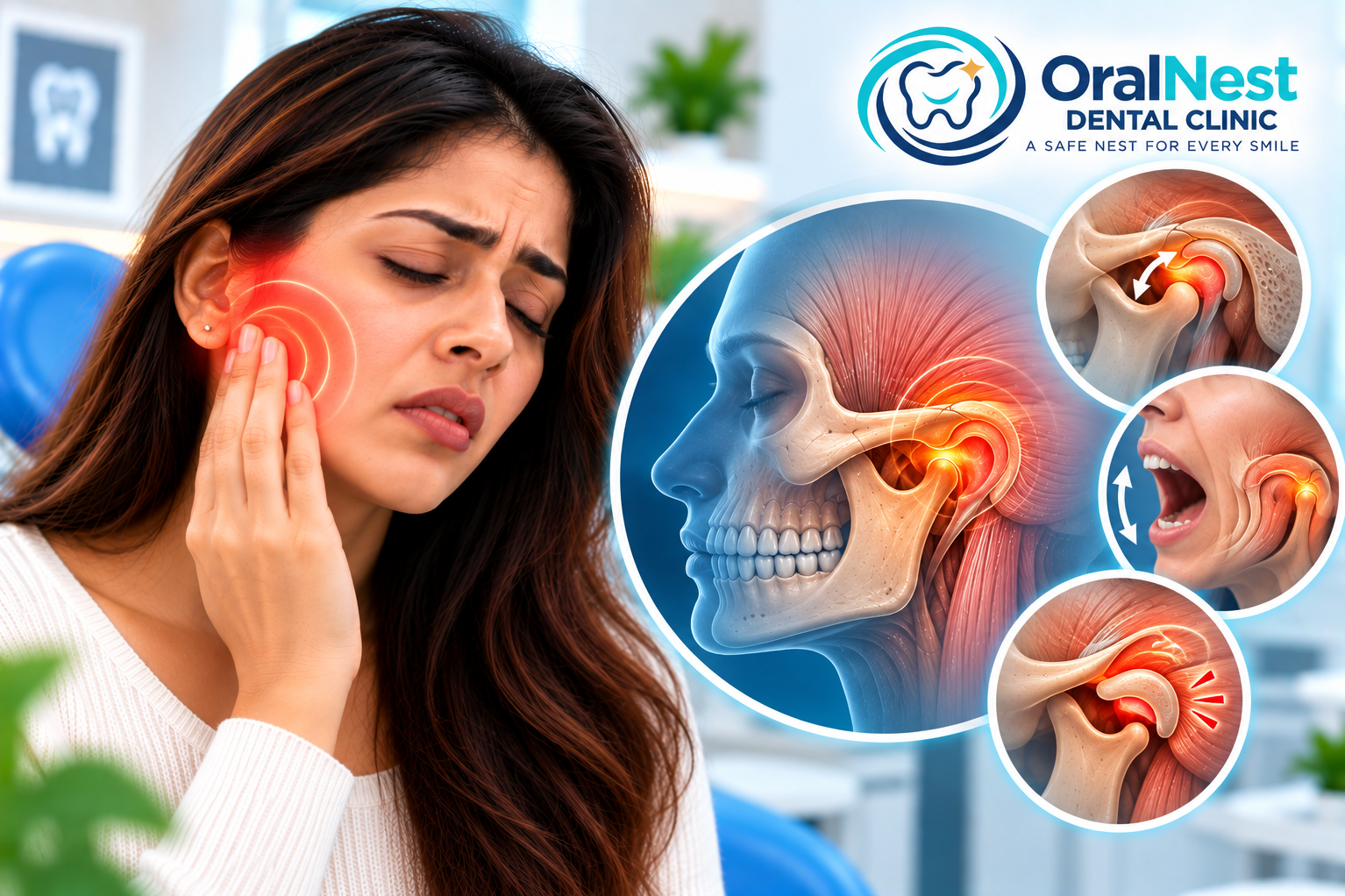
The temporomandibular joint (TMJ) is a small but complex joint located just in front of each ear. It allows the lower jaw to move forward, backward and from side to side.
Inside the joint is a small disc that helps the joint move smoothly.
A clicking or popping sound can occur when the movement of the disc and the jaw joint is altered. One recognised condition is disc displacement with reduction, where the disc moves out of its usual position during part of jaw movement and then returns.
But not every jaw sound means the same thing.
Jaw noises may also be associated with changes within the joint, muscle-related problems or other TMJ conditions. Proper clinical assessment is therefore more useful than trying to diagnose the cause from the sound alone.
Is Jaw Clicking Normal?
In some people, yes.
A person may have a clicking or popping jaw for years without significant pain or difficulty using the jaw.
According to the National Institute of Dental and Craniofacial Research (NIDCR), jaw joint sounds can be common, and clicking or popping without pain or limitation of movement does not necessarily require treatment.
Therefore:
Clicking ≠ automatically disease.
The context matters.
When Does Jaw Clicking Become More Important?
A jaw click deserves greater attention when it occurs together with symptoms such as:
Jaw pain
Pain while chewing
Difficulty opening the mouth
A feeling that the jaw is getting stuck
Episodes of jaw locking
Increasing stiffness
Pain around the ear
Temple or facial pain
Recurrent headaches associated with jaw symptoms
A noticeable change in jaw movement
A change in how the upper and lower teeth meet
In these situations, the objective should not simply be to “stop the clicking.”
The first objective should be to understand why the clicking is occurring and whether it is clinically significant.
Does Every Clicking Jaw Need Treatment?
No.
This is an important distinction.
If a patient has an isolated jaw click without pain, functional limitation or other concerning findings, treatment may not be necessary.
On the other hand, if clicking is accompanied by pain, locking or restricted movement, an evaluation may help determine whether a specific temporomandibular disorder is present.
Treatment decisions should therefore be based on the overall clinical picture, not the sound alone.
What If My Jaw Clicks But Doesn't Hurt?
This is one of the most common situations.
If your jaw clicks occasionally but:
You have no pain
You can open your mouth normally
Your jaw does not lock
Chewing is comfortable
There is no progressive change
there may not be a reason to immediately pursue aggressive treatment.
However, if the pattern changes—for example, a previously painless click becomes painful or your jaw starts catching or locking—professional evaluation becomes more relevant.
Can Jaw Clicking Get Worse?
It can change over time, but a click does not automatically mean that the condition will progressively worsen.
Some patients remain stable for years.
Others develop additional symptoms such as pain or restricted movement.
This is why it is more useful to monitor the symptom pattern and function of the jaw rather than becoming anxious about the sound itself.
Should You Try to Stop the Clicking Yourself?
It is generally better not to repeatedly force the jaw open or deliberately reproduce the click.
Constantly testing the joint can increase awareness of the symptom and may place unnecessary repetitive stress on the jaw.
Instead, pay attention to:
When does it click?
Does it hurt?
Does the jaw ever lock?
Can you open normally?
Does chewing trigger discomfort?
These observations can provide much more useful information during a consultation.
Why Is TMJ Evaluation More Than Listening for a Click?
A proper TMJ evaluation is not simply:
“Open your mouth and let me hear the sound.”
A clinician may consider:
The history and duration of symptoms
Pain location and character
Jaw opening and movement
Joint sounds
Jaw deviation during opening
Chewing-muscle tenderness
Joint tenderness
Locking episodes
Dental findings
Associated facial or headache symptoms
Previous trauma or dental treatment
Habits such as clenching or grinding
Imaging is not automatically required for every patient. When clinical findings indicate that imaging could provide useful information, the appropriate modality may be considered.
Can a Dental Problem Cause Jaw Pain Along With Clicking?
The symptoms of dental and orofacial conditions can overlap.
A patient may assume that discomfort near the jaw joint is a TMJ problem when the actual source needs to be evaluated elsewhere.
That is why a diagnosis-first approach is particularly useful when jaw symptoms are unclear.
The question should not simply be:
“How do I stop my jaw from clicking?”
It should be:
“What does my jaw clicking mean in my particular situation?”
How Dr. Ashutosh Dighe Approaches Jaw & TMJ Symptoms
At OralNest Dental Clinic | Wakad, TMJ and orofacial symptoms are approached through clinical assessment rather than automatically labelling every jaw sound as a TMJ disorder.
Dr. Ashutosh Dighe — BDS, MDS – Oral Medicine & Maxillofacial Radiology, PhD Scholar, Fellowship in Contemporary Endodontics and Certified Endodontist — evaluates the patient's symptoms, clinical findings and, when appropriate, radiographic information to understand the underlying problem.
His Oral Medicine & Maxillofacial Radiology background is particularly relevant when symptoms involve the jaw, face, oral structures and pain patterns that may not have an obvious dental explanation.
The purpose is not to treat every click.
It is to determine whether the click is:
Simply a joint sound → something to monitor → associated with a functional problem → or part of a broader TMJ/orofacial pain condition.
That distinction can prevent unnecessary treatment while ensuring that meaningful symptoms are not overlooked.
TMJ Care in Wakad & Pimple Gurav
For patients searching for TMJ consultation in Wakad, jaw pain consultation in Wakad, TMJ treatment near Pimple Gurav, or jaw clicking treatment near Pimple Gurav, the important first step is understanding the symptom rather than selecting treatment based only on the keyword “TMJ.”
OralNest Dental Clinic is currently located in Kaspate Wasti, Wakad, and its online presence already includes patient information relating to TMJ and jaw-pain care.
For patients coming from Pimple Gurav, Rahatani, Pimple Saudagar and surrounding PCMC areas, the clinic's Wakad location can also serve as a nearby option for consultation.
A Note About Pimple Gurav — Our Long-Term SEO & Location Strategy
Since you specifically want Wakad + Pimple Gurav to become the two major geographic targets, I think this is a sensible long-term SEO strategy, but I would handle the location positioning carefully.
Pimple Gurav already has an established dental market. Current online listings show multiple dental practices there, including Khare Dental Home, while Practo lists practices such as Ekdant Dental Care and Dr. Saurabh's Oral Health Clinic.
So I would not position Pimple Gurav as an empty or uncontested dental market.
Instead, the opportunity is to gradually build a specialist-led diagnostic identity around topics such as:
Oral Medicine
Oral diagnosis
TMJ & orofacial pain
Complex dental diagnosis
Dental second opinions
Root canal decision-making
Wisdom tooth assessment
Dental imaging and treatment planning
My honest opinion on a possible move in 1–2 years
I would not move the clinic purely because of SEO.
Your strongest asset right now is the existing Wakad entity, reviews, website history, patient experience and location association. Moving too early could mean giving up accumulated local authority and rebuilding your physical-location signals.
Instead, I would use the next 12–24 months to build:
OralNest → Wakad → Specialist Diagnosis → TMJ → Oral Medicine → Complex Dental Problems
while simultaneously developing a secondary digital association:
OralNest → Pimple Gurav → Oral Medicine → TMJ → Dental Diagnosis
without ever pretending that the clinic is physically located in Pimple Gurav.
If a physical move eventually becomes commercially attractive, you would then have an established digital audience already searching for OralNest in both geographic areas.
That is a much safer strategy than suddenly changing the entire website from Wakad to Pimple Gurav.
The Key Takeaway
A clicking jaw is not automatically a damaged jaw.
A click without pain may simply need observation.
A click with pain, locking or restricted movement deserves proper evaluation.
And the most important decision is not:
“How do I stop the clicking?”
It is:
“What is causing my jaw to click, and does it actually need treatment?”
Frequently Asked Questions
Is jaw clicking always a TMJ disorder?
No. Jaw sounds can occur for several reasons, and clicking without pain or functional limitation does not necessarily require treatment.
Should I worry if my jaw clicks but doesn't hurt?
Not necessarily. However, changes such as pain, locking or restricted movement should be evaluated.
Can jaw clicking disappear?
Symptoms can change over time, but whether a click resolves or persists varies between individuals.
Should every clicking jaw get an X-ray?
No. Imaging is generally considered according to the clinical findings and whether it is likely to add useful diagnostic information.
Can jaw clicking be related to teeth grinding?
Clenching and grinding can contribute to jaw symptoms in some individuals, but they are not the only possible explanation.
Where can I consult for jaw clicking in Wakad?
A structured TMJ/orofacial evaluation can help determine whether the clicking is clinically significant and whether further investigation is necessary.
At OralNest Dental Clinic | Wakad
Understand First. Diagnose Carefully. Decide With Clarity.
Mon–Sat: 5:30 PM–9:00 PM
Sunday: 10:00 AM–1:00 PM
Prior appointment is convenient.
Keywords