
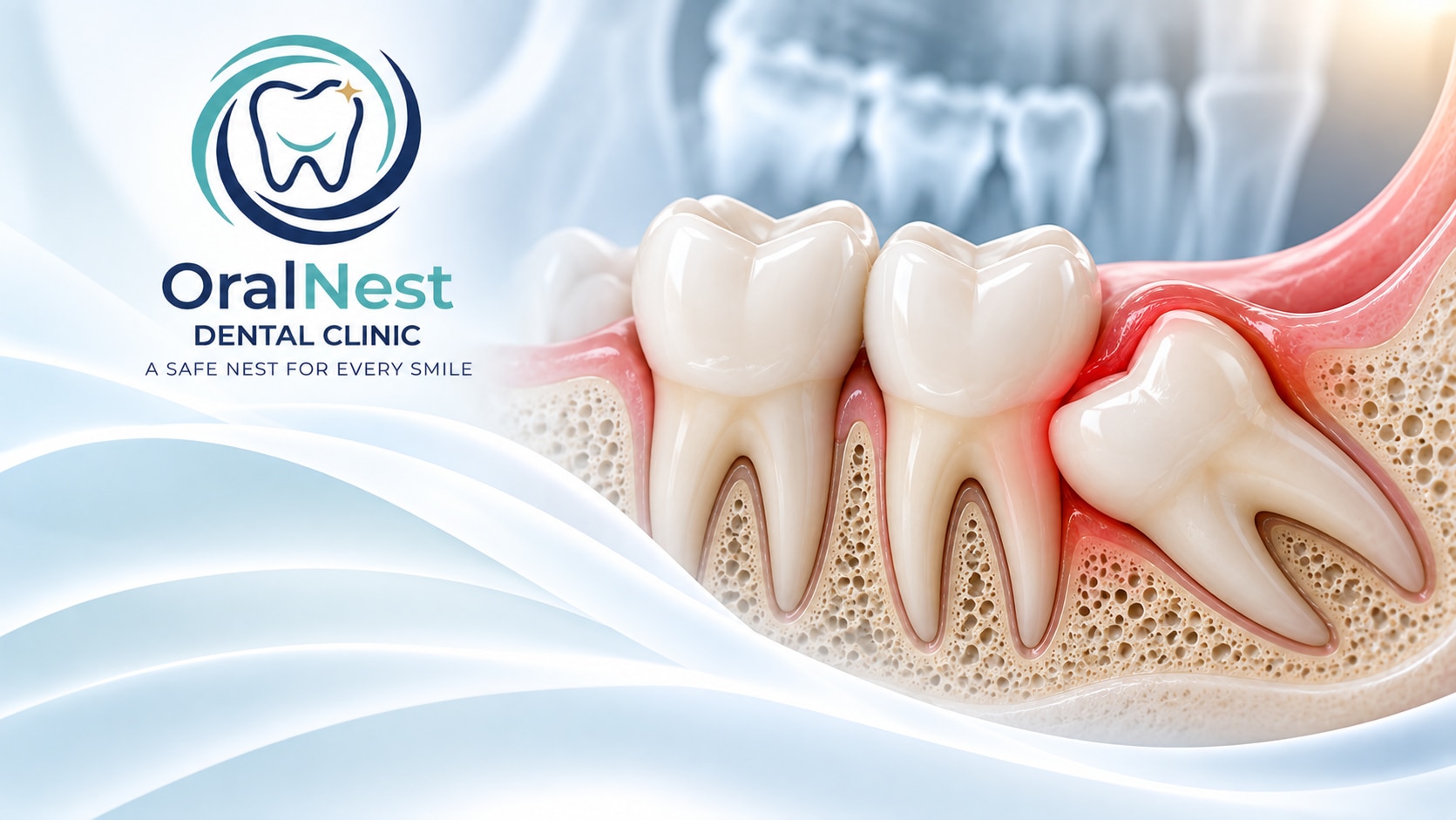
Wisdom Tooth Removal in Wakad & Pimple Gurav, Pune
Experiencing wisdom tooth pain or swelling? Explore impacted wisdom tooth evaluation, removal, treatment planning and recovery at OralNest Dental Clinic in Wakad, Pune.
When a Wisdom Tooth Becomes a Problem, the Right Decision Starts With Understanding Why
Pain at the back of the jaw, swelling near the last molar, difficulty opening the mouth or food repeatedly getting trapped behind a tooth can sometimes indicate a wisdom tooth problem. However, not every wisdom tooth requires removal, and not every episode of back-tooth pain originates from a wisdom tooth.
At OralNest DENTAL CLINIC | Wakad, Pune, wisdom tooth evaluation focuses on understanding the tooth's position, symptoms, surrounding structures and potential effect on neighbouring teeth. The aim is to determine whether monitoring, preventive guidance, treatment of an existing problem or wisdom tooth removal is the most appropriate option.
Patients looking for wisdom tooth removal in Wakad, impacted wisdom tooth treatment near Pimple Gurav, wisdom tooth pain evaluation in Pune or a dental consultation for recurring swelling around the last molar can seek an assessment based on their individual clinical condition.
A wisdom tooth should not be removed simply because it is the last tooth in the mouth. The important questions are whether it is healthy, whether it can be cleaned and maintained, whether it is causing disease and what the likely long-term consequences may be.
What Is a Wisdom Tooth?
A wisdom tooth is the third molar, located at the back of the mouth. These teeth usually emerge during the late teenage years or early adulthood, although the timing varies.
Some wisdom teeth erupt normally, function comfortably and remain healthy. Others may have insufficient space to emerge properly, remain partly covered by gum tissue or become trapped beneath the gum or jawbone.
Depending on its position, a wisdom tooth may be:
Fully erupted and functional
Partially erupted through the gum
Impacted beneath the gum or within the jawbone
Angled towards the neighbouring molar
Positioned almost horizontally
Difficult to clean because of its location
Associated with recurrent inflammation or decay
The position, accessibility, surrounding tissues and condition of the neighbouring tooth all influence whether treatment is necessary.
Does Every Wisdom Tooth Need to Be Removed?
No. A healthy, properly positioned and maintainable wisdom tooth may not require extraction.
Removal may be considered when there is a clear clinical reason, including:
Recurrent pain or swelling around the wisdom tooth
Infection of the gum surrounding a partially erupted tooth
Significant tooth decay that cannot be managed predictably
Gum disease affecting the wisdom tooth or adjacent tooth
Damage or decay involving the neighbouring second molar
Repeated food trapping associated with inflammation or disease
Certain cystic or other pathological changes
A position or condition that creates a significant clinical problem
In some cases, monitoring and appropriate oral hygiene may be suitable. In others, removal may be recommended to manage existing disease or reduce a meaningful risk to nearby structures.
The decision should follow an individual examination and appropriate investigations rather than a blanket rule that all wisdom teeth must be removed.
What Is an Impacted Wisdom Tooth?
An impacted wisdom tooth cannot erupt normally because of its position, insufficient space or obstruction from surrounding gum tissue or bone.
Impaction does not always cause immediate symptoms. However, depending on its position, an impacted tooth may be associated with inflammation, food accumulation, decay, periodontal problems or damage to the adjacent molar.
Common positions of impacted wisdom teeth
Mesioangular impaction: The tooth tilts towards the neighbouring molar.
Horizontal impaction: The tooth lies almost sideways and may be directed towards the adjacent tooth.
Vertical impaction: The tooth is relatively upright but cannot erupt normally.
Distoangular impaction: The tooth angles away from the neighbouring molar.
These descriptions help explain tooth position, but they do not independently determine whether removal is necessary. The clinical condition, surrounding anatomy and potential risks must also be considered.
Symptoms That May Indicate a Wisdom Tooth Problem
Consider a dental evaluation if you experience:
Pain at the back of the jaw
Swelling or redness around the last molar
Tenderness behind the second molar
Difficulty opening the mouth comfortably
Pain while chewing
Repeated gum inflammation near the wisdom tooth
Food frequently becoming trapped behind the last tooth
An unpleasant taste or smell from the affected area
Difficulty cleaning the back of the mouth
Recurrent swelling that settles and returns
Discomfort extending towards the ear or jaw
These symptoms can have several causes, including decay, gum infection, problems with the adjacent molar or jaw-related conditions. An examination helps distinguish between them.
Seek urgent dental assessment for significant or worsening swelling, fever, or difficulty opening the mouth. Facial swelling with difficulty swallowing or breathing requires emergency medical attention.
Why Is Examination and Imaging Important Before Wisdom Tooth Removal?
Wisdom tooth removal requires an understanding of the tooth's position and its relationship with the surrounding anatomy.
Clinical examination and appropriate dental imaging, when indicated, may help assess:
The direction and depth of impaction
Root shape and development
The condition of the neighbouring molar
The surrounding bone
Signs of decay, infection or other pathology
The relationship to important anatomical structures
The type of imaging depends on the clinical findings and complexity of the case. Additional imaging is not automatically required for every patient; it should be recommended when it is expected to provide useful information for diagnosis, planning or risk assessment.
At OralNest, the purpose of assessment is to understand the actual problem, evaluate treatment options and plan an appropriate approach before proceeding.
What Happens During Wisdom Tooth Removal?
The procedure depends on whether the wisdom tooth is fully erupted, partially erupted or impacted.
1. Clinical consultation
Your symptoms, dental history and the condition of the wisdom tooth and neighbouring teeth are evaluated.
2. Diagnostic assessment
Examination and appropriate imaging help establish the tooth's position, surrounding anatomy and the complexity of the procedure.
3. Treatment planning
The findings are used to discuss whether monitoring or removal is appropriate and whether a straightforward extraction or a surgical approach may be required.
4. Anaesthesia
Appropriate anaesthesia, commonly local anaesthesia, is used according to the procedure and individual requirements.
5. Tooth removal
A fully erupted wisdom tooth may sometimes be removed using a straightforward extraction technique. An impacted tooth may require surgical access through the gum and, where necessary, carefully planned removal of some surrounding bone or sectioning of the tooth.
The approach depends on the tooth's position and anatomy.
6. Post-treatment instructions
Aftercare guidance is provided according to the procedure. Instructions may cover bleeding control, oral hygiene, diet, activity, prescribed medication where indicated and follow-up.
Is Wisdom Tooth Removal Painful?
During the procedure, appropriate anaesthesia is used to control pain. You may feel pressure or movement, but the experience varies according to the procedure and individual circumstances.
After removal, some soreness, swelling, jaw stiffness or difficulty chewing can occur. These effects vary with the complexity of the extraction and individual healing.
Your dentist should explain the expected recovery and the steps to follow if symptoms worsen or do not improve as expected.
How Long Does Wisdom Tooth Removal Take?
There is no single duration for every wisdom tooth procedure.
A fully erupted tooth may be relatively straightforward to remove, while a deeply impacted tooth with complex roots may require a more involved surgical approach.
The complexity can depend on the tooth's position, depth of impaction, root anatomy, surrounding bone, relationship to nearby structures and presence of infection.
A clinical assessment helps establish the likely complexity and allows the procedure to be discussed before treatment.
What Is Recovery Like After Wisdom Tooth Removal?
Recovery differs from patient to patient and depends on the nature of the procedure.
Temporary soreness, swelling, mild bleeding, jaw stiffness and difficulty chewing may occur. Following the instructions provided by your dental team helps protect the extraction site while it heals.
Aftercare commonly involves:
Following instructions for bleeding control
Choosing suitable foods during the initial recovery period
Maintaining oral hygiene carefully
Avoiding activities that may interfere with healing
Taking prescribed medication only as directed
Attending follow-up when advised
Contact your dental provider if pain or swelling worsens, bleeding does not settle as instructed, fever develops or you experience other concerning symptoms. Difficulty swallowing or breathing requires emergency medical attention.
What Are the Possible Risks of Wisdom Tooth Removal?
Wisdom tooth removal is a commonly performed dental procedure, but it carries potential risks.
Depending on the case, these may include bleeding, infection, swelling, temporary jaw stiffness, dry socket, injury to nearby structures or nerve-related symptoms. The nature and likelihood of complications vary with the tooth's position, anatomy and the complexity of removal.
A tooth located close to important nerves or other anatomical structures may require particular attention during treatment planning. Appropriate assessment and imaging, when indicated, help inform the approach and discussion of risks.
Patients should have the opportunity to understand the expected benefits, limitations and potential complications before deciding how to proceed.
Can a Wisdom Tooth Damage the Tooth Next to It?
Yes, an improperly positioned or partially erupted wisdom tooth can contribute to problems affecting the adjacent second molar.
Food and plaque may accumulate in difficult-to-clean areas, increasing the risk of decay or local gum problems. Depending on the position and condition of the wisdom tooth, the neighbouring tooth may also require assessment for damage.
For this reason, wisdom tooth evaluation should consider both the wisdom tooth and the adjacent molar. Preserving the health of the neighbouring tooth is an important part of treatment planning.
Can Wisdom Tooth Problems Cause Bad Breath or Jaw Pain?
They can, but these symptoms are not specific to wisdom teeth.
A partially erupted tooth may create an area where food and bacteria accumulate, contributing to inflammation, unpleasant taste or odour. Infection or inflammation around the tooth may also cause pain near the back of the jaw.
Jaw pain can arise from several other causes, including dental decay, muscle problems or temporomandibular joint disorders. Persistent symptoms should be evaluated rather than automatically attributed to wisdom teeth.
Clinical Evaluation at OralNest Dental Clinic
Wisdom tooth treatment is not simply about removing the last tooth in the mouth. The tooth's position, surrounding anatomy, relationship with neighbouring teeth and potential risks all matter.
At OralNest DENTAL CLINIC | Wakad, clinical evaluation and treatment planning are supported by Dr. Ashutosh Dighe — BDS, MDS – Oral Medicine & Maxillofacial Radiology, PhD Scholar, Fellowship in Contemporary Endodontics, Certified Endodontist.
His training in Oral Medicine & Maxillofacial Radiology supports a diagnostic approach to evaluating oral conditions and relevant imaging findings. The recommended management depends on the patient's clinical findings and the complexity of the case.
The emphasis is on understanding whether the tooth needs monitoring, treatment or removal, explaining the available options and helping the patient make an informed decision.
Wisdom Tooth Removal in Wakad, Pimple Gurav and Nearby Pune Areas
If you are searching for wisdom tooth removal in Wakad, impacted wisdom tooth treatment near Pimple Gurav, wisdom tooth pain consultation in Rahatani, wisdom tooth extraction near Pimple Saudagar or a dental assessment for recurring swelling around the last molar in Pimpri-Chinchwad, OralNest DENTAL CLINIC in Wakad can help you understand the appropriate next steps.
The clinic serves patients from:
Wakad and Kaspate Wasti
Pimple Gurav and Rahatani
Pimple Saudagar
Hinjawadi and Tathawade
Punawale and Ravet
Baner and Balewadi
Sangvi and nearby Pimpri-Chinchwad areas
OralNest is located in Wakad, Pune. These nearby localities are service areas, not separate clinic branches.
Whether you are experiencing wisdom tooth pain, repeated gum swelling, difficulty opening your mouth or concerns about an impacted tooth, an individual assessment can help establish whether treatment is necessary and what approach may be suitable.
Frequently Asked Questions About Wisdom Tooth Removal
When should a wisdom tooth be removed?
Removal may be recommended when a wisdom tooth causes recurrent infection, significant decay, gum problems, damage to an adjacent tooth or another clinically important problem. The decision depends on the examination and relevant investigations.
Is wisdom tooth removal necessary if there is no pain?
Not always. Some wisdom teeth without symptoms can be monitored, while others may have clinical findings that justify treatment. An assessment helps determine the appropriate approach.
What is an impacted wisdom tooth?
An impacted wisdom tooth cannot erupt normally because of its position, lack of space or obstruction from surrounding tissue or bone.
Can a wisdom tooth cause swelling and difficulty opening the mouth?
Yes. Inflammation or infection around a wisdom tooth may cause swelling, pain and restricted mouth opening. These symptoms should be assessed promptly, particularly if they are worsening.
Can wisdom tooth removal damage nearby nerves?
Nerve-related complications are possible in certain cases, depending on the tooth's location and anatomy. Assessment and appropriate imaging, when indicated, help evaluate the relationship to important structures and inform treatment planning.
How long does wisdom tooth removal take to heal?
Recovery varies according to the complexity of the extraction and individual healing. Your dental provider can explain expected recovery and aftercare for your procedure.
Can all four wisdom teeth be removed together?
In selected cases, multiple wisdom teeth may be removed during the same treatment plan. Whether this is appropriate depends on the patient's clinical condition, tooth positions, complexity and treatment requirements.
Is wisdom tooth removal always a surgical procedure?
No. A fully erupted tooth may sometimes be removed through a straightforward extraction. An impacted tooth may require a surgical approach.
Where can I consult for wisdom tooth removal in Wakad?
OralNest DENTAL CLINIC is located in Wakad, Pune, and serves patients from Wakad, Pimple Gurav and nearby Pimpri-Chinchwad areas. A consultation can help establish whether the wisdom tooth requires monitoring, treatment or removal.
Make the Right Decision About Your Wisdom Tooth
Wisdom tooth pain, swelling and impaction can raise important questions. The appropriate next step is not always immediate extraction; it is understanding the tooth's position, assessing any existing problems and considering the risks and benefits of the available options.
At OralNest DENTAL CLINIC | Wakad, Pune, the focus is on appropriate evaluation, clear explanations and individualised treatment planning.
Evaluate the tooth. Understand its position. Assess the risks. Choose the appropriate treatment.
OralNest DENTAL CLINIC
A SAFE NEST FOR EVERY SMILE