
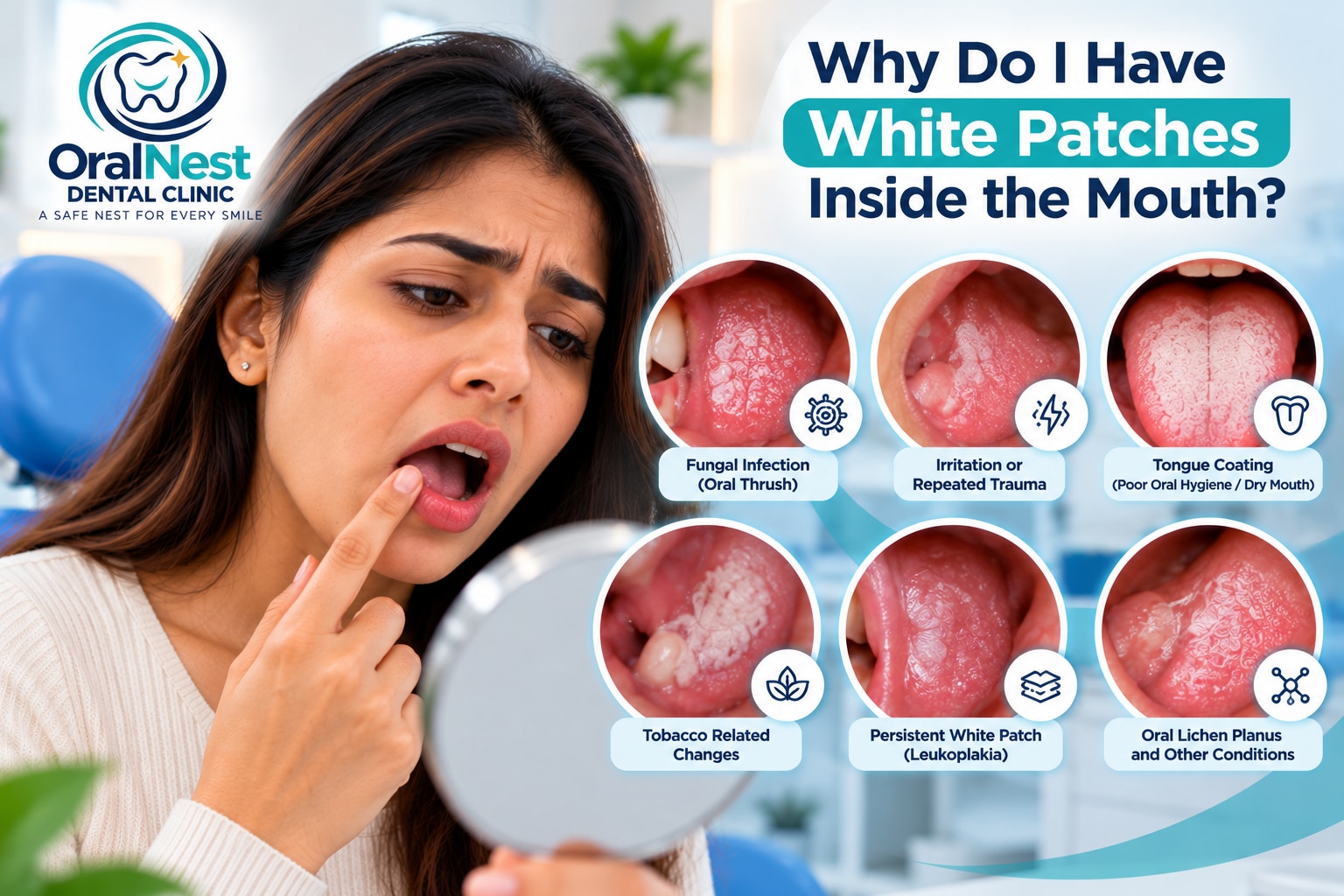
White or red patches inside your mouth? Learn about possible causes, warning signs and oral medicine assessment at OralNest Dental Clinic in Wakad, Pune.
White or Red Patches in the Mouth: Oral Medicine Consultation in Wakad & Pimple Gurav, Pune
Have you noticed a white patch inside your cheek, a red area on your tongue, or a change in the lining of your mouth that does not seem to disappear? Such changes can have several causes. Some are related to irritation or inflammation, while others require more detailed clinical assessment.
The important step is not to assume that every patch is dangerous—or that every painless patch is harmless.
At OralNest Dental Clinic in Wakad, Pune, patients can seek consultation for unusual oral changes, persistent patches and other concerns involving the lining of the mouth. The purpose is to assess the finding, understand its clinical context and determine whether monitoring, treatment, further investigation or referral is appropriate.
For patients searching for oral medicine consultation near Wakad, Pimple Gurav or Rahatani, understanding when a patch needs professional evaluation can help avoid unnecessary delay.
What Are White and Red Patches Inside the Mouth?
The lining of the mouth, known as the oral mucosa, covers areas such as the inner cheeks, lips, gums, tongue and floor of the mouth. Changes in its colour, texture or surface can occur for different reasons.
A white patch may appear as a flat area, a thicker plaque or a change in the surface texture. A red patch may look like an area of persistent redness, irritation or altered tissue.
Some patches cause burning, soreness or discomfort. Others remain painless and are discovered incidentally while brushing or examining the mouth.
Colour alone cannot establish the diagnosis. The patch's location, duration, appearance, texture, associated symptoms and relevant personal history all influence the assessment.
What Can Cause a White Patch Inside the Mouth?
1. Frictional Irritation
Repeated rubbing from a sharp tooth, biting the cheek or another source of local trauma can cause changes in the oral lining. The affected area may appear whitish or thickened.
A suspected source of irritation should be assessed and addressed appropriately. A patch that persists after the irritation is removed should not automatically be assumed to be harmless.
2. Oral Lichen Planus
Oral lichen planus is an inflammatory condition that can produce white, lace-like lines or other changes inside the mouth. Some people experience soreness or burning, while others have few symptoms.
Its appearance can overlap with other oral conditions. Clinical assessment is important to establish the likely diagnosis and determine whether follow-up or additional investigation is needed.
3. Oral Candidiasis
Oral candidiasis is a fungal infection that can sometimes produce white areas in the mouth. Its appearance and associated symptoms vary, and certain risk factors can increase the likelihood of infection.
Not every white patch is fungal. Antifungal medication should not be used simply because an area looks white; the diagnosis and appropriate treatment need to be established.
4. Leukoplakia and Other Persistent White Lesions
Leukoplakia is a clinical term used for certain predominantly white oral patches that cannot be classified as another specific condition after appropriate assessment.
Some persistent white lesions may carry a risk of potentially malignant change. However, not every white patch is leukoplakia, and the term should not be applied through self-diagnosis or photographs alone.
A persistent unexplained white patch deserves professional examination to determine whether further assessment or a biopsy is indicated.
What Can Cause a Red Patch Inside the Mouth?
Red areas may occur because of inflammation, trauma, infection or other changes affecting the oral tissues.
Some red patches are associated with identifiable causes. Others may represent conditions that require more detailed investigation.
A persistent, unexplained red patch—particularly one that is not healing, has an irregular appearance or occurs alongside other concerning changes—should be assessed promptly. Certain red lesions can have a higher risk of significant underlying tissue changes, so they should not be ignored merely because they do not hurt.
The aim of examination is to distinguish between possible causes and determine the appropriate next step without assuming a diagnosis from colour alone.
When Should You Be Concerned About an Oral Patch?
Arrange a professional assessment if you notice:
A white or red patch that persists or does not heal.
A patch that grows, changes in appearance or develops an irregular surface.
A sore, lump or thickened area without a clear explanation.
Unexplained bleeding, numbness or continuing discomfort.
A persistent ulcer or a lesion that repeatedly returns.
Difficulty moving the tongue, chewing or swallowing associated with an oral change.
A patch that remains after a suspected source of irritation has been addressed.
A patch lasting around two weeks or longer should be assessed, especially when there is no clear cause or it shows no sign of healing. Do not wait for that threshold if the lesion is enlarging, bleeding, hard, or otherwise concerning.
These signs do not automatically mean cancer. They indicate that the cause needs to be established rather than guessed.
Are White or Red Patches Signs of Oral Cancer?
Not necessarily. Many oral patches arise from non-cancerous conditions, irritation or inflammation. However, certain persistent oral lesions can represent potentially malignant disorders or, less commonly, oral cancer.
A lesion's colour, absence of pain or appearance in a photograph cannot reliably rule out a serious condition. Clinical examination and, when indicated, additional investigations are needed.
Early assessment is important because it helps identify which lesions can be managed conservatively and which require closer investigation or specialist referral.
How Are Oral Patches Assessed at OralNest Dental Clinic?
Assessment of an oral patch involves more than simply looking at its colour.
Depending on the findings, a consultation may include:
Medical and dental history: Reviewing when the patch appeared, whether it has changed, whether it has occurred before, and whether there are associated symptoms or relevant exposures.
Examination of the oral tissues: Assessing the location, size, distribution, texture and surrounding mucosa, as well as checking for other oral changes.
Evaluation of possible irritants: Considering sharp tooth edges, repeated trauma, oral products, tobacco or areca nut exposure and other relevant factors.
Further investigations when indicated: Depending on the suspected condition, the clinician may recommend additional tests, specialist assessment or referral for biopsy and tissue diagnosis by an appropriate clinician.
Dr. Ashutosh Dighe holds BDS, MDS – Oral Medicine & Maxillofacial Radiology, is a PhD Scholar, has completed a Fellowship in Contemporary Endodontics, and is a Certified Endodontist. His postgraduate background is relevant to the assessment of oral conditions and diagnostic concerns. The appropriate investigation and management plan depend on the clinical findings.
Does Every White or Red Patch Need a Biopsy?
No. A biopsy is not necessary for every oral patch. Some findings may have a clear, reversible cause and can be managed with appropriate treatment and follow-up.
However, a biopsy or referral may be recommended when the appearance, persistence, history or clinical examination raises concern or when a definitive tissue diagnosis is needed.
The decision depends on the individual lesion. It is not possible to determine reliably from colour alone whether a patch needs a biopsy.
What Should You Do Before Your Appointment?
If you notice an unexplained oral patch:
Record when you first noticed it and whether it has changed.
Avoid repeatedly rubbing, scraping or trying to remove it.
Avoid tobacco and areca nut products.
Avoid any product that appears to aggravate the area.
Bring a list of relevant medications and previous investigations if available.
Arrange an assessment rather than repeatedly applying unprescribed gels or home remedies.
If you have a photograph showing how the lesion has changed over time, it may help explain the history. However, photographs cannot replace a clinical examination.
Oral Medicine Consultation in Wakad & Pimple Gurav, Pune
If you are searching for an oral medicine consultation in Wakad, Pune, OralNest Dental Clinic provides consultation for oral symptoms and mucosal changes that require clinical assessment.
Patients from Wakad, Pimple Gurav, Rahatani, Pimple Saudagar, Hinjawadi, Tathawade, Punawale, Ravet, Baner, Balewadi and nearby parts of Pimpri-Chinchwad may visit the Wakad clinic.
The clinic is physically located in Wakad; the surrounding localities are service areas, not separate clinic branches.
The objective of consultation is to understand the nature of the oral change, explain the findings and guide appropriate treatment, further investigation or referral where required.
Frequently Asked Questions About White or Red Patches in the Mouth
Why do I have a white patch inside my cheek?
Possible causes include frictional irritation, oral lichen planus, candidiasis and other oral conditions. A persistent or unexplained patch should be examined rather than diagnosed by appearance alone.
Is a painless white patch something to worry about?
A painless patch is not necessarily serious, but absence of pain does not establish that it is harmless. Persistent or changing patches deserve professional assessment.
Can a red patch inside the mouth be serious?
Some red patches result from inflammation or irritation, while others may need more detailed investigation. An unexplained persistent red patch should be assessed promptly.
Can white patches be caused by tobacco or areca nut use?
Tobacco and areca nut exposure are associated with important oral health risks and certain potentially malignant oral conditions. Avoiding these products is strongly advisable, and persistent oral changes should be evaluated.
Does every oral patch require a biopsy?
No. The decision depends on the suspected diagnosis and examination findings. Some lesions can be managed through treatment and follow-up, while others require tissue diagnosis or referral.
Which doctor should I consult for a persistent oral patch in Wakad?
An oral medicine consultation can help assess persistent oral lesions and determine whether further investigation or referral is required. OralNest Dental Clinic in Wakad offers consultation for relevant oral health concerns.
When should I seek urgent medical attention?
Seek prompt professional assessment for an enlarging or persistent lesion, unexplained bleeding, a lump, numbness or difficulty swallowing. Difficulty breathing or swallowing associated with swelling requires emergency medical care.
Do Not Guess the Cause of a Persistent Oral Patch
A white or red patch may be harmless, but its appearance alone cannot establish that conclusion. Duration, texture, location, associated symptoms and clinical findings all matter.
At OralNest Dental Clinic, Wakad, Pune, the focus is on careful oral assessment and appropriate guidance so that patients understand whether a lesion needs treatment, monitoring, further investigation or specialist referral.
OralNest Dental Clinic — A SAFE NEST FOR EVERY SMILE.