
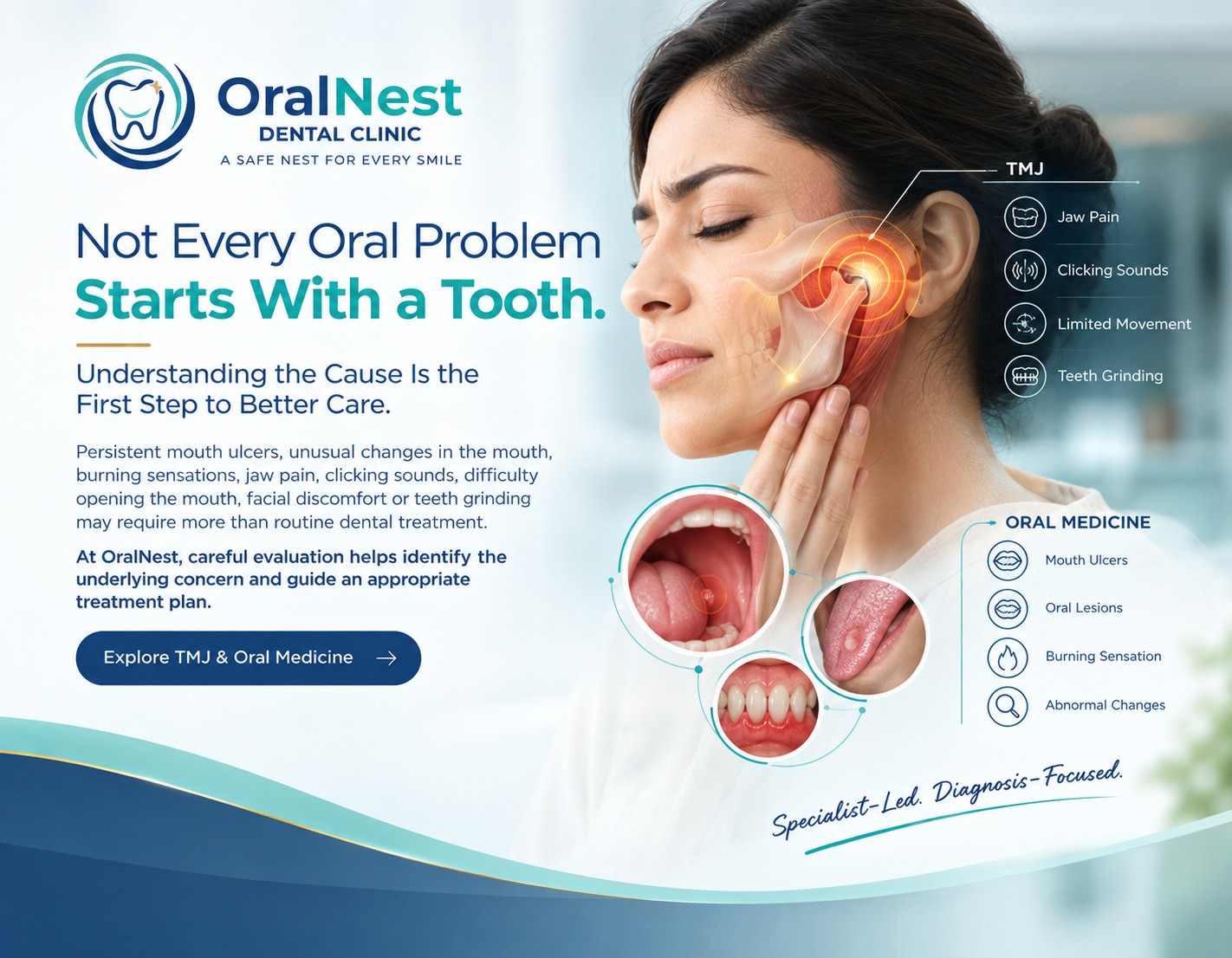
TMJ & Jaw Pain Consultation in Wakad & Pimple Gurav, Pune
Jaw pain, clicking, stiffness or difficulty opening your mouth? Explore TMJ assessment and jaw pain care at OralNest Dental Clinic in Wakad, Pune.
Understanding Jaw Pain, Clicking, Restricted Movement and Facial Discomfort
Jaw pain is not always a dental problem—and not every clicking jaw needs treatment.
If you experience pain near the ears, difficulty opening your mouth, discomfort while chewing, morning jaw stiffness, facial muscle tenderness or recurring jaw-related headaches, the cause may involve the temporomandibular joint (TMJ), the muscles responsible for jaw movement or another condition affecting the teeth and surrounding structures.
For some people, symptoms are occasional. For others, they interfere with eating, speaking, yawning, sleeping or everyday comfort. The uncertainty can be just as frustrating as the discomfort itself: Is it a TMJ disorder? Could clenching or grinding be contributing? Is the pain coming from a tooth, a muscle or the joint?
At OralNest Dental Clinic in Wakad, Pune, patients with jaw-related concerns can seek clinical assessment to understand their symptoms and determine an appropriate next step. The approach focuses on careful evaluation, relevant diagnostic investigations when indicated, clear explanations and individualised treatment planning.
The priority is to understand the cause of your symptoms before deciding what care may be appropriate.
What Is the Temporomandibular Joint (TMJ)?
The temporomandibular joints are the paired joints located on either side of your head, just in front of your ears. Each connects the lower jaw to the skull and works with surrounding muscles and other structures to coordinate jaw movement.
You use these joints when you:
Open and close your mouth.
Chew food and swallow.
Speak and yawn.
Move your lower jaw from side to side.
The joint, its supporting structures and the muscles that control jaw movement work together. Symptoms may therefore arise from the joint itself, the surrounding muscles or other conditions that produce similar discomfort.
TMJ refers to the joint. Temporomandibular disorders (TMD) is the broader term used for conditions involving the joint, jaw muscles and related structures.
Understanding this distinction matters because jaw pain does not have one universal cause or one universal treatment.
Symptoms That May Need a TMJ or Jaw Pain Assessment
Consider a dental assessment if you experience persistent, recurrent or function-limiting symptoms such as:
Jaw pain: discomfort near the jaw joint, in front of the ear or along the jaw muscles.
Clicking or popping: sounds during opening, closing or chewing, particularly when accompanied by pain or restricted movement.
Difficulty opening the mouth: reduced movement, stiffness or discomfort when yawning or eating.
Jaw locking: episodes in which the jaw becomes stuck or movement is suddenly restricted.
Pain while chewing: discomfort that increases with prolonged chewing or particular jaw movements.
Morning jaw stiffness: tightness or soreness after waking, sometimes associated with clenching or grinding.
Facial muscle tenderness: soreness around the cheeks, temples or muscles used for chewing.
Jaw-related headaches: headaches that occur alongside jaw tenderness or symptoms triggered by jaw movement.
Teeth clenching or grinding: habits that may contribute to tooth wear, muscle discomfort or other symptoms.
Ear-area discomfort: pain near the ear without an obvious explanation from the ear itself.
Changes in jaw function: discomfort, fatigue or difficulty using the jaw normally.
These symptoms do not automatically confirm a TMJ disorder. Some people have painless jaw clicking without requiring treatment, while similar pain may arise from dental, muscular, joint-related or other medical conditions.
The pattern of symptoms and the clinical findings help determine what should be investigated.
Why Does Jaw Pain Occur?
Identifying the likely source of discomfort is an important part of choosing appropriate care.
1. Temporomandibular joint-related conditions
Problems affecting the joint or its supporting structures may cause pain, clicking, restricted movement or episodes of locking. Different joint conditions can produce similar symptoms, so the sound or location of the pain alone is not enough to establish a diagnosis.
2. Jaw muscle pain and overuse
The muscles used for chewing can become painful or tender. Prolonged clenching, repeated muscle activity and other contributing factors may be associated with discomfort around the jaw and temples.
3. Teeth clenching and grinding
Bruxism refers to clenching or grinding the teeth. It may occur during sleep or while awake. Some people develop tooth wear, muscle fatigue or jaw soreness, while others have few noticeable symptoms.
Clenching should not automatically be assumed to be the cause of every jaw complaint. Assessment helps establish whether it is likely to be relevant.
4. Dental conditions that resemble jaw pain
A cracked tooth, dental infection, inflamed dental pulp or other dental problem can cause pain that spreads towards the jaw or ear. Treating a presumed TMJ disorder without considering dental causes may delay appropriate care.
5. Other causes of facial or jaw discomfort
Jaw symptoms can sometimes be associated with trauma, inflammatory conditions, nerve-related pain or other medical problems. Depending on the presentation, assessment by a clinician from another medical or dental discipline may be necessary.
The same symptom can have different explanations. The correct approach depends on the clinical picture, not simply the presence of clicking or pain.
How Is a TMJ and Jaw Pain Consultation Conducted?
An appropriate assessment begins with your symptoms and medical and dental history. The purpose is to understand the nature of the problem, identify relevant findings and determine whether further investigations or referral are needed.
Step 1: Understand your symptoms
The clinician may ask:
When did the discomfort begin?
Is it constant or does it occur during specific movements?
Does chewing, yawning or opening the mouth make it worse?
Is there clicking, locking or reduced movement?
Do you wake with jaw soreness or notice clenching during the day?
Have you experienced facial trauma, recent dental treatment or similar symptoms before?
Are there associated dental, ear-area, facial or general symptoms?
These details help establish the pattern and context of the complaint.
Step 2: Examine jaw movement and relevant structures
Depending on the symptoms, the clinical examination may include assessment of jaw opening and movement, tenderness around the joint and chewing muscles, relevant teeth and oral structures, and signs that may help distinguish dental pain from other sources of discomfort.
The examination is tailored to the individual. Not every patient needs the same tests or assessment steps.
Step 3: Decide whether further investigations are needed
Many jaw complaints can initially be assessed through history and clinical examination. Imaging or other investigations may be considered when the findings suggest that additional information is needed.
The appropriate investigation depends on the clinical question. Different imaging methods show different structures, and specialised imaging is not automatically necessary for every patient with jaw pain.
Step 4: Explain the findings and next steps
Once the available information has been reviewed, the findings and their implications can be discussed with you.
If the cause is reasonably clear, an appropriate management plan may be considered. If the diagnosis remains uncertain, the next step may involve additional assessment, monitoring or referral to a clinician with the relevant expertise.
The objective is to avoid assuming a diagnosis before the evidence supports it.
Specialist-Informed Assessment at OralNest Dental Clinic
OralNest Dental Clinic follows a diagnosis-focused approach to dental care, with attention to understanding the patient's symptoms before selecting a treatment pathway.
Dr. Ashutosh Dighe's qualifications include:
BDS
MDS – Oral Medicine & Maxillofacial Radiology
PhD Scholar
Fellowship in Contemporary Endodontics
Certified Endodontist
His postgraduate training in Oral Medicine & Maxillofacial Radiology is relevant to the assessment of oral and maxillofacial diagnostic concerns. His endodontic training is relevant to evaluating dental conditions that may sometimes resemble or contribute to pain around the jaw.
For a patient with jaw discomfort, this diagnostic perspective can help guide the assessment of possible oral and dental causes and the need for further evaluation.
However, not all jaw pain originates from a dental condition, and not every TMJ disorder can be managed through dental treatment alone. Where appropriate, referral or coordinated care with another clinician may be recommended.
The emphasis is on identifying the most appropriate care pathway for the individual—not assuming that one professional or one procedure is suitable for every case.
TMJ Treatment: Why There Is No Single Solution for Everyone
Treatment depends on the suspected diagnosis, symptom severity, duration, functional limitations and individual clinical findings.
For many uncomplicated temporomandibular disorders, conservative management is considered before invasive or irreversible procedures. Depending on the case, this may involve education, monitoring, self-care measures, habit modification, guided exercises or other appropriate interventions.
Conservative care and symptom management
When clinically suitable, a management plan may include temporarily reducing activities that aggravate the symptoms, avoiding excessive jaw opening and learning to recognise daytime clenching. Advice should be adapted to the individual's condition rather than applied as a universal prescription.
Oral appliances and night guards
An appropriately selected oral appliance may be considered in some patients, particularly where tooth protection or management of certain clenching-related concerns is relevant.
A night guard is not a guaranteed cure for every TMJ disorder. Its design, purpose, suitability and follow-up should be determined by a qualified clinician. Patients should not assume that an appliance is necessary simply because their jaw clicks or they experience a headache.
Further evaluation or specialist care
Persistent pain, significant restriction of movement, recurrent locking or symptoms that do not improve may require further assessment. Depending on the findings, other dental or medical professionals may need to be involved.
Irreversible changes to the bite, extensive restorative treatment or surgery should not be undertaken solely on the assumption that they will resolve unexplained jaw pain. Such decisions require an appropriate diagnosis and careful consideration of the benefits, risks and alternatives.
The goal is appropriate, proportionate care—not unnecessary intervention or a promise of instant relief.
Teeth Clenching, Grinding and Jaw Pain
Clenching or grinding can place repeated forces on the teeth and may be associated with muscle discomfort in some individuals. Bruxism can occur during sleep or while awake, and patients do not always realise they are doing it.
Possible signs include:
Jaw soreness or fatigue on waking.
Tenderness in the chewing muscles.
Worn or flattened tooth surfaces.
Chipped teeth or damaged restorations.
Awareness of clenching during concentration or stress.
These signs are not proof that bruxism is the sole cause of the symptoms. Tooth wear may have other explanations, and headaches can arise from many conditions.
An assessment can help determine whether clenching or grinding appears relevant and whether habit awareness, monitoring, tooth protection or another intervention may be appropriate.
Jaw Clicking Without Pain: Should You Be Worried?
A clicking or popping sound can occur during jaw movement without pain or loss of function. In some people, this does not require active treatment.
However, clicking accompanied by pain, recurrent locking, difficulty opening the mouth or a noticeable change in jaw function deserves assessment.
Avoid repeatedly forcing the jaw to click or performing aggressive jaw exercises in an attempt to correct the sound. If the symptom is new, worsening or affecting everyday activities, seek professional advice.
The need for treatment depends on the clinical findings and the impact on function—not simply whether a sound is present.
Can TMJ Disorders Cause Headaches or Ear-Area Pain?
Some temporomandibular disorders and jaw muscle conditions can be associated with pain around the temples, face or ear region. Symptoms may be influenced by chewing, jaw movement or muscle tenderness.
However, a headache or earache should not automatically be attributed to the TMJ. Ear conditions, migraine, nerve-related pain and other medical causes may produce overlapping symptoms.
If you have persistent headaches, ear symptoms or facial pain, an appropriate assessment can help determine whether the jaw is likely to be involved or whether medical evaluation is needed.
When Should You Seek Professional Assessment?
Consider arranging an evaluation if you have:
Jaw pain that persists or repeatedly returns.
Pain while eating or speaking.
Restricted mouth opening.
Recurrent episodes of jaw locking.
Clicking accompanied by discomfort.
Jaw muscle tenderness or morning stiffness that affects daily life.
Symptoms that are worsening or interfering with normal activities.
Jaw discomfort alongside unexplained dental or facial symptoms.
You do not need to identify the exact condition before seeking help. The purpose of an assessment is to investigate the symptoms and determine the appropriate next step.
When is urgent medical care necessary?
Seek prompt medical assessment for significant facial or jaw trauma, sudden severe restriction of jaw movement, or rapidly developing swelling. Difficulty breathing or swallowing, rapidly spreading facial swelling, or jaw pain accompanied by chest pressure, breathlessness, sweating or faintness requires emergency medical attention.
Do not assume that every episode of jaw pain is dental or TMJ-related.
What Can You Do While Waiting for an Assessment?
If your symptoms are mild and there are no urgent warning signs, some temporary measures may reduce strain while you arrange appropriate advice:
Choose softer foods if chewing aggravates the pain.
Avoid chewing gum and unnecessarily hard or chewy foods.
Avoid forcing the mouth open widely.
Notice whether you are holding your teeth tightly together during the day; when relaxed, the teeth generally do not need to remain in contact.
Avoid repeatedly testing or forcing a painful jaw movement.
Follow only medication advice that is appropriate for you, taking account of your medical history and other medicines.
These measures are not a substitute for diagnosis. If symptoms worsen, persist or limit function, seek professional assessment rather than relying on self-care alone.
TMJ and Jaw Pain Care in Wakad and Pimple Gurav, Pune
If you are searching for TMJ consultation in Wakad, jaw pain assessment in Wakad, jaw clicking evaluation near Pimple Gurav or dental assessment for facial discomfort in Pune, OralNest Dental Clinic provides a local point of contact for discussing your symptoms and determining the appropriate clinical pathway.
Our clinic is located in Wakad and may be convenient for patients travelling from nearby areas, including Pimple Gurav, Rahatani, Pimple Saudagar, Hinjawadi, Baner, Balewadi, Tathawade, Punawale, Ravet, Sangvi and other parts of Pimpri-Chinchwad.
These are nearby service areas, not separate OralNest clinic locations.
Whether you are experiencing a clicking jaw, difficulty chewing, recurring muscle discomfort or uncertainty about the source of your symptoms, the first step is to understand what may be contributing to the problem.
Frequently Asked Questions About TMJ and Jaw Pain
1. Which doctor should I consult for TMJ pain in Wakad?
The appropriate clinician depends on the symptoms and suspected cause. A dental consultation may be a useful starting point when dental or jaw-related causes are being considered. Depending on the findings, referral to an appropriate specialist or medical professional may be necessary. At OralNest Dental Clinic in Wakad, patients can discuss their symptoms and undergo an initial assessment to determine the next step.
2. Does jaw clicking always mean I have a TMJ disorder?
No. Clicking can occur without pain or functional difficulty and may not require treatment. Clicking accompanied by pain, locking or restricted movement should be assessed. A sound alone cannot establish the diagnosis.
3. Can a TMJ disorder cause headaches?
Some jaw joint and chewing-muscle conditions can be associated with headaches, particularly when symptoms occur alongside jaw tenderness or movement-related discomfort. However, headaches have many possible causes, so they should not automatically be attributed to the TMJ.
4. Can teeth grinding cause jaw pain?
Clenching and grinding may contribute to muscle soreness, tooth wear and jaw discomfort in some patients. They are not necessarily the cause of every jaw symptom. Assessment helps determine whether bruxism is relevant and whether management is indicated.
5. Will I need a night guard for TMJ pain?
Not everyone with jaw pain needs a night guard. An oral appliance may be appropriate for selected patients, depending on the diagnosis and treatment objectives. Its suitability should be assessed individually rather than assumed from symptoms alone.
6. Is imaging required for every TMJ consultation?
No. The need for imaging depends on the history, examination and specific clinical question. When imaging is indicated, the appropriate method is selected according to the information needed.
7. Can TMJ pain go away on its own?
Some mild symptoms may settle, but the course varies with the underlying cause. Persistent, recurrent or worsening pain, locking or restricted movement should be evaluated rather than assumed to resolve without care.
8. Should I stop eating normally if my jaw hurts?
You do not necessarily need to stop eating. If chewing aggravates your symptoms, temporarily choosing softer foods and avoiding excessive jaw strain may help. Persistent pain or difficulty eating warrants assessment.
9. Is TMJ treatment always surgical?
No. Many temporomandibular disorders are initially managed with conservative approaches when appropriate. The treatment depends on the diagnosis, severity and response to care. Surgery is not the default treatment for ordinary jaw clicking or unexplained jaw pain.
10. Can I visit OralNest if I am unsure whether my pain is dental or TMJ-related?
Yes, you can seek an assessment to discuss your symptoms and determine whether a dental or jaw-related cause should be investigated. If the findings suggest a non-dental condition or the need for additional expertise, further evaluation or referral may be recommended.
Begin With Understanding, Not Assumptions
Jaw pain can have several explanations, and the right treatment depends on identifying the problem as accurately as possible.
At OralNest Dental Clinic, Wakad, the focus is on listening to your concerns, evaluating the relevant findings, explaining the available options and helping you understand the next appropriate step.
TMJ & Jaw Pain Care in Wakad and Pimple Gurav, Pune
Your symptoms deserve careful attention—not guesswork.
OralNest Dental Clinic
A SAFE NEST FOR EVERY SMILE