
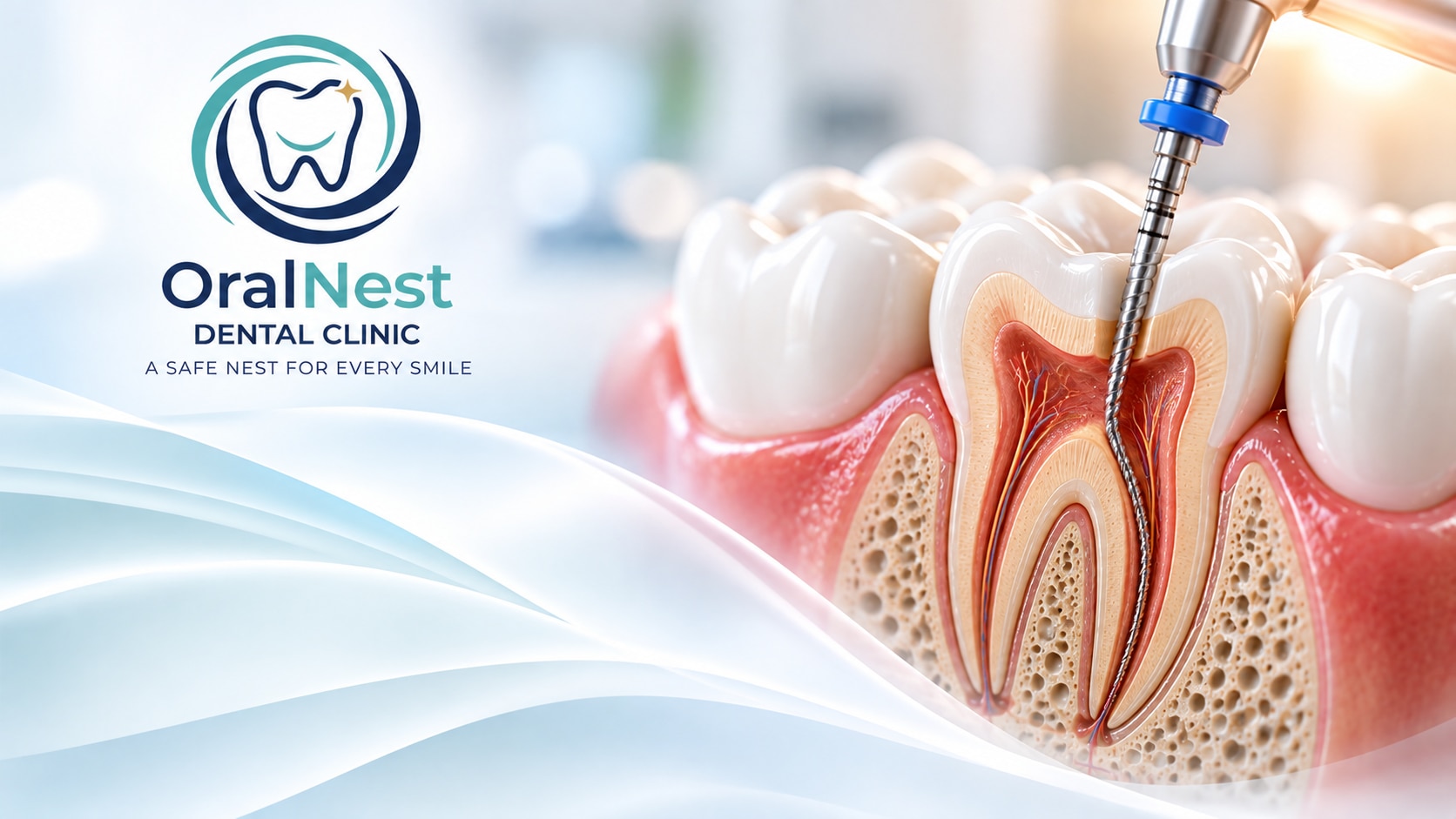
Root Canal Treatment in Wakad & Pimple Gurav, Pune
Severe tooth pain, lingering sensitivity or dental infection? Explore root canal treatment, tooth preservation and crown options at OralNest Dental Clinic, Wakad, Pune.
Severe Tooth Pain? Understand Whether Your Tooth Can Be Saved.
Persistent toothache, sensitivity to hot or cold, pain while chewing, or swelling around a tooth can indicate an underlying dental problem. Sometimes, the cause is deep decay or inflammation of the dental pulp, the soft tissue inside the tooth. In such cases, Root Canal Treatment (RCT) may help treat the diseased tissue and preserve the natural tooth when it can be predictably restored.
However, not every toothache requires a root canal, and not every damaged tooth can be saved with one. The correct treatment depends on the cause of the symptoms, the extent of damage, the condition of the root and surrounding tissues, and the amount of healthy tooth structure remaining.
At OralNest DENTAL CLINIC | Wakad, root canal treatment is approached as an individual clinical decision rather than a standard procedure offered for every painful tooth. The objective is to understand the problem, explain the available options, and determine whether root canal treatment, another dental procedure, or extraction is appropriate.
For patients searching for root canal treatment in Wakad, Pimple Gurav and nearby areas of Pune, understanding these differences can help make an important dental decision with greater confidence.
What Is Root Canal Treatment?
Root canal treatment is a dental procedure used to treat disease or damage involving the pulp inside a tooth. The pulp contains nerves, blood vessels and connective tissue. Deep decay, trauma, cracks or other damage can cause irreversible inflammation or infection.
During root canal treatment, the dentist accesses the internal canal system, removes the diseased pulp tissue, cleans and disinfects the canals, and seals the prepared space. The tooth is then restored to help it function as part of the natural dentition.
The aim is to treat the internal problem while preserving the natural tooth when preservation is clinically reasonable.
Root canal treatment does not make a tooth indestructible. The tooth may still require a suitable filling, crown or other restoration, depending on the amount of remaining structure and its functional demands.
Do You Need a Root Canal? Symptoms You Should Not Ignore
Patients often search for root canal treatment after several days of discomfort or when tooth pain suddenly becomes difficult to tolerate. Symptoms can provide important clues, but they cannot establish the diagnosis on their own.
A dental assessment may be necessary if you experience:
Persistent or spontaneous toothache
Pain that wakes you at night
Sensitivity to hot or cold that continues after the stimulus is removed
Pain while biting or chewing
Deep decay or a large damaged filling
Swelling around a tooth or gum
A recurring gum boil or discharge near a tooth
Tooth discoloration following an injury
Pain in a tooth that has already undergone root canal treatment
These symptoms can occur in different dental conditions. A cavity, cracked tooth, gum problem, bite-related issue or inflammation of the pulp may produce similar discomfort.
The important question is not simply whether the tooth hurts, but what is causing the pain.
If you have facial swelling, fever, rapidly increasing swelling or difficulty swallowing or breathing, seek urgent medical or dental care. Difficulty breathing or swallowing requires emergency assessment.
Does Every Toothache Need Root Canal Treatment?
No. Tooth pain does not automatically mean that root canal treatment is required.
A tooth may hurt because of a cavity, exposed dentine, a cracked restoration, gum inflammation, an injury or a problem with the bite. Some conditions can be managed without root canal treatment, while irreversible pulp inflammation or infection may require endodontic treatment.
The appropriate assessment may include:
Understanding when the pain started and what triggers it
Examining the tooth, existing restorations and surrounding gums
Performing relevant clinical tests
Obtaining dental X-rays or other imaging when indicated
Assessing the extent of damage and whether the tooth is restorable
Explaining the diagnosis and suitable treatment options
This approach helps avoid choosing a procedure based on symptoms alone.
At OralNest, the treatment decision should be guided by the clinical findings, the needs of the individual patient and the realistic prospects for preserving the tooth.
When Is Root Canal Treatment Recommended?
Root canal treatment may be recommended when the pulp has become irreversibly inflamed, infected or compromised and the tooth remains suitable for restoration.
1. Deep Tooth Decay
When decay progresses close to or into the pulp, the tooth may develop severe sensitivity, persistent pain or infection. Depending on the extent of pulp involvement, treatment may range from a suitable pulp-preserving procedure to root canal treatment.
2. Severe or Persistent Toothache
Spontaneous pain, lingering temperature sensitivity or pain that interferes with sleep can indicate significant pulpal inflammation. Examination and appropriate tests are needed to establish the cause and choose treatment.
3. Dental Infection or Abscess
Infection involving the pulp can spread to the tissues around the root and may lead to swelling or abscess formation. Root canal treatment may be suitable when the tooth can be preserved, but the treatment plan depends on the clinical condition.
Antibiotics alone do not remove the source of infection inside a tooth. When antibiotics are indicated, they do not replace necessary dental treatment.
4. Dental Injury or Trauma
A tooth can suffer pulp damage after an accident, sports injury or direct impact, even when the outer surface does not appear severely broken. Some injuries require monitoring, while others may require endodontic treatment.
5. A Cracked or Structurally Damaged Tooth
Certain cracks may affect the pulp and cause pain during chewing. The location and depth of the crack are important because some teeth can be restored while others have a poor prognosis.
6. A Previously Treated Tooth
A tooth that has already undergone root canal treatment may develop new symptoms because of persistent or recurrent infection, a restoration problem, a new cavity or another cause. It needs reassessment rather than an automatic assumption that retreatment is required.
What Happens During Root Canal Treatment?
The precise treatment sequence depends on the tooth, its canal anatomy, the extent of disease and whether previous treatment has been performed.
Step 1: Diagnosis and assessment
The dentist investigates the symptoms, examines the tooth and reviews appropriate diagnostic findings to understand the source of the problem.
Step 2: Treatment planning
The tooth's restorability, surrounding tissues, canal anatomy and likely restorative requirements are considered. Suitable alternatives are discussed when relevant.
Step 3: Access to the pulp and canals
After appropriate anesthesia, an opening is made to access the internal canal system.
Step 4: Cleaning and shaping
Diseased pulp tissue is removed, and the canals are prepared to support effective cleaning and subsequent sealing.
Step 5: Disinfection
The canal system is disinfected using appropriate endodontic techniques. The method and complexity depend on the individual case.
Step 6: Sealing the canals
Once the canals have been appropriately prepared, they are filled and sealed to help reduce the risk of reinfection.
Step 7: Final restoration
The tooth is restored to protect its remaining structure and restore function. Depending on the case, this may involve a filling, crown or another appropriate restoration.
A root canal is not complete in a meaningful long-term sense simply because the internal canals have been treated. The final restoration and subsequent maintenance are important parts of the overall plan.
Why Is a Crown Sometimes Needed After Root Canal Treatment?
Patients frequently ask whether a crown is compulsory after every root canal. The answer is not in every case.
The need for a crown depends on the type of tooth, the amount of healthy structure remaining, the extent of previous decay or fracture, and the forces placed on the tooth during chewing.
A tooth that has lost substantial structure may require a crown or another restoration that provides suitable protection. In other cases, a more conservative restoration may be appropriate.
The purpose is to restore the tooth according to its structural condition and functional requirements, not to recommend the same restoration for every patient.
Where appropriate, restorative planning should be considered alongside root canal treatment so that the preserved tooth can be protected and maintained.
Root Canal Treatment or Tooth Extraction: Which Is Better?
This is an important decision when a tooth is severely damaged or infected.
If a tooth can be predictably treated and restored, preserving the natural tooth may be a reasonable option. However, extraction may be more appropriate when the tooth is not predictably restorable or has other limitations that make long-term preservation unsuitable.
The decision should consider:
How much healthy tooth structure remains
The depth and location of decay
Whether a crack extends into an unfavourable part of the tooth
The condition of the roots and surrounding bone
Gum and periodontal health
Whether a suitable final restoration is possible
The expected function and long-term prognosis
The available alternatives if extraction is necessary
Neither root canal treatment nor extraction should be chosen solely because one is assumed to be faster or simpler.
The goal is to select the treatment that makes the most clinical sense for that particular tooth.
If extraction is necessary, replacement options may include a bridge, dental implant or another suitable solution, depending on the patient's oral condition and treatment goals.
Is Root Canal Treatment Painful?
Root canal treatment is generally performed using local anesthesia to control discomfort during the procedure. The experience varies with the condition of the tooth, the degree of inflammation, the complexity of the case and individual sensitivity.
A severely inflamed tooth can sometimes be more challenging to anesthetize adequately. The dentist assesses the response and uses appropriate measures to manage discomfort.
Some tenderness may occur after treatment. Persistent, worsening or unexpected pain should be reviewed rather than ignored.
No responsible treatment plan can guarantee that every patient will experience no discomfort. The priority is appropriate pain management, careful treatment and clear guidance about recovery.
How Many Visits Does a Root Canal Require?
There is no fixed number of appointments suitable for every root canal case.
Treatment duration can depend on the tooth's anatomy, the number and shape of canals, the extent of infection, the presence of previous treatment, the complexity of the procedure and the response to treatment.
Some cases may be completed in one appointment, while others may require multiple visits. A complex or previously treated tooth may need a different schedule from a straightforward case.
The number of visits should therefore be based on the clinical requirements—not a blanket promise.
Can Every Tooth Be Saved With Root Canal Treatment?
No. Root canal treatment cannot predictably preserve every tooth.
The tooth must have a reasonable prospect of being restored and maintained after treatment. Severe structural damage, certain fractures, inadequate remaining tooth structure, advanced periodontal problems or other complications may affect its prognosis.
An assessment helps determine whether treatment is feasible and whether the expected benefits justify proceeding.
Being told that a tooth may not be restorable can be disappointing. Nevertheless, understanding the limitations before treatment helps patients make informed decisions and avoid investing in a restoration with an unfavourable outlook.
Why Can Root Canal Cases Differ So Much?
Two patients may both need root canal treatment, yet the clinical challenges can be very different.
One tooth may have relatively straightforward canal anatomy. Another may have narrow or curved canals, extensive infection, previous treatment, difficult access or substantial loss of tooth structure.
These differences influence treatment planning, technical requirements, appointment scheduling and the type of final restoration needed.
This is why the phrase “root canal treatment” does not describe one identical procedure for every patient. The actual treatment must be adapted to the tooth and the problem being managed.
What If a Previously Root Canal-Treated Tooth Starts Hurting Again?
Pain in a previously treated tooth deserves careful evaluation. It does not automatically mean that the original treatment failed, nor does it automatically mean that retreatment is necessary.
Possible causes include a new cavity, a loose or damaged restoration, a crack, persistent or recurrent disease around the root, or a problem involving nearby teeth or tissues.
Depending on the findings, the dentist may recommend monitoring, restoration repair or replacement, root canal retreatment, specialist assessment or another appropriate approach.
If you have pain, swelling or discomfort when biting on a previously treated tooth, arrange an assessment to identify the cause.
What Happens If a Dental Infection Is Left Untreated?
A dental infection should not be assumed to have resolved simply because the pain decreases. Symptoms can fluctuate while the underlying problem remains.
Depending on the cause and severity, an untreated infection may progress into surrounding tissues, contribute to abscess formation or damage supporting structures. Prompt assessment can help identify the source and determine appropriate treatment.
Do not wait for severe pain before seeking care if you have persistent symptoms, swelling or a suspected dental infection.
Caring for Your Tooth After Root Canal Treatment
After treatment, follow the instructions provided for your particular tooth and complete the recommended final restoration.
Important steps include:
Avoid placing excessive chewing force on a tooth that has not yet received its planned final restoration.
Brush regularly and clean between teeth.
Attend follow-up visits when advised.
Arrange the recommended crown or other restoration when indicated.
Seek review for persistent pain, swelling, a change in the bite or a damaged restoration.
A root canal-treated tooth can continue to function for many years, but its longevity depends on the quality of treatment, the final restoration, the remaining tooth structure and ongoing oral care. No particular lifespan can be guaranteed.
Frequently Asked Questions About Root Canal Treatment
Where can I get root canal treatment in Wakad, Pune?
OralNest DENTAL CLINIC in Wakad, Pune, provides dental evaluation and treatment planning for patients experiencing tooth pain, deep decay, suspected pulpal disease and problems involving previously treated teeth. The appropriate treatment is determined after clinical assessment.
Is root canal treatment possible for severe tooth pain?
It may be, depending on the cause of the pain and whether the tooth can be restored. Severe pain needs prompt evaluation because several dental conditions can produce similar symptoms.
Can a root canal be avoided?
Sometimes. If the pulp remains suitable for a pulp-preserving approach, or if the symptoms arise from another condition, root canal treatment may not be necessary. The choice depends on the diagnosis.
Does a root canal remove the tooth's nerve?
Root canal treatment removes the diseased pulp tissue from inside the tooth. The tooth remains in the mouth, supported by its surrounding tissues, and can continue to function when appropriately restored and maintained.
Will I need a dental crown after RCT?
Some teeth need a crown or another form of protective restoration, particularly when substantial tooth structure has been lost. The decision depends on the individual tooth.
Can an infected tooth be treated without antibiotics?
Many dental infections require treatment of the underlying dental source rather than antibiotics alone. Antibiotics may be indicated in selected circumstances, based on the patient's clinical condition. A dentist should determine the appropriate approach.
What if I have had a root canal but still feel pain?
Persistent or recurrent pain requires reassessment. The cause may involve the treated tooth, its restoration, nearby teeth or surrounding tissues. Further treatment depends on the findings.
Can root canal treatment fail?
Yes. No procedure has a guaranteed outcome. If symptoms recur or healing is not as expected, the tooth can be reassessed to determine whether monitoring, retreatment or another option is appropriate.
Root Canal Treatment at OralNest DENTAL CLINIC | Wakad
When a tooth hurts, patients need more than a procedure name. They need to understand what is causing the pain, what can realistically be treated, whether the tooth can be preserved, and what will be required after treatment.
At OralNest DENTAL CLINIC | Wakad, clinical evaluation and treatment planning are supported by Dr. Ashutosh Dighe — BDS, MDS – Oral Medicine & Maxillofacial Radiology, PhD Scholar, Fellowship in Contemporary Endodontics, Certified Endodontist.
His qualifications combine specialist training in oral diagnosis and maxillofacial radiology with additional training in contemporary endodontics. This background is relevant when evaluating dental symptoms, assessing diagnostic findings and considering appropriate endodontic treatment options. The treatment plan remains specific to each patient's clinical needs.
Whether you have severe toothache, deep decay, pain while chewing, a dental injury or a previously treated tooth that has become symptomatic, an evaluation can help clarify the cause and the options available.
Looking for Root Canal Treatment in Wakad or Pimple Gurav?
OralNest DENTAL CLINIC | Wakad, Pune, welcomes patients from Wakad and nearby localities, including Pimple Gurav, Rahatani, Pimple Saudagar, Hinjawadi, Baner, Balewadi, Tathawade, Punawale, Ravet and other parts of Pimpri-Chinchwad.
If you are experiencing persistent tooth pain or suspect an infection, seek a dental assessment rather than relying on symptoms alone. Early evaluation may help clarify whether the tooth requires root canal treatment, another procedure or a different treatment plan.
Understand the diagnosis. Evaluate the tooth. Choose the treatment thoughtfully. Preserve the natural tooth when it can be predictably preserved.
OralNest DENTAL CLINIC
A SAFE NEST FOR EVERY SMILE