
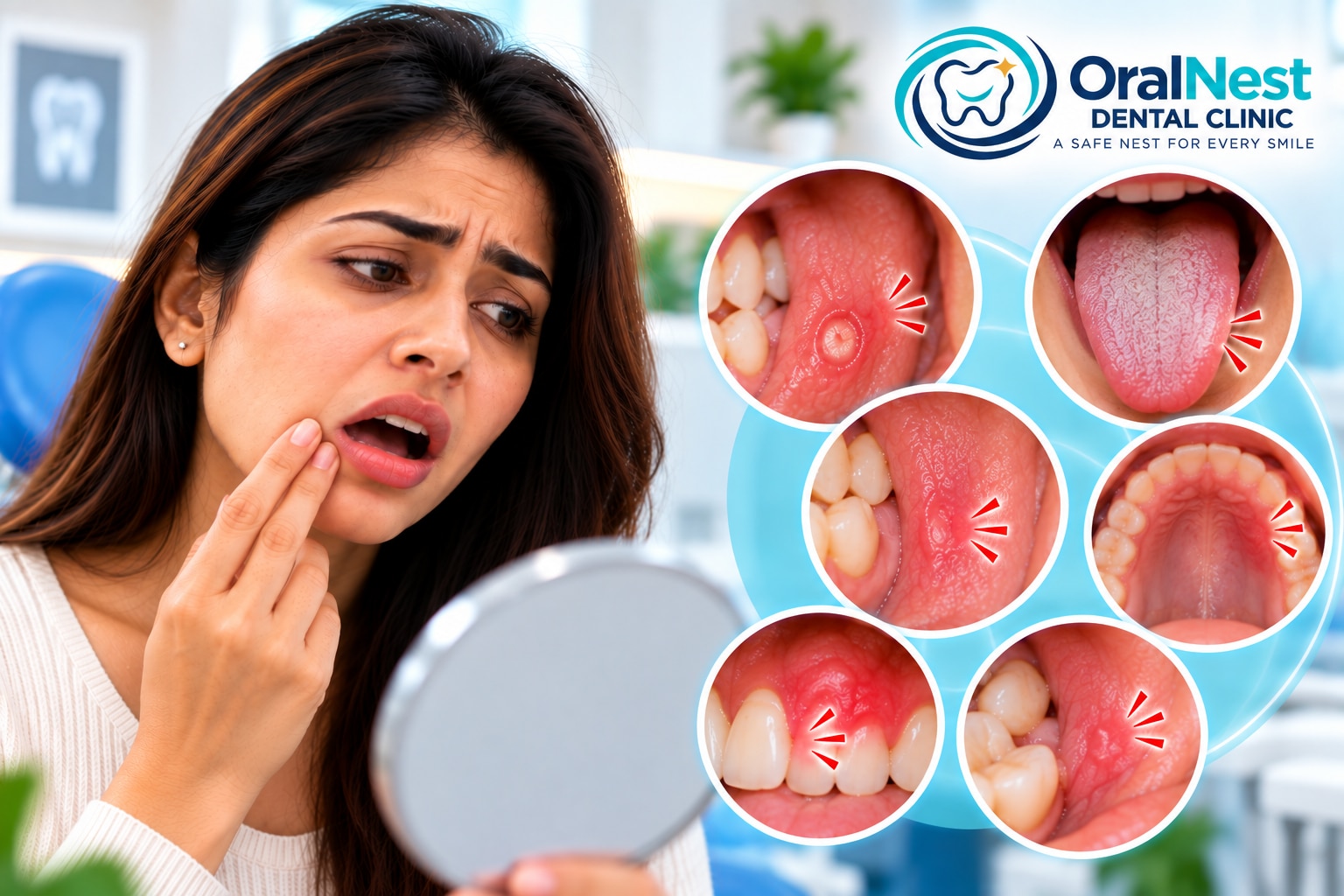
Recurrent mouth ulcers or a sore that will not heal? Explore possible causes and oral medicine assessment at OralNest Dental Clinic in Wakad, Pune.
Mouth Ulcer Consultation in Wakad & Pimple Gurav, Pune
A small ulcer inside the mouth can make eating, drinking, speaking and even brushing uncomfortable. While many mouth ulcers heal without specific treatment, some repeatedly return, last longer than expected, or appear alongside other symptoms. Understanding which pattern you are experiencing is an important first step.
At OralNest Dental Clinic in Wakad, Pune, patients can seek consultation for recurrent mouth ulcers, persistent oral sores and related oral health concerns. The purpose of assessment is to examine the lesion, consider possible causes and determine whether treatment, follow-up or further investigation is appropriate.
If you are searching for a mouth ulcer consultation near Wakad, Pimple Gurav or Rahatani, remember this: not every mouth ulcer has the same cause, and a persistent ulcer should not be managed indefinitely with home remedies alone.
What Is a Mouth Ulcer?
A mouth ulcer is an open sore affecting the lining of the mouth. It may appear on the inner lips, cheeks, tongue, floor of the mouth, gums or other oral surfaces.
Ulcers can be painful, particularly when exposed to spicy, acidic or hot foods. Some are small and short-lived, while others recur or persist and require closer evaluation.
The appearance of an ulcer can provide useful clinical information, but appearance alone does not always establish the diagnosis. Its duration, location, recurrence pattern, associated symptoms and the patient's medical history also matter.
What Causes Mouth Ulcers?
1. Recurrent Aphthous Ulcers
Recurrent aphthous ulcers, commonly called canker sores, are a frequent cause of painful ulcers inside the mouth. They often appear as small, round or oval sores with a pale centre and a reddish border.
They may recur periodically. Factors associated with episodes can include local trauma, stress in some individuals, and certain nutritional or medical factors. The exact cause is not always identifiable.
Not every recurring ulcer is aphthous, so repeated episodes may warrant clinical assessment.
2. Accidental Injury or Irritation
A sharp tooth edge, cheek biting, a poorly fitting dental appliance or irritation from certain oral products may contribute to ulceration.
An ulcer caused by trauma should generally improve when the source of irritation is removed. If it persists, enlarges or does not heal as expected, it should be examined rather than assumed to be traumatic.
3. Nutritional or Medical Factors
Some recurrent oral ulcers may be associated with deficiencies such as iron, vitamin B12 or folate, or with certain underlying medical conditions.
Testing is not necessary for every uncomplicated ulcer. When the history or examination suggests a possible underlying factor, a clinician may recommend appropriate investigations or medical referral.
4. Medication-Related Ulcers
Some medicines can contribute to oral ulceration or mucosal changes. Do not stop a prescribed medicine on your own if you suspect it is responsible.
A clinician can review the timing of symptoms and help determine whether further medical advice is needed.
5. Oral Mucosal Conditions
Certain inflammatory or immune-related conditions can cause recurring ulcers, multiple sores or other changes to the oral lining.
Where ulcers occur frequently, appear unusual, or are accompanied by persistent red or white patches, a more focused oral medicine assessment may be appropriate.
6. Infections and Other Causes
Some infections and other oral or systemic conditions can cause ulcer-like lesions. The likely cause depends on the clinical pattern, associated symptoms and medical history.
Because different conditions can look similar, self-diagnosis from photographs alone is unreliable.
Why Do My Mouth Ulcers Keep Coming Back?
Recurrent ulcers may be associated with repeated local injury, individual susceptibility, nutritional factors, stress-related triggers or underlying medical conditions. Sometimes no single trigger can be identified.
It may help to note:
How often the ulcers appear.
How long each episode lasts.
Where the ulcers occur.
Whether the same area is repeatedly affected.
Whether you have additional symptoms or recent medication changes.
Whether particular foods, products or injuries seem to trigger episodes.
This information can help guide the consultation. Frequent recurrence deserves attention when it disrupts eating, drinking or daily life, or when the pattern changes.
When Is a Mouth Ulcer Considered Persistent?
Many common minor ulcers heal within approximately one to two weeks. However, healing time varies according to the cause, location and individual circumstances.
An ulcer that lasts around two weeks or longer, particularly without a clear cause or with no sign of healing, should be professionally assessed. Do not wait for this time threshold if the lesion is enlarging, hard, bleeding without an obvious reason, or accompanied by other concerning changes.
Persistent ulcers can have several explanations. A clinical examination helps determine whether observation, treatment, further investigation or referral is appropriate.
How Are Mouth Ulcers Assessed at OralNest Dental Clinic?
A mouth ulcer consultation should look beyond the immediate discomfort and consider the characteristics of the lesion.
Depending on the presentation, assessment may involve:
History of the ulcer: When it started, whether it has occurred before, how long previous episodes lasted, and whether there are associated symptoms.
Examination of the oral tissues: Evaluating the ulcer's location, size, shape, surrounding tissue and other visible oral changes.
Review of possible triggers: Considering local trauma, oral hygiene products, medications, relevant medical history and other potential contributors.
Further investigations when indicated: Depending on the findings, the clinician may recommend laboratory tests, specialist evaluation or referral for additional assessment. A biopsy may be considered by an appropriate clinician when a lesion requires tissue diagnosis.
Dr. Ashutosh Dighe holds BDS, MDS – Oral Medicine & Maxillofacial Radiology, is a PhD Scholar, has completed a Fellowship in Contemporary Endodontics, and is a Certified Endodontist. His postgraduate background is relevant to oral medicine and the assessment of oral conditions. The appropriate investigations and next steps depend on the individual clinical findings.
How Are Mouth Ulcers Treated?
Treatment depends on the cause. There is no single medicine that is appropriate for every oral ulcer.
Managing Pain and Irritation
For uncomplicated ulcers, avoiding foods that trigger discomfort, maintaining gentle oral hygiene and preventing further trauma may help while healing occurs.
A clinician may recommend suitable symptom-relief measures depending on the patient's circumstances.
Treating the Underlying Cause
If a sharp tooth or another source of local irritation is responsible, addressing that factor may help prevent repeated injury.
Where a nutritional deficiency, medication-related problem or underlying medical condition is suspected, management should be guided by appropriate clinical assessment and investigations.
Medication When Appropriate
Certain diagnosed inflammatory or ulcerative conditions may benefit from prescribed topical treatment. The choice depends on the diagnosis, and medication should not be used indiscriminately for every mouth sore.
Further Investigation or Referral
A persistent, unusual or suspicious lesion may require additional evaluation or referral. This is important because some conditions cannot be distinguished reliably by symptoms or appearance alone.
The objective is to identify the cause where possible, manage symptoms appropriately and avoid overlooking a lesion that requires further assessment.
What Can You Do at Home for a Mouth Ulcer?
While waiting for a consultation, the following measures may help reduce irritation:
Choose softer foods if chewing is painful.
Avoid foods or drinks that noticeably aggravate the ulcer, particularly very spicy or acidic items.
Maintain gentle oral hygiene using a soft-bristled toothbrush.
Avoid repeatedly touching, scraping or trying to remove the ulcer.
Avoid applying aspirin, concentrated chemicals or unprescribed substances directly to the lesion.
Note the date the ulcer appeared and whether it is changing.
These measures may help with comfort, but they do not replace assessment of a persistent or unusual ulcer.
When Should You Seek Urgent Assessment?
Arrange a dental or medical assessment if an ulcer persists, repeatedly returns, grows, bleeds without an obvious cause, or is accompanied by a lump, a red or white patch, unexplained numbness or difficulty swallowing.
Seek prompt care if you cannot drink enough because of pain, develop significant swelling or have symptoms suggesting a more widespread illness.
Difficulty breathing or swallowing associated with swelling requires emergency medical care.
Mouth Ulcer Consultation in Wakad & Pimple Gurav, Pune
If you are looking for a mouth ulcer specialist or oral medicine consultation in Wakad, Pune, OralNest Dental Clinic provides consultation for oral symptoms that require clinical assessment.
Patients from Wakad, Pimple Gurav, Rahatani, Pimple Saudagar, Hinjawadi, Tathawade, Punawale, Ravet, Baner, Balewadi and nearby parts of Pimpri-Chinchwad may visit the Wakad clinic.
The clinic is physically located in Wakad. Nearby localities are service areas, not separate clinic branches.
A consultation can help clarify whether an ulcer appears consistent with a common self-limiting condition or whether further investigation is warranted.
Frequently Asked Questions About Mouth Ulcers
Why do I keep getting mouth ulcers?
Recurring ulcers can be associated with local trauma, recurrent aphthous ulceration, nutritional factors, certain medical conditions or other triggers. Sometimes no single cause is found. Frequent or changing episodes may warrant assessment.
How long should a normal mouth ulcer take to heal?
Many minor ulcers heal within one to two weeks. If an ulcer lasts around two weeks or longer, does not show signs of healing, or has concerning features, seek professional assessment.
Are mouth ulcers a sign of a serious disease?
Most ordinary short-lived mouth ulcers are not caused by serious disease. However, persistent or unusual lesions require examination because several conditions can resemble one another.
Can vitamin deficiency cause mouth ulcers?
Iron, vitamin B12 and folate deficiencies may be associated with recurrent ulcers in some patients. Testing and supplementation should be guided by the clinical history and appropriate medical advice.
Should I apply medicine to every mouth ulcer?
No. The appropriate treatment depends on the cause. Some minor ulcers need only supportive care, while others may require prescribed medication or further investigation.
Can a dentist assess a non-healing mouth ulcer?
A dental consultation can assess the lesion and determine whether further investigation or referral is needed. Some lesions require specialist evaluation or a biopsy by an appropriate clinician.
Where can I get a mouth ulcer consultation in Wakad?
OralNest Dental Clinic is located in Wakad, Pune, and serves patients from nearby areas including Pimple Gurav and Rahatani. The consultation helps assess the ulcer and guide suitable next steps.
Do Not Ignore an Ulcer That Is Not Healing
A short-lived ulcer and a persistent oral lesion should not automatically be treated in the same way. Duration, recurrence, location and associated findings all help determine whether further assessment is needed.
At OralNest Dental Clinic, Wakad, Pune, the focus is on understanding the patient's symptoms, examining the oral tissues and guiding appropriate treatment or further evaluation based on the clinical findings.
OralNest Dental Clinic — A SAFE NEST FOR EVERY SMILE.