
Dental Implants in Wakad & Pimple Gurav, Pune
Looking for dental implants in Wakad or Pimple Gurav, Pune? Understand implant suitability, bone assessment, tooth replacement options and treatment planning at OralNest Dental Clinic.
Missing a Tooth? Understand Your Options Before Choosing a Replacement.
A missing tooth can affect more than your smile. Depending on its location, tooth loss may influence chewing, appearance, speech and the way your remaining teeth function. It can also be associated with changes in the supporting bone over time.
Dental implants are an established option for replacing missing teeth. However, an implant is not automatically the right solution for every missing tooth or every patient.
The important first step is to determine which tooth-replacement option is appropriate for your oral condition, functional needs and long-term goals.
At OralNest DENTAL CLINIC | Wakad, dental implant planning begins with an assessment of the missing tooth, neighbouring teeth, gums, available bone, bite and overall oral health. Appropriate clinical examination and diagnostic imaging help establish whether implant treatment is suitable and what the treatment may involve.
For patients searching for dental implants in Wakad, Pimple Gurav and nearby areas of Pune, understanding the available options can make the decision clearer and more informed.
What Are Dental Implants?
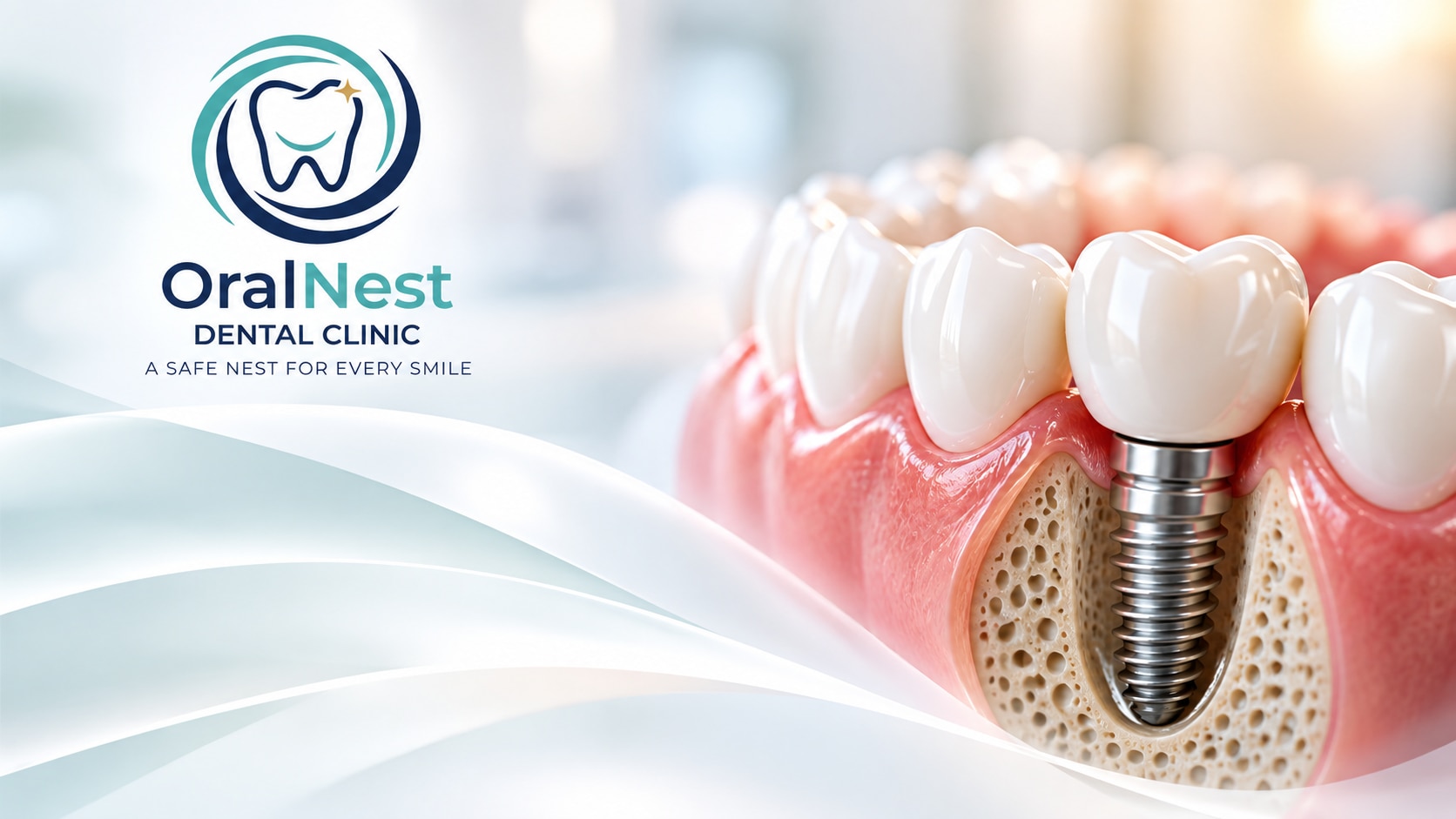
A dental implant is a biocompatible fixture placed in the jawbone to support a replacement tooth or teeth. After suitable healing and integration with the surrounding bone, the implant can support a restoration such as a crown, bridge or another appropriate prosthesis.
A single missing tooth may be replaced with an implant-supported crown. Multiple missing teeth may be replaced using an implant-supported bridge or another suitable restorative design, depending on the clinical findings.
Dental implant treatment aims to restore function and replace missing teeth while considering appearance, stability, the surrounding tissues and long-term maintenance.
An implant is not the replacement tooth itself. It is the supporting fixture, while the visible replacement is the restoration attached to it.
Who May Be Suitable for Dental Implant Treatment?
Dental implants may be considered for patients who have:
One missing tooth and want to explore fixed replacement options.
Several missing teeth that affect chewing or appearance.
A tooth that cannot be predictably preserved and may require replacement.
An existing tooth replacement that needs reassessment.
Sufficient bone and healthy surrounding tissues, or a clinical situation in which deficiencies can be appropriately managed.
However, suitability cannot be determined by age or the presence of a gap alone. Bone condition, gum health, oral hygiene, bite, medical and dental history, available space and the overall restorative plan all influence the decision.
Certain health conditions, smoking, active gum disease, uncontrolled oral infection and other factors may affect treatment planning or healing. These factors require individual assessment rather than an automatic assumption that implant treatment is either suitable or unsuitable.
The correct question is not simply, “Can an implant be placed?” It is, “Can an implant-supported restoration be planned and maintained appropriately in this particular case?”
What Should Be Checked Before Dental Implant Placement?
Implant treatment planning begins before the procedure. The purpose of the assessment is to understand the site, identify potential concerns and compare suitable treatment options.
1. The Missing Tooth and Its Cause
The dentist considers which tooth is missing, how long it has been missing and why it was lost. If the tooth is still present but severely damaged, its restorability should be evaluated before extraction is assumed to be necessary.
2. Bone Availability
The jawbone provides support for a dental implant. Its quantity, shape and anatomical relationship to nearby structures influence implant planning. Additional procedures may sometimes be considered if the available bone is insufficient.
3. Gum and Oral Health
Healthy surrounding tissues and appropriate oral hygiene are important considerations. Active gum disease, untreated decay or other oral health problems may need to be addressed before implant treatment proceeds.
4. Neighbouring Teeth
The condition of adjacent teeth can influence whether an implant, bridge or another option is appropriate. The missing tooth should not be considered in isolation from the rest of the mouth.
5. Bite and Available Space
The position of the missing tooth, the space available for the restoration and the forces generated during chewing can affect the treatment design.
6. Diagnostic Imaging
Dental X-rays or three-dimensional imaging may be recommended when clinically indicated. The type of imaging depends on the information needed to assess the site and plan treatment safely.
7. The Final Restoration
Implant planning should account for the replacement tooth that will ultimately be fitted. Its position, appearance, function and cleanability influence the overall plan.
The result is a treatment decision based on the complete clinical picture rather than the missing tooth alone.
Single Dental Implant or Multiple Dental Implants?
The number of missing teeth and their positions help determine the replacement approach.
Dental Implant for a Single Missing Tooth
A single implant-supported crown may be considered when one tooth is missing and the surrounding conditions are suitable. One potential advantage is that the replacement can be supported by the implant rather than relying on the neighbouring natural teeth as a conventional bridge does.
However, an implant-supported crown is not the only option. A bridge or another suitable restoration may be considered depending on the condition of the adjacent teeth, bone, gums and the patient's preferences.
Dental Implants for Multiple Missing Teeth
When several teeth are missing, the treatment plan may involve individual implant-supported crowns, an implant-supported bridge or another restorative design. The number of implants required is not necessarily identical to the number of missing teeth.
The decision depends on the location and distribution of missing teeth, available bone, bite, restorative requirements and overall oral condition.
For extensive tooth loss or complex restorative needs, a broader assessment may be required. This is different from planning the replacement of one isolated missing tooth.
Dental Implant or Dental Bridge: Which Is Better?
This is one of the most important questions patients ask when considering missing-tooth replacement.
A dental implant uses a fixture placed in the jawbone to support a replacement tooth. A conventional dental bridge uses supporting teeth or structures to hold the replacement.
Neither option is universally better. The most appropriate choice depends on the individual situation.
A dental implant may be considered when:
The missing tooth can be replaced with an implant-supported restoration.
The bone and surrounding tissues are suitable or can be appropriately managed.
The patient prefers an option that does not rely on adjacent natural teeth in the same way as a conventional bridge.
A dental bridge may be considered when:
The supporting teeth are suitable.
The number and position of missing teeth permit a predictable bridge design.
A bridge fits the patient's clinical needs and treatment preferences.
A conventional bridge may require preparation of neighbouring teeth. An implant, meanwhile, involves a surgical procedure, healing and ongoing maintenance. Both options have limitations and require appropriate planning.
The decision should account for treatment time, cost, maintenance, the condition of the supporting structures and the expected long-term function—not advertisements or general claims that one option is always superior.
What If There Is Not Enough Bone for a Dental Implant?
Bone availability is an important part of implant planning, but limited bone does not always mean that implant treatment is impossible.
The available bone must be assessed in relation to the proposed implant position and nearby anatomical structures. In selected cases, bone augmentation or another preparatory procedure may be considered. In other cases, a different implant design or an alternative tooth-replacement option may be more appropriate.
Additional procedures can affect the complexity, cost and overall duration of treatment. They should only be recommended when supported by the clinical assessment.
A patient should not assume that bone grafting is always necessary—or that it will never be necessary—without an appropriate evaluation.
What Does the Dental Implant Procedure Involve?
The treatment sequence varies according to the patient's oral condition, the site being treated and the type of restoration planned.
Step 1: Consultation and Diagnosis
The missing tooth, surrounding teeth, gums, bone and bite are assessed. Relevant medical and dental history is reviewed.
Step 2: Treatment Planning
The available replacement options are discussed. Where implant treatment is appropriate, the proposed implant position, restorative design and expected sequence are planned.
Step 3: Preparation When Required
Some patients may need treatment for gum disease, management of infection, extraction of a non-restorable tooth or another preparatory procedure. Not every patient requires these additional steps.
Step 4: Implant Placement
When implant treatment proceeds, the implant fixture is placed in the planned position using an appropriate clinical technique.
Step 5: Healing and Integration
The implant generally requires a period of healing and integration with the surrounding bone. The duration varies according to the site, the patient's healing response and whether additional procedures have been performed.
Step 6: Placement of the Final Restoration
Once the site is ready, an appropriate crown, bridge or other prosthetic restoration is attached according to the treatment plan.
Step 7: Review and Maintenance
Follow-up appointments help assess the restoration, surrounding tissues, bite and ongoing oral health.
Some cases follow a relatively straightforward sequence, while others require additional stages. The treatment timeline should be explained according to the individual clinical findings.
How Long Does Dental Implant Treatment Take?
There is no single timeline that applies to every dental implant patient.
Treatment duration may depend on whether a tooth needs to be extracted, the condition and quantity of available bone, gum health, the need for additional procedures, healing and integration, and the type of final restoration.
In selected cases, an immediate or early restoration approach may be possible. This does not mean that every patient is suitable for immediate loading or that all implant treatment can be completed in one appointment.
The expected sequence and timing should be discussed before treatment begins so that patients understand the likely stages and any factors that may alter the plan.
What Happens If a Missing Tooth Is Left Unreplaced?
The effects of a missing tooth vary according to its location, the number of missing teeth, the condition of the remaining dentition and the patient's overall oral health.
Possible consequences include changes in chewing, movement of neighbouring teeth, changes involving the opposing tooth and gradual loss of bone in the area where the tooth was lost.
However, every missing tooth does not automatically require an implant or immediate replacement. The clinical importance of the gap and the available treatment options should be evaluated.
An assessment helps determine whether replacement is advisable, which options are feasible and what may happen if treatment is deferred.
How Long Do Dental Implants Last?
Dental implants can provide long-term tooth replacement, but no particular lifespan can be guaranteed for every patient.
Long-term outcomes depend on factors such as the health of the surrounding tissues, oral hygiene, bite forces, smoking, general health, the condition of the restoration and regular professional maintenance.
The implant fixture and the visible restoration are different components. A crown or bridge may need repair or replacement even when the implant itself remains stable.
For this reason, implant treatment should be viewed as a long-term commitment to oral hygiene and professional monitoring rather than a one-time procedure that requires no further attention.
How Should You Care for Dental Implants?
Implant-supported teeth need daily cleaning and periodic professional assessment. The tissues surrounding an implant can develop inflammation and disease, so careful maintenance remains essential.
Patients should:
Brush regularly with an appropriate technique.
Clean between teeth and around the implant restoration.
Use recommended interdental cleaning aids where appropriate.
Attend follow-up appointments and professional maintenance visits.
Avoid smoking where possible and discuss relevant health risks with the treating clinician.
Seek assessment for bleeding, swelling, discomfort, looseness or changes in the bite.
Good maintenance helps support the health of the surrounding tissues and allows potential problems to be identified earlier.
Frequently Asked Questions About Dental Implants
Where can I get dental implants in Wakad, Pune?
OralNest DENTAL CLINIC in Wakad provides dental consultations and treatment planning for missing teeth and tooth-replacement options. An assessment helps determine whether implant-supported treatment or another restoration is suitable for the individual case.
Can one missing tooth be replaced with a dental implant?
Yes. A single missing tooth can often be replaced with an implant-supported crown when the clinical conditions are appropriate.
Are dental implants suitable for everyone?
No. Bone condition, gum health, medical and dental history, oral hygiene, bite and other factors influence suitability. A clinical assessment is required.
Are dental implants better than bridges?
Not in every case. Implants and bridges have different requirements, advantages and limitations. The condition of neighbouring teeth, available bone, treatment preferences and maintenance needs should all be considered.
Is bone grafting always necessary before an implant?
No. Bone grafting is only considered when indicated by the clinical findings and treatment plan. Many patients do not require it, while selected cases may need additional bone-related procedures.
Can a dental implant be placed immediately after extraction?
Immediate implant placement may be possible in selected cases, but it is not appropriate for every extraction site. Bone conditions, infection, tissue health, implant stability and other factors influence the decision.
Does dental implant treatment hurt?
Implant placement is a surgical procedure performed with appropriate anesthesia. Postoperative discomfort and swelling can occur and vary between patients. The clinician should explain the expected recovery and appropriate aftercare for the planned procedure.
Do dental implants require maintenance?
Yes. Implant-supported restorations require daily cleaning and periodic professional monitoring. Maintenance is important for the health of the surrounding tissues and the condition of the restoration.
Should every missing tooth be replaced?
Not necessarily. The decision depends on the tooth's location, functional importance, surrounding teeth, oral health and the patient's overall needs. A dental assessment helps clarify the available options.
What if I have several missing teeth?
Multiple missing teeth may be managed using different restorative approaches, including implant-supported bridges or other suitable prostheses. The appropriate design depends on the distribution of missing teeth, bone availability, bite and the overall restorative plan.
Dental Implant Treatment Planning at OralNest DENTAL CLINIC | Wakad
Replacing a missing tooth is an important restorative decision. The most appropriate treatment depends on more than the gap itself: the surrounding teeth, bone, gums, bite, functional requirements and maintenance needs all matter.
At OralNest DENTAL CLINIC | Wakad, the approach is centred on understanding the oral condition, explaining the available options and planning treatment according to individual clinical findings.
Clinical evaluation and diagnostic assessment are supported by Dr. Ashutosh Dighe — BDS, MDS – Oral Medicine & Maxillofacial Radiology, PhD Scholar, Fellowship in Contemporary Endodontics, Certified Endodontist. His qualifications provide a background in oral diagnosis and maxillofacial radiology, with additional training in contemporary endodontics. These credentials should not be interpreted as a separate implant-specialist qualification; the suitability of implant treatment and the appropriate clinical team or referral pathway must be established for each case.
The objective is to help patients understand the reason for replacing a tooth, the available treatment choices and the considerations involved in maintaining the final restoration.
Dental Implants in Wakad and Pimple Gurav, Pune
If you have one missing tooth, several missing teeth or a tooth that may need replacement, a dental consultation can help you understand the options available.
OralNest DENTAL CLINIC | Wakad, Pune serves patients from Wakad and nearby localities, including Pimple Gurav, Rahatani, Pimple Saudagar, Hinjawadi, Baner, Balewadi, Tathawade, Punawale, Ravet and other parts of Pimpri-Chinchwad.
Whether you are comparing a dental implant with a bridge, exploring replacement for a single missing tooth or seeking advice about more extensive tooth loss, the starting point is an assessment of your individual oral condition.
Understand the site. Compare the options. Plan the restoration. Maintain it for the long term.
OralNest DENTAL CLINIC
A SAFE NEST FOR EVERY SMILE