
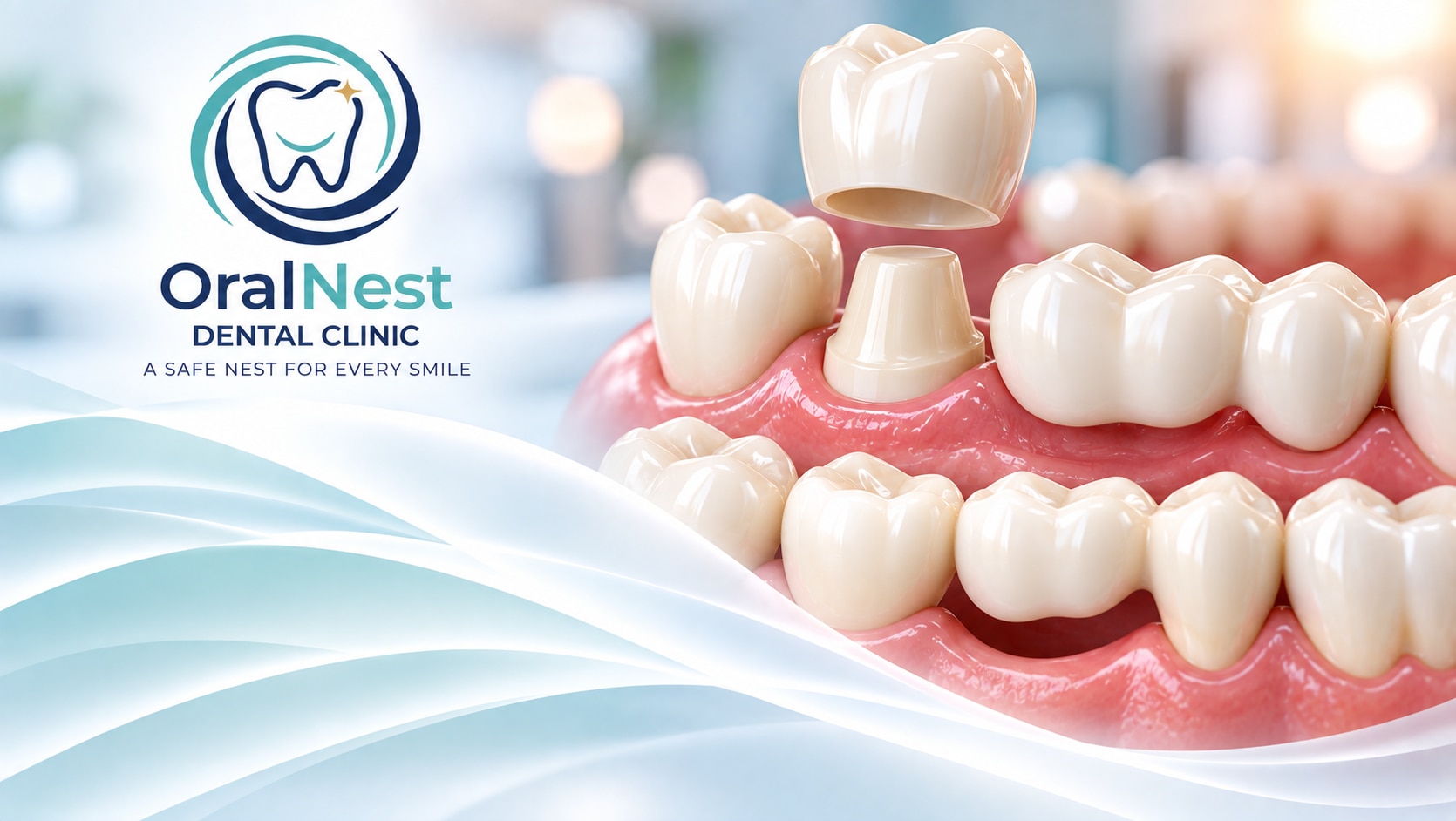
Dental Crowns and Bridges: Restoring Damaged Teeth and Replacing Missing Teeth
Need a dental crown or bridge in Wakad or Pimple Gurav, Pune? Understand treatment options for damaged, weakened and missing teeth at OralNest Dental Clinic
A damaged tooth does not always need to be removed, and a missing tooth does not have just one replacement option. The right treatment depends on the condition of the tooth, the health of the surrounding tissues, the bite, and the long-term objective.
At OralNest DENTAL CLINIC | Wakad, dental crowns and bridges are considered as part of an individual restorative treatment plan. Whether you have a broken tooth, extensive decay, a tooth weakened after root canal treatment, a damaged existing crown, or a missing tooth, the first step is to understand what can be restored and which option is appropriate for your situation.
Patients looking for dental crowns and bridges in Wakad, Pimple Gurav and nearby Pimpri-Chinchwad areas of Pune can seek an evaluation to understand the available treatment choices, their limitations, and the care required to maintain the result.
What Is a Dental Crown?
A dental crown is a custom-made restoration that covers a tooth to restore its shape, function and, when indicated, provide additional structural protection.
A dentist may recommend a crown when a tooth has lost substantial structure because of extensive decay, fracture, a large existing filling or previous treatment. Some root canal-treated teeth may also require crowns, depending on how much healthy tooth structure remains and the forces the tooth must withstand.
A crown is not simply a cosmetic covering. Its purpose is to restore the tooth appropriately while considering the remaining structure, bite, gum health, appearance and long-term maintenance.
A crown may be considered for:
A severely weakened or substantially damaged tooth
A tooth with extensive decay after the affected tissue has been treated
A tooth that has undergone root canal treatment and needs additional protection
A fractured tooth that remains suitable for restoration
An existing crown that is damaged, worn or no longer fits appropriately
A crown cannot make every damaged tooth restorable. The underlying tooth must be assessed before treatment is recommended.
What Is a Dental Bridge?
A dental bridge is a fixed restoration used to replace one or more missing teeth in suitable cases. A conventional bridge generally relies on neighbouring teeth for support, although other bridge designs may use different forms of support.
A bridge may be considered when the supporting teeth, gums, bite and available space make the treatment appropriate. The decision should also account for the condition of the neighbouring teeth and whether preparing them for a bridge is justified.
Before choosing a bridge, it is important to understand the alternatives. Depending on the clinical situation, these may include an implant-supported restoration or another suitable replacement option.
Dental Crown vs Dental Bridge: What Is the Difference?
The key difference is the problem each restoration addresses.
Dental crown: Restores and covers an existing tooth that needs structural support or full-coverage restoration.
Dental bridge: Replaces a missing tooth or teeth by connecting the replacement to suitable supporting structures.
Implant-supported crown: Replaces a missing tooth using a dental implant to support the restoration, when appropriate.
For example, a tooth weakened by extensive damage may need a crown if it can be predictably preserved. If the tooth is missing, a bridge or implant-supported restoration may be considered after evaluating the surrounding teeth and tissues.
There is no single option that is best for every patient. The choice should reflect the clinical findings, treatment objectives, maintenance requirements and patient preferences.
When Do You Need a Dental Crown?
A dental crown may be recommended when a tooth needs more coverage or protection than a conventional filling can appropriately provide.
1. After Root Canal Treatment
Some teeth become structurally vulnerable because of extensive decay, fractures or the amount of tooth structure lost before or during treatment. A crown may be appropriate to restore function and protect the remaining tooth. However, not every root canal-treated tooth automatically requires a crown; the decision depends on the individual tooth and restorative plan.
2. When a Tooth Has Extensive Decay
When decay affects a large portion of a tooth, the dentist must assess whether the remaining structure can support a filling or whether a crown would provide a more suitable restoration. Any active decay and underlying disease must be addressed first.
3. When a Tooth Is Broken or Weakened
A fractured or weakened tooth may sometimes be restored with a crown. The depth and direction of the fracture, the remaining healthy structure and the condition of the supporting tissues influence whether preservation is feasible.
4. When an Existing Crown Needs Attention
Pain, looseness, visible damage, food trapping or changes around an existing crown may indicate a need for evaluation. Replacement may be possible, but the underlying tooth and gums should be examined before a decision is made.
When Might a Dental Bridge Be Suitable?
A dental bridge may be considered when one or more teeth are missing and the supporting structures are suitable.
Important factors include:
The number and position of missing teeth
The health and strength of potential supporting teeth
Gum and bone health
Bite forces and available space
The condition of the remaining teeth
The patient's preferences and long-term treatment goals
A conventional bridge may be a reasonable choice in selected situations. However, preparing neighbouring teeth is a meaningful clinical decision, particularly when those teeth are otherwise healthy. The advantages and limitations should be discussed before proceeding.
Dental Bridge or Dental Implant: Which Should You Choose?
Patients searching for dental bridges or dental implants in Wakad and Pimple Gurav often want to know which option will suit them better. The answer depends on the individual case.
A conventional bridge uses supporting teeth or structures to hold the replacement tooth. An implant-supported restoration uses a dental implant placed in the jawbone to support a replacement tooth, when the patient is suitable for implant treatment.
The comparison should consider the condition of neighbouring teeth, available bone, gum health, bite, number of missing teeth, treatment time, maintenance and overall oral health.
An implant is not automatically the better choice for everyone, just as a bridge is not appropriate for every missing tooth. A clinical assessment helps establish which options are feasible and what each would involve.
What Happens During Crown and Bridge Treatment?
The treatment sequence depends on the condition of the tooth or teeth and the type of restoration planned. It may include:
Clinical examination: Assessing the tooth, gums, bite and surrounding structures.
Diagnosis and planning: Determining whether the tooth can be restored and comparing appropriate options.
Imaging when indicated: Obtaining additional information when required for diagnosis or treatment planning.
Treating underlying problems: Addressing decay, infection or gum concerns where necessary.
Preparing for the restoration: Preparing the tooth or supporting teeth when the chosen treatment requires it.
Recording the required details: Taking impressions or digital records, depending on the method used.
Restoration placement: Checking the fit, bite, contact, appearance and function of the final crown or bridge.
Review and maintenance: Providing care instructions and arranging follow-up when appropriate.
A successful restorative plan involves more than placing the crown or bridge. Fit, bite, cleansability and the health of the supporting tissues are all important considerations.
Can a Severely Damaged Tooth Still Be Saved?
Sometimes. The deciding factor is not simply how damaged the tooth looks, but whether enough healthy structure remains and whether the tooth can be restored with a reasonable long-term outlook.
The dentist may need to assess the extent of decay or fracture, the condition of the root, the supporting bone and gums, and any existing infection. In some cases, restoration may be feasible; in others, extraction and replacement options may need to be discussed.
A crown cannot compensate for a tooth that is fundamentally non-restorable. Understanding this distinction helps patients make informed decisions rather than choosing a restoration before the underlying problem is understood.
How Long Do Dental Crowns and Bridges Last?
No crown or bridge has a guaranteed lifespan. Its longevity depends on the condition of the supporting tooth or teeth, the fit of the restoration, oral hygiene, gum health, bite forces, grinding or clenching habits, diet and regular maintenance.
A restoration should be monitored over time. Pain, persistent food trapping, looseness, a change in the bite or swelling around the area should be assessed rather than ignored.
How to Care for Dental Crowns and Bridges
Restored teeth still require daily care. A crown does not prevent decay at its margins, and a bridge needs careful cleaning around its supporting teeth and beneath the replacement tooth.
For better long-term maintenance:
Brush twice daily using an appropriate technique.
Clean between teeth and around restoration margins.
Use suitable aids to clean beneath a bridge, as advised by your dentist.
Avoid biting hard objects or using teeth to open packaging.
Seek evaluation if a restoration feels loose, becomes painful or changes your bite.
Attend periodic dental check-ups and professional cleaning when recommended.
Consistent care helps maintain the health of the surrounding teeth and gums and allows potential problems to be identified earlier.
Frequently Asked Questions About Dental Crowns and Bridges
1. Is a dental crown the same as a cap?
Yes. “Cap” is a common everyday term for a dental crown, which covers a tooth to restore its form and function.
2. Does every root canal-treated tooth need a crown?
No. The need depends on the tooth involved, how much healthy structure remains, the location of the tooth and the forces it must withstand.
3. Can a dental bridge replace one missing tooth?
Yes. A bridge can replace a single missing tooth in suitable cases, provided the supporting structures are appropriate.
4. Is a dental implant better than a bridge?
Neither option is universally better. Suitability depends on the neighbouring teeth, bone and gum health, bite, overall oral condition and the patient's treatment goals.
5. Can dental crowns look natural?
Crowns can be designed to complement the surrounding teeth. Shade, shape, proportion, fit and the relationship with the gums influence the final appearance.
6. Can an old or damaged crown be replaced?
Often, yes. The dentist should first assess why the crown needs attention and whether the underlying tooth can support a replacement.
7. Where can I get dental crowns and bridges in Wakad?
Patients can visit OralNest DENTAL CLINIC in Wakad, Pune, for an assessment of damaged teeth, existing restorations and missing-tooth replacement options.
Restorative Dental Care at OralNest DENTAL CLINIC | Wakad
Choosing a crown or bridge should begin with understanding the tooth, the surrounding tissues and the purpose of the restoration. At OralNest DENTAL CLINIC | Wakad, treatment planning considers the clinical condition, the options available and the factors that may affect function and long-term maintenance.
Clinical care is supported by Dr. Ashutosh Dighe — BDS, MDS – Oral Medicine & Maxillofacial Radiology, PhD Scholar, Fellowship in Contemporary Endodontics, Certified Endodontist. His background is relevant to evaluating oral conditions and supporting the assessment of teeth that may require restorative or endodontic care.
If you have a broken or weakened tooth, a crown that needs evaluation, or one or more missing teeth, a consultation can help clarify whether a crown, bridge, implant-supported restoration or another option is appropriate.
OralNest DENTAL CLINIC | Wakad serves patients from Wakad and nearby areas, including Pimple Gurav, Rahatani, Pimple Saudagar, Hinjawadi, Baner, Balewadi, Tathawade, Punawale and Ravet, Pune.
OralNest DENTAL CLINIC
A SAFE NEST FOR EVERY SMILE