Where Dental Care Begins With Understanding, Not Just Treatment
Choosing a dental clinic is not always as simple as finding a place for a filling, cleaning, or tooth extraction. Sometimes the real problem is uncertainty.
Why does the tooth hurt when nothing looks wrong?
Does every painful tooth need a root canal?
Should a wisdom tooth be removed or monitored?
Why does the jaw click or hurt?
What does a persistent mouth ulcer mean?
Is an extraction really necessary?
Which option is appropriate when several treatments are possible?
These questions are often more important than the procedure itself.
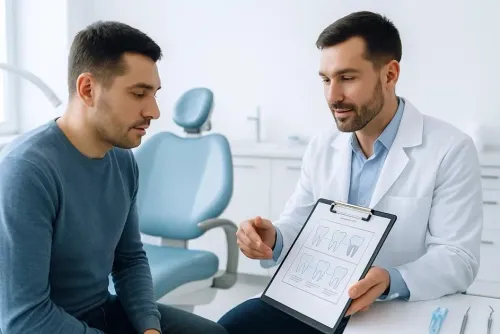
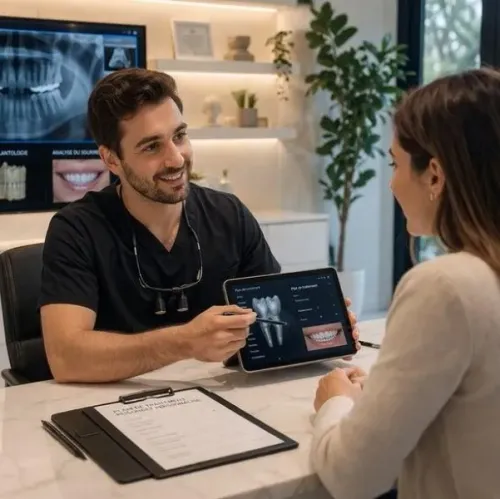
At OralNest Dental Clinic, Wakad, our approach is built around a simple clinical principle: the right treatment begins with the right understanding of the problem.
Rather than treating every dental complaint as a routine procedure, OralNest focuses on understanding the patient's symptoms, clinical findings, dental condition, and relevant diagnostic information before deciding what treatment is appropriate.
Dentistry Is Not Always About Finding a Procedure
A dental problem can have more than one possible explanation.
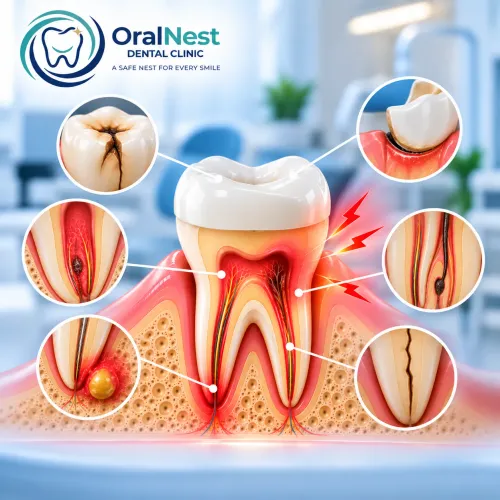
Tooth pain may arise from decay, inflammation of the dental pulp, a crack, a previous restoration, trauma, gum-related problems, or even pain that is not originating from the tooth itself.
Similarly, jaw pain may involve the temporomandibular joint, chewing muscles, tooth-related problems, parafunctional habits, or other causes of orofacial pain.
A mouth ulcer may be temporary and harmless, but recurrent or persistent oral changes may require a more careful assessment.
This is why diagnosis matters.
The purpose of a consultation should not simply be to decide what procedure can be performed. It should first establish:
What is actually causing the problem?
Which structures are involved?
How extensive is the condition?
Does treatment need to begin immediately?
Are there alternatives?
Can the natural tooth or oral structure be preserved?
What happens if the condition is monitored?
What information is needed before making the treatment decision?
This way of thinking forms an important part of the OralNest clinical philosophy.
A Diagnosis-First Approach
At OralNest, dental care is approached as a process:
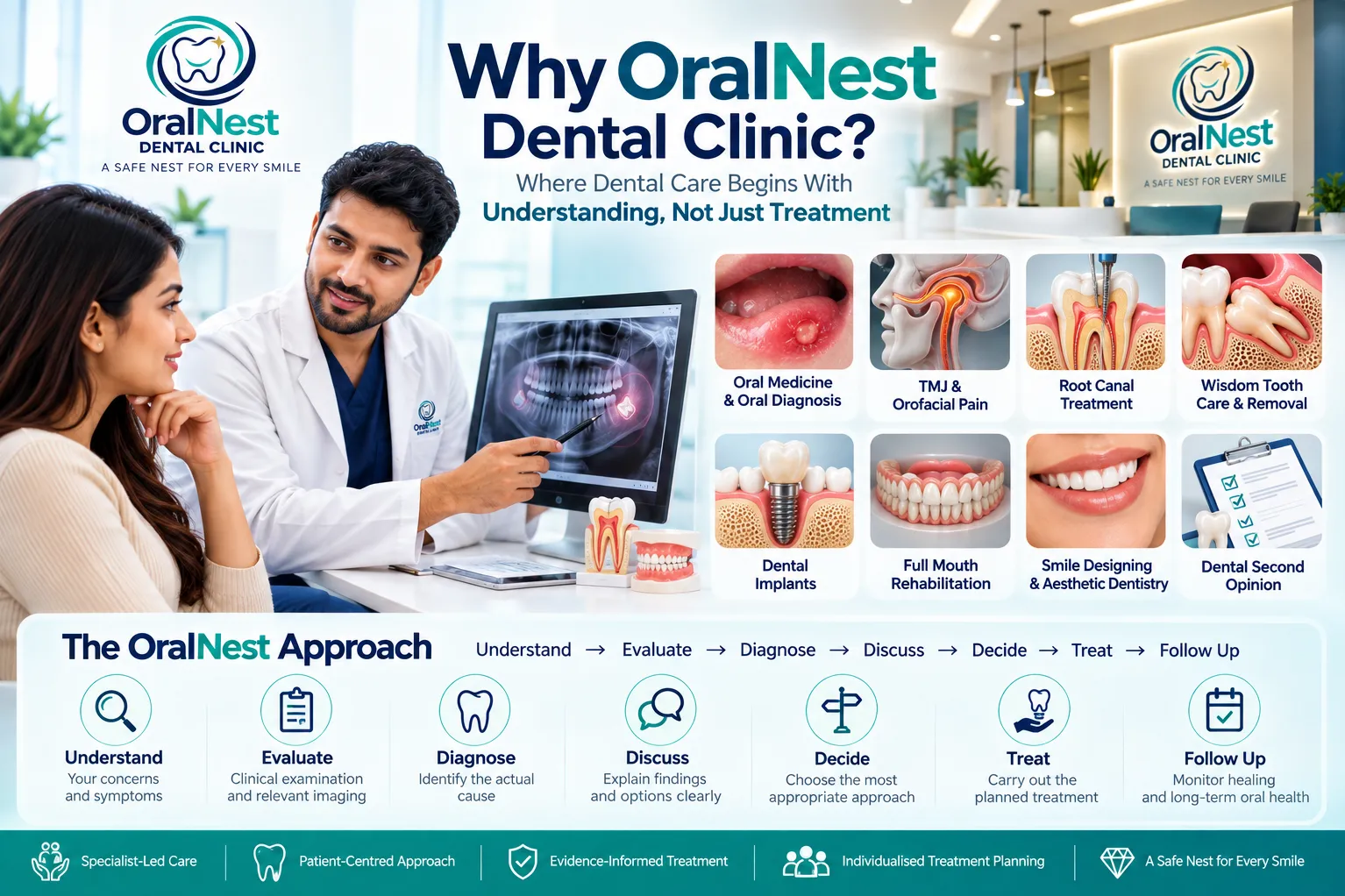
Understand → Evaluate → Diagnose → Discuss → Decide → Treat → Follow Up
The sequence matters.
Treatment without sufficient understanding can sometimes address the visible problem without adequately addressing the underlying cause.
A diagnosis-first approach allows treatment to be selected according to the individual situation rather than assuming that the same procedure is appropriate for everyone with a similar symptom.
For example, two people may both report tooth pain, but their treatment needs may be completely different.
One may require a filling.
Another may require root canal treatment.
Another may have a cracked tooth.
Another may have pain associated with the gums.
And another may need further evaluation because the source of pain is not immediately obvious.
The symptom may be similar. The diagnosis may not be.
Specialist-Led Dental Care
OralNest is built around specialist-informed diagnosis and treatment planning.
Dr. Ashutosh Dighe is a BDS, MDS in Oral Medicine & Maxillofacial Radiology, and PhD Scholar, with a clinical focus that includes oral diagnosis, treatment planning, oral mucosal conditions, TMJ disorders, orofacial pain and radiological evaluation. He also has a Fellowship in Contemporary Endodontics and is a Certified Endodontist.
This background is particularly relevant when a dental complaint is not straightforward.
The purpose is not to make every patient undergo complicated investigations or specialist treatment.
The purpose is to recognize when a problem is straightforward—and when it deserves a deeper look.
Oral Medicine & Oral Diagnosis
Some of the most confusing dental complaints are not necessarily related to the teeth.
Persistent mouth ulcers, burning sensations, white or red patches, tongue discomfort, unexplained oral lesions, recurrent mucosal changes and other oral symptoms can require a different diagnostic perspective.
Oral Medicine focuses on conditions affecting the mouth and surrounding structures that may not fit into a simple “tooth problem” category.
At OralNest, this forms an important part of the clinical approach.
The goal is to understand what the patient is experiencing, what may be causing it, and whether further evaluation is appropriate.
TMJ, Jaw Pain & Orofacial Problems
Jaw pain is another area where symptoms can be confusing.
Clicking, restricted mouth opening, facial discomfort, chewing pain, headaches associated with jaw problems, muscle tenderness and other symptoms may have different causes.
Not every jaw click requires treatment.
Not every facial pain is a dental problem.
And not every patient with jaw discomfort needs the same intervention.
A careful evaluation can help determine whether the symptoms are related to the temporomandibular joint, muscles, teeth, habits, or another source.
That distinction can significantly influence treatment decisions.
Root Canal Treatment & Tooth Preservation
Root canal treatment is often discussed simply as a procedure for “saving a tooth.”
But the more important question is:
Does this particular tooth actually require root canal treatment, and can it be predictably preserved?
The answer depends on the clinical condition of the tooth, the pulp and surrounding tissues, the anatomy of the root canal system, previous treatment, infection and the amount of healthy tooth structure remaining.
With a Fellowship in Contemporary Endodontics and Certified Endodontist background, endodontic treatment is approached with attention to diagnosis, treatment planning and tooth preservation.
Not every toothache needs a root canal.
But every root canal should begin with the right diagnosis.
Wisdom Tooth Decisions Should Not Always Be Automatic
Wisdom teeth are another example where the correct decision depends on the individual situation.
An impacted wisdom tooth may require removal in some circumstances.
Another may be monitored.
The decision can depend on its position, relationship with the neighbouring tooth, surrounding structures, symptoms, infection, hygiene accessibility and other clinical findings.
Therefore, the question is not simply:
“Should wisdom teeth always be removed?”
It is:
“What is happening with this particular wisdom tooth, and what is the most appropriate course of action?”
Dental Implants: Planning Before Placement
Replacing a missing tooth is not simply about placing an implant.
A successful implant treatment involves understanding the missing tooth, available bone, surrounding teeth and tissues, functional requirements, restoration and long-term maintenance.
Different patients may require different approaches.
In some situations, an implant may be appropriate.
In others, a bridge, denture, or another restorative option may need to be considered.
The treatment decision should therefore follow evaluation and planning rather than begin with the procedure itself.
When a Second Opinion Can Be Valuable
A second opinion is not necessarily about questioning another dentist.
Sometimes it is simply about understanding your diagnosis and options more clearly before making an important decision.
This can be particularly useful when:
extraction has been suggested;
several teeth require treatment;
root canal treatment has failed;
implant treatment has been proposed;
symptoms do not match the visible dental findings;
you have received different treatment recommendations;
you are unsure why a particular treatment has been recommended.
A useful second opinion should provide clarity, not simply another treatment recommendation.
Technology Is Useful When It Answers a Clinical Question
Modern dentistry offers many diagnostic and treatment technologies.
But technology should serve the diagnosis—not replace clinical reasoning.
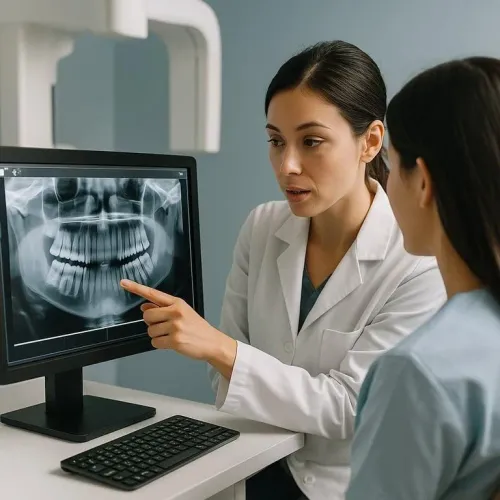
Radiographic evaluation, clinical examination and other diagnostic tools are useful when they provide information that helps answer a specific clinical question.
The objective is not to perform more tests simply because they are available.
The objective is to obtain the information necessary to make an informed treatment decision.
Treatment Should Be Individualised
There is rarely one dental treatment that is appropriate for every person with the same symptom.
The appropriate approach can depend on:
the diagnosis;
severity and extent of disease;
tooth anatomy;
remaining tooth structure;
surrounding tissues;
previous treatment;
functional requirements;
oral habits;
overall dental condition;
long-term prognosis;
patient priorities and expectations.
That is why two patients with seemingly similar complaints may receive different treatment recommendations.
Individualised treatment begins with individualised diagnosis.
What Can Patients Expect at OralNest?
A consultation should give you more than a procedure name.
It should help you understand:
What is happening?
Your symptoms and clinical findings.
Why is it happening?
The possible underlying cause.
How certain is the diagnosis?
Whether additional evaluation is required.
What are the treatment options?
Including appropriate alternatives where applicable.
What happens if you wait?
Whether monitoring is reasonable or treatment should be considered.
What is the purpose of the recommended treatment?
Understanding the objective helps patients make informed decisions.
What happens after treatment?
Follow-up, restoration, maintenance or further care when required.
A Dental Clinic for Questions, Not Just Procedures
Many people delay dental care because they are unsure whether their problem is serious enough to justify a consultation.
Others seek treatment only after pain becomes severe.
But dentistry does not always work that way.
Some conditions cause significant symptoms early.
Others can remain relatively quiet while progressing.
Some symptoms are harmless and temporary.
Others deserve evaluation when they persist or recur.
The purpose of an informed dental consultation is therefore not to create fear.
It is to replace uncertainty with understanding.
Why OralNest?
OralNest Dental Clinic in Wakad is built around a patient-centred, diagnosis-focused approach to dental care.
The clinic's clinical scope includes:
Oral Medicine and Oral Diagnosis
TMJ Disorders and Orofacial Pain
Root Canal Treatment
Wisdom Tooth Evaluation and Removal
Dental Implants
Dental Crowns and Bridges
Smile Designing
Full Mouth Rehabilitation
Dental Second Opinions
Preventive and General Dental Care
Management of complex and unexplained dental complaints
The common thread is not a particular procedure.
It is the effort to understand the patient's problem before deciding what should be done.
The OralNest Philosophy
Good dentistry is not simply about treating teeth.
It is about understanding why a problem exists, what can be preserved, what needs treatment, what alternatives exist, and what makes sense for the patient in the long term.
Sometimes the right treatment is a procedure.
Sometimes it is monitoring.
Sometimes it is prevention.
Sometimes it is a second opinion.
And sometimes the most important part of the consultation is simply finding the correct diagnosis.
That is the philosophy behind OralNest:
Understand First. Decide Carefully. Treat Precisely.
For patients in Wakad and surrounding areas of Pune, OralNest aims to provide dental care where diagnosis, explanation and treatment planning remain at the centre of the patient journey.
Frequently Asked Questions
Is OralNest only for patients who already know what treatment they need?
No. A dental consultation can begin with a symptom, concern or uncertainty. The diagnosis helps determine what treatment, if any, is appropriate.
Do I need a root canal if my tooth hurts?
Not necessarily. Tooth pain can have several causes. A clinical evaluation is needed to determine whether root canal treatment is appropriate.
Does every wisdom tooth need to be removed?
No. The decision depends on its position, condition, symptoms, surrounding structures and other clinical findings.
Can I seek a second opinion before dental treatment?
Yes. A second opinion can help you understand the diagnosis, treatment options and reasons behind a proposed treatment plan.
What if my dental problem is difficult to diagnose?
Some dental and oral symptoms can have multiple possible causes. A detailed clinical assessment and appropriate diagnostic evaluation may help narrow down the cause.
OralNest Dental Clinic | Wakad
A diagnosis-focused approach to modern dental care.
Primary location: Wakad, Pune
Core principle:
The right treatment begins with the right diagnosis.
Choosing a dental clinic is not always as simple as finding a place for a filling, cleaning, or tooth extraction. Sometimes the real problem is uncertainty.
Why does the tooth hurt when nothing looks wrong?
Does every painful tooth need a root canal?
Should a wisdom tooth be removed or monitored?
Why does the jaw click or hurt?
What does a persistent mouth ulcer mean?
Is an extraction really necessary?
Which option is appropriate when several treatments are possible?
These questions are often more important than the procedure itself.
At OralNest Dental Clinic, Wakad, our approach is built around a simple clinical principle: the right treatment begins with the right understanding of the problem.
Rather than treating every dental complaint as a routine procedure, OralNest focuses on understanding the patient's symptoms, clinical findings, dental condition, and relevant diagnostic information before deciding what treatment is appropriate.
Dentistry Is Not Always About Finding a Procedure
A dental problem can have more than one possible explanation.
Tooth pain may arise from decay, inflammation of the dental pulp, a crack, a previous restoration, trauma, gum-related problems, or even pain that is not originating from the tooth itself.
Similarly, jaw pain may involve the temporomandibular joint, chewing muscles, tooth-related problems, parafunctional habits, or other causes of orofacial pain.
A mouth ulcer may be temporary and harmless, but recurrent or persistent oral changes may require a more careful assessment.
This is why diagnosis matters.
The purpose of a consultation should not simply be to decide what procedure can be performed. It should first establish:
What is actually causing the problem?
Which structures are involved?
How extensive is the condition?
Does treatment need to begin immediately?
Are there alternatives?
Can the natural tooth or oral structure be preserved?
What happens if the condition is monitored?
What information is needed before making the treatment decision?
This way of thinking forms an important part of the OralNest clinical philosophy.
A Diagnosis-First Approach
At OralNest, dental care is approached as a process:
Understand → Evaluate → Diagnose → Discuss → Decide → Treat → Follow Up
The sequence matters.
Treatment without sufficient understanding can sometimes address the visible problem without adequately addressing the underlying cause.
A diagnosis-first approach allows treatment to be selected according to the individual situation rather than assuming that the same procedure is appropriate for everyone with a similar symptom.
For example, two people may both report tooth pain, but their treatment needs may be completely different.
One may require a filling.
Another may require root canal treatment.
Another may have a cracked tooth.
Another may have pain associated with the gums.
And another may need further evaluation because the source of pain is not immediately obvious.
The symptom may be similar. The diagnosis may not be.
Specialist-Led Dental Care
OralNest is built around specialist-informed diagnosis and treatment planning.
Dr. Ashutosh Dighe is a BDS, MDS in Oral Medicine & Maxillofacial Radiology, and PhD Scholar, with a clinical focus that includes oral diagnosis, treatment planning, oral mucosal conditions, TMJ disorders, orofacial pain and radiological evaluation. He also has a Fellowship in Contemporary Endodontics and is a Certified Endodontist.
This background is particularly relevant when a dental complaint is not straightforward.
The purpose is not to make every patient undergo complicated investigations or specialist treatment.
The purpose is to recognize when a problem is straightforward—and when it deserves a deeper look.
Oral Medicine & Oral Diagnosis
Some of the most confusing dental complaints are not necessarily related to the teeth.
Persistent mouth ulcers, burning sensations, white or red patches, tongue discomfort, unexplained oral lesions, recurrent mucosal changes and other oral symptoms can require a different diagnostic perspective.
Oral Medicine focuses on conditions affecting the mouth and surrounding structures that may not fit into a simple “tooth problem” category.
At OralNest, this forms an important part of the clinical approach.
The goal is to understand what the patient is experiencing, what may be causing it, and whether further evaluation is appropriate.
TMJ, Jaw Pain & Orofacial Problems
Jaw pain is another area where symptoms can be confusing.
Clicking, restricted mouth opening, facial discomfort, chewing pain, headaches associated with jaw problems, muscle tenderness and other symptoms may have different causes.
Not every jaw click requires treatment.
Not every facial pain is a dental problem.
And not every patient with jaw discomfort needs the same intervention.
A careful evaluation can help determine whether the symptoms are related to the temporomandibular joint, muscles, teeth, habits, or another source.
That distinction can significantly influence treatment decisions.
Root Canal Treatment & Tooth Preservation
Root canal treatment is often discussed simply as a procedure for “saving a tooth.”
But the more important question is:
Does this particular tooth actually require root canal treatment, and can it be predictably preserved?
The answer depends on the clinical condition of the tooth, the pulp and surrounding tissues, the anatomy of the root canal system, previous treatment, infection and the amount of healthy tooth structure remaining.
With a Fellowship in Contemporary Endodontics and Certified Endodontist background, endodontic treatment is approached with attention to diagnosis, treatment planning and tooth preservation.
Not every toothache needs a root canal.
But every root canal should begin with the right diagnosis.
Wisdom Tooth Decisions Should Not Always Be Automatic
Wisdom teeth are another example where the correct decision depends on the individual situation.
An impacted wisdom tooth may require removal in some circumstances.
Another may be monitored.
The decision can depend on its position, relationship with the neighbouring tooth, surrounding structures, symptoms, infection, hygiene accessibility and other clinical findings.
Therefore, the question is not simply:
“Should wisdom teeth always be removed?”
It is:
“What is happening with this particular wisdom tooth, and what is the most appropriate course of action?”
Dental Implants: Planning Before Placement
Replacing a missing tooth is not simply about placing an implant.
A successful implant treatment involves understanding the missing tooth, available bone, surrounding teeth and tissues, functional requirements, restoration and long-term maintenance.
Different patients may require different approaches.
In some situations, an implant may be appropriate.
In others, a bridge, denture, or another restorative option may need to be considered.
The treatment decision should therefore follow evaluation and planning rather than begin with the procedure itself.
When a Second Opinion Can Be Valuable
A second opinion is not necessarily about questioning another dentist.
Sometimes it is simply about understanding your diagnosis and options more clearly before making an important decision.
This can be particularly useful when:
extraction has been suggested;
several teeth require treatment;
root canal treatment has failed;
implant treatment has been proposed;
symptoms do not match the visible dental findings;
you have received different treatment recommendations;
you are unsure why a particular treatment has been recommended.
A useful second opinion should provide clarity, not simply another treatment recommendation.
Technology Is Useful When It Answers a Clinical Question
Modern dentistry offers many diagnostic and treatment technologies.
But technology should serve the diagnosis—not replace clinical reasoning.
Radiographic evaluation, clinical examination and other diagnostic tools are useful when they provide information that helps answer a specific clinical question.
The objective is not to perform more tests simply because they are available.
The objective is to obtain the information necessary to make an informed treatment decision.
Treatment Should Be Individualised
There is rarely one dental treatment that is appropriate for every person with the same symptom.
The appropriate approach can depend on:
the diagnosis;
severity and extent of disease;
tooth anatomy;
remaining tooth structure;
surrounding tissues;
previous treatment;
functional requirements;
oral habits;
overall dental condition;
long-term prognosis;
patient priorities and expectations.
That is why two patients with seemingly similar complaints may receive different treatment recommendations.
Individualised treatment begins with individualised diagnosis.
What Can Patients Expect at OralNest?
A consultation should give you more than a procedure name.
It should help you understand:
What is happening?
Your symptoms and clinical findings.
Why is it happening?
The possible underlying cause.
How certain is the diagnosis?
Whether additional evaluation is required.
What are the treatment options?
Including appropriate alternatives where applicable.
What happens if you wait?
Whether monitoring is reasonable or treatment should be considered.
What is the purpose of the recommended treatment?
Understanding the objective helps patients make informed decisions.
What happens after treatment?
Follow-up, restoration, maintenance or further care when required.
A Dental Clinic for Questions, Not Just Procedures
Many people delay dental care because they are unsure whether their problem is serious enough to justify a consultation.
Others seek treatment only after pain becomes severe.
But dentistry does not always work that way.
Some conditions cause significant symptoms early.
Others can remain relatively quiet while progressing.
Some symptoms are harmless and temporary.
Others deserve evaluation when they persist or recur.
The purpose of an informed dental consultation is therefore not to create fear.
It is to replace uncertainty with understanding.
Why OralNest?
OralNest Dental Clinic in Wakad is built around a patient-centred, diagnosis-focused approach to dental care.
The clinic's clinical scope includes:
Oral Medicine and Oral Diagnosis
TMJ Disorders and Orofacial Pain
Root Canal Treatment
Wisdom Tooth Evaluation and Removal
Dental Implants
Dental Crowns and Bridges
Smile Designing
Full Mouth Rehabilitation
Dental Second Opinions
Preventive and General Dental Care
Management of complex and unexplained dental complaints
The common thread is not a particular procedure.
It is the effort to understand the patient's problem before deciding what should be done.
The OralNest Philosophy
Good dentistry is not simply about treating teeth.
It is about understanding why a problem exists, what can be preserved, what needs treatment, what alternatives exist, and what makes sense for the patient in the long term.
Sometimes the right treatment is a procedure.
Sometimes it is monitoring.
Sometimes it is prevention.
Sometimes it is a second opinion.
And sometimes the most important part of the consultation is simply finding the correct diagnosis.
That is the philosophy behind OralNest:
Understand First. Decide Carefully. Treat Precisely.
For patients in Wakad and surrounding areas of Pune, OralNest aims to provide dental care where diagnosis, explanation and treatment planning remain at the centre of the patient journey.
Frequently Asked Questions
Is OralNest only for patients who already know what treatment they need?
No. A dental consultation can begin with a symptom, concern or uncertainty. The diagnosis helps determine what treatment, if any, is appropriate.
Do I need a root canal if my tooth hurts?
Not necessarily. Tooth pain can have several causes. A clinical evaluation is needed to determine whether root canal treatment is appropriate.
Does every wisdom tooth need to be removed?
No. The decision depends on its position, condition, symptoms, surrounding structures and other clinical findings.
Can I seek a second opinion before dental treatment?
Yes. A second opinion can help you understand the diagnosis, treatment options and reasons behind a proposed treatment plan.
What if my dental problem is difficult to diagnose?
Some dental and oral symptoms can have multiple possible causes. A detailed clinical assessment and appropriate diagnostic evaluation may help narrow down the cause.
OralNest Dental Clinic | Wakad
A diagnosis-focused approach to modern dental care.
Primary location: Wakad, Pune
Core principle:
The right treatment begins with the right diagnosis.
Keywords